
On this page
- How big quick commerce has become in India
- Is a dark store right for your business?
- Step 1: Choose the right location
- Step 2: Decide the size
- Step 3: Stock what people need in a hurry
- Step 4: Lay the store out for picking
- Step 5: Pick, pack and hand over
- Step 6: Set a delivery promise you can keep
- Step 7: Get the software right
- Step 8: Win your first customers locally
- Step 9: Do the per-order maths
- Step 10: Watch the numbers that matter
- Mistakes that sink new dark stores
- Your launch checklist
Quick commerce means delivering everyday items within minutes, or within an hour, of the order. The businesses that do it run dark stores: small warehouses that are closed to walk-in customers and laid out only for picking and packing online orders fast. To start one, choose a dense area with steady demand, stock the products people need in a hurry, set the space up for quick picking, and promise only the delivery time you can keep.
This guide covers location, size, stock, layout, the pick-pack-dispatch flow, delivery promises, software and the numbers to watch, for a business that wants to run its own dark store rather than supply someone else's.
How big quick commerce has become in India
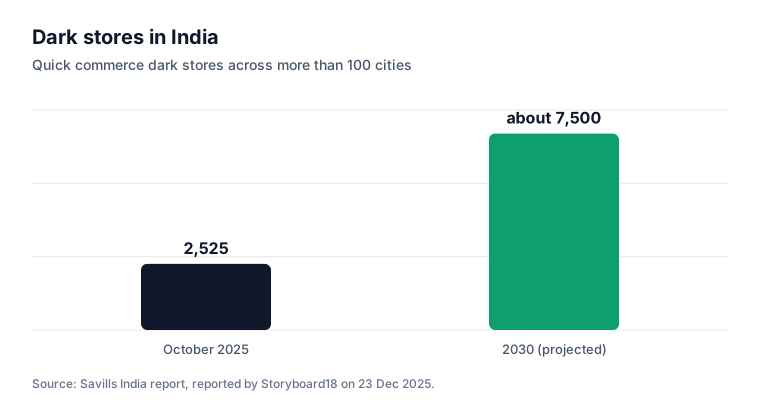
Dark stores have spread quickly through Indian cities. A Savills India report counted about 2,525 dark stores across more than 100 cities as of October 2025, together taking up close to 13 million square feet, and projected around 7,500 by 2030 (Storyboard18). The same report found that tier 1 cities hold about 68% of them.
You do not have to be one of the big apps to use the model. A grocery chain, a meat shop, a pet store or a pharmacy-adjacent wellness store can run its own small dark store for its own customers, under its own brand.
Is a dark store right for your business?
A dark store makes sense when:
- You already get many orders from one area and your shop floor is slowing down packing.
- Your customers order small baskets often: daily needs, snacks, milk, fresh produce.
- Rent for a back-street space is much cheaper than a shop front, and you do not need walk-in sales.
It is the wrong first step if you have not yet proven online demand. Start by delivering from your shop, as in our guide on how to start an online grocery delivery business, and open a dark store when the shop can no longer keep up.
Step 1: Choose the right location
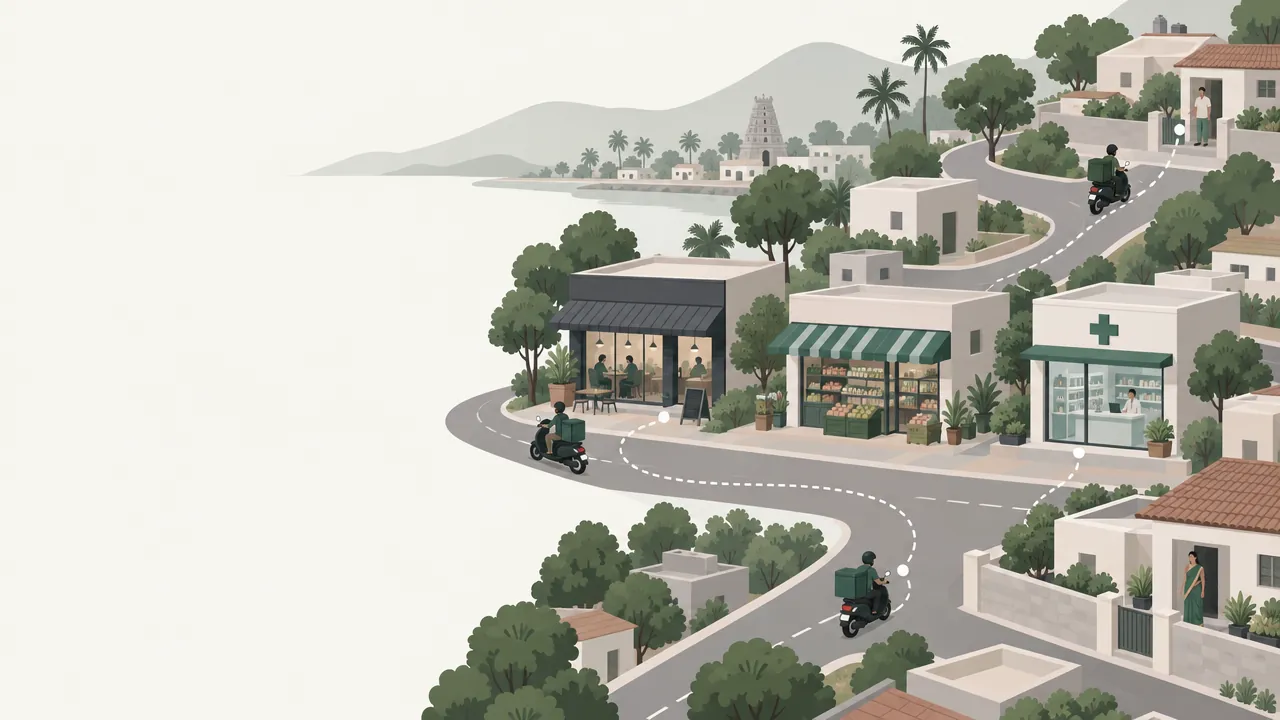
Quick delivery only works if your customers are close. When you look at a space:
| What to check | Why it matters |
|---|---|
| Homes within 2 to 3 km | Density decides how many orders each delivery partner can carry an hour |
| Ground floor, wide access | Delivery partners go in and out all day; stairs and narrow lanes slow every order |
| Two-wheeler parking outside | Waiting space for delivery partners at peak times |
| Power backup | Cold rooms and freezers cannot go down |
| Rent you can afford with no walk-ins | A side street is fine; you do not need a shop front |
| Local rules for commercial use | Residential buildings and some lanes do not allow warehouses |
| Licences | If you sell food, FSSAI registration covers turnover up to ₹1.5 crore from 1 April 2026; above that, a State licence up to ₹50 crore and a Central licence beyond |
Step 2: Decide the size
Savills India puts typical dark stores at 3,000 to 8,000 square feet (Storyboard18), and Inc42 reports that a typical Swiggy dark store is 2,500 to 4,000 square feet (Inc42). A local business can start in a shop-sized space and move once orders grow.
Size matters less than how fast a picker can walk the aisles. A tight 1,500 square feet laid out well can beat a sprawling 5,000 square feet where pickers cross the store for every order.
Step 3: Stock what people need in a hurry
Quick commerce orders are small and urgent: milk at 7 am, snacks before a cricket match, a charger that just broke. Start with:
| Group | Examples |
|---|---|
| Daily needs | Milk, bread, eggs, curd, butter, paneer |
| Staples | Rice, atta, dal, oil, sugar, tea |
| Fruits and vegetables | Onions, potatoes, tomatoes, bananas, seasonal fruit |
| Snacks and drinks | Chips, biscuits, cold drinks, juices, ice cream |
| Personal care | Soap, shampoo, toothpaste, sanitary pads, razors |
| Household | Detergent, cleaners, bin bags, batteries, bulbs |
| Baby and pet | Diapers, baby food, pet food |
Start with a few hundred to a couple of thousand fast-moving products that are always in stock. After the first month, cut what does not sell and add what customers search for but cannot find. Your store's search log is the best stock list you will ever get.
Tip: Track "out of stock when ordered" every day. Missing items are one of the quickest ways to lose a repeat customer.
Step 4: Lay the store out for picking
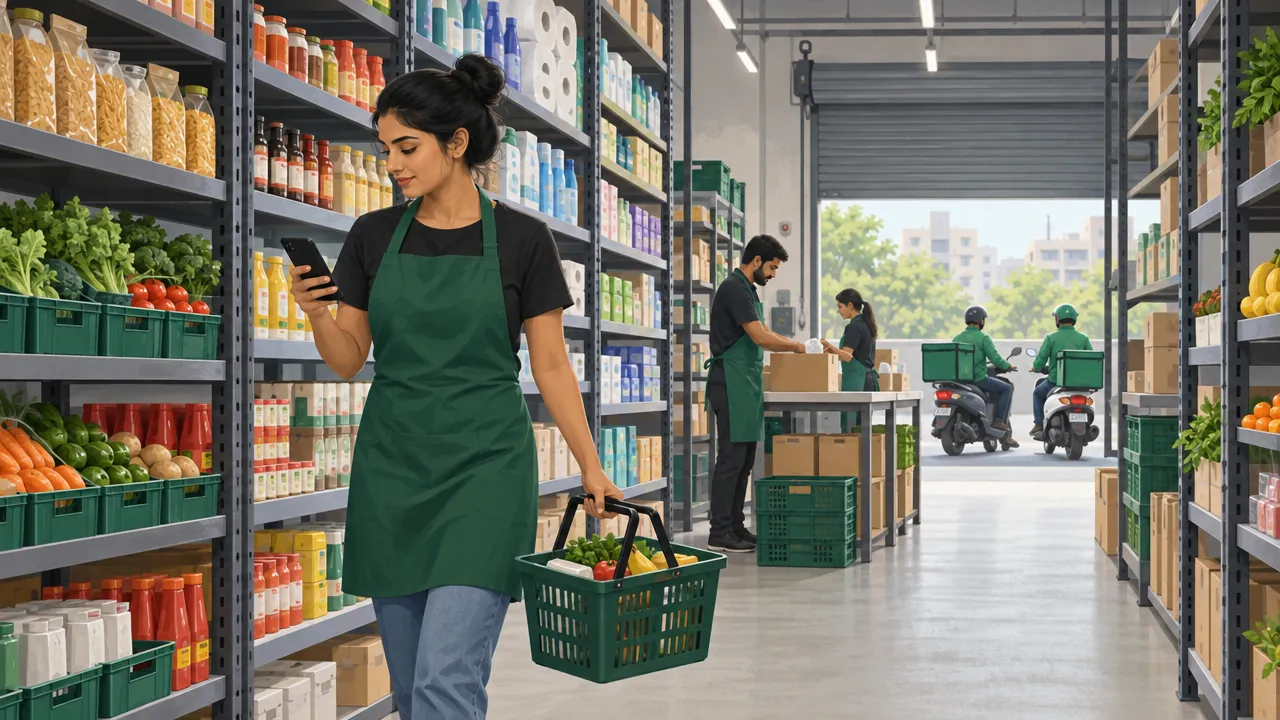
In a dark store, every second of walking adds to delivery time. Design the floor around the order, not around a shop's look.
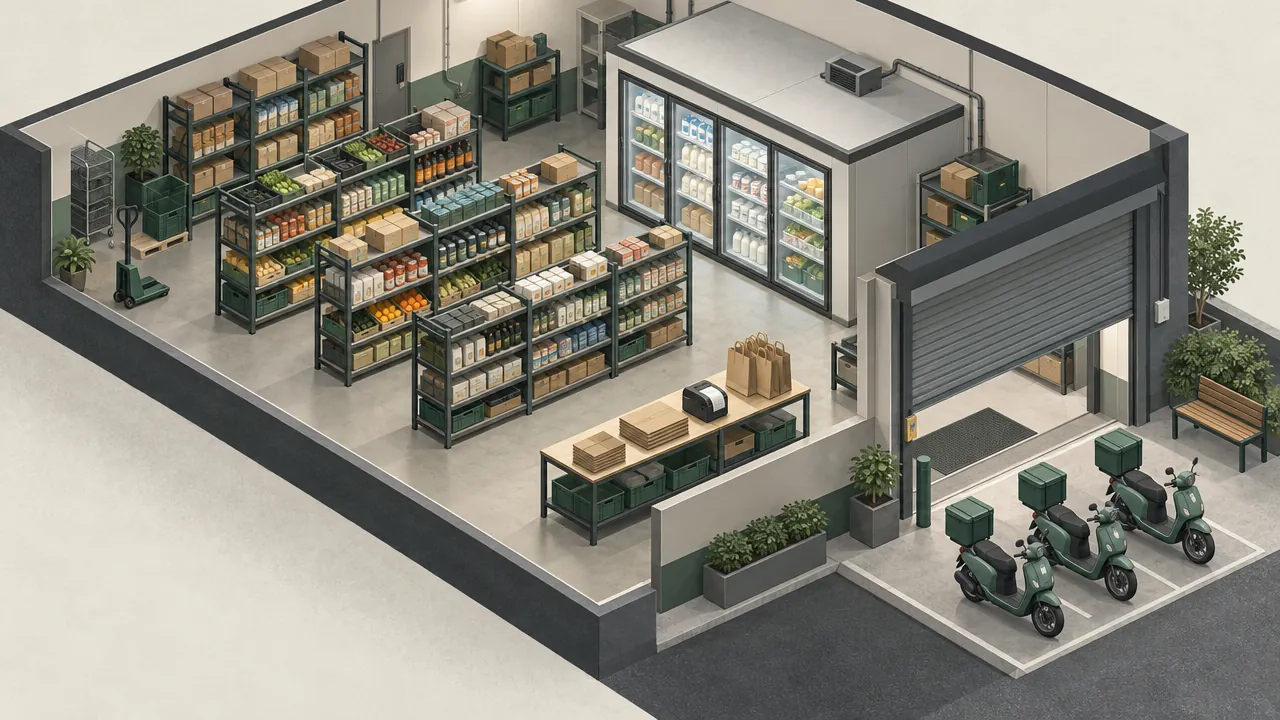
- Put your top 100 products nearest the packing table. Look at your orders to find them; a small group of products often makes up a large share of orders.
- Group by how people order, not by brand: breakfast items together, cleaning together, snacks together.
- Label every shelf and bin with a location code, such as aisle, rack and shelf, so a new picker finds items on day one.
- Keep the cold room next to packing and pick cold items last, so they stay cold.
- Put packing next to the exit, with bags, ice packs and a printer for order slips.
- Keep a returns and damages corner away from good stock.
Step 5: Pick, pack and hand over
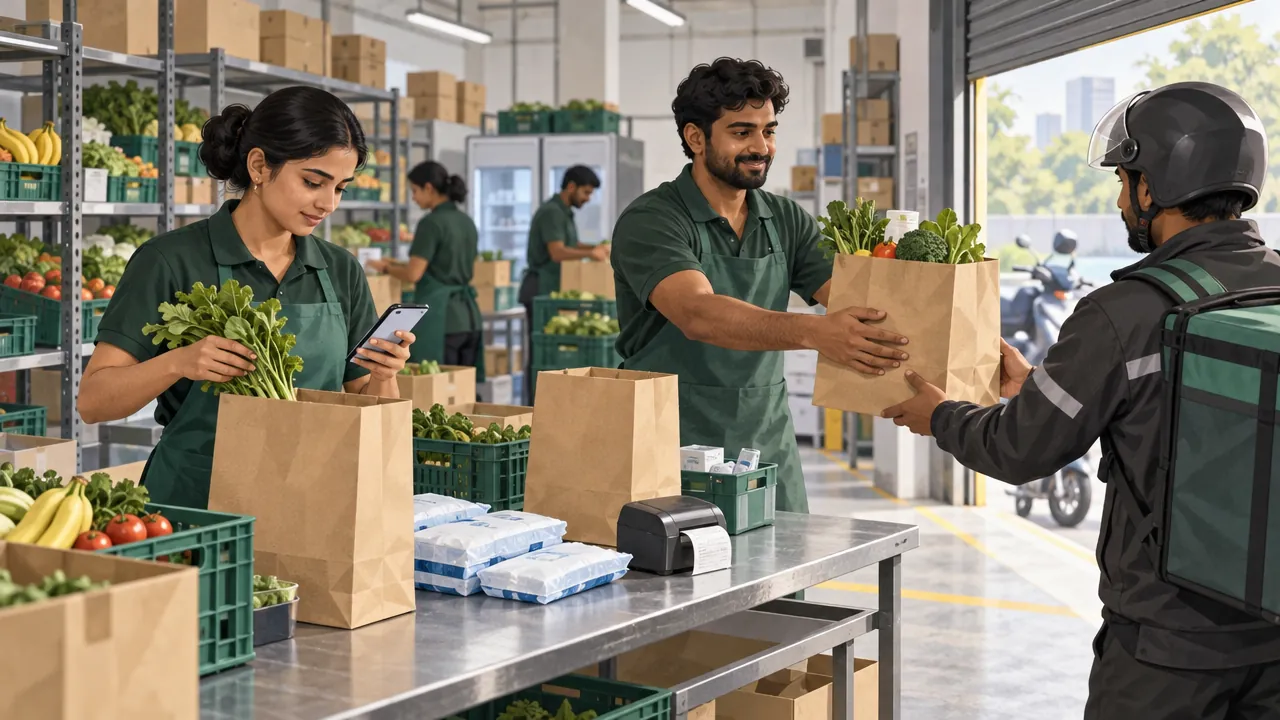
Each order goes through three steps: pick the items, pack them, and hand them to a delivery partner. With more than a handful of orders an hour, paper lists and phone calls fall apart.
Use a picker and packer app:
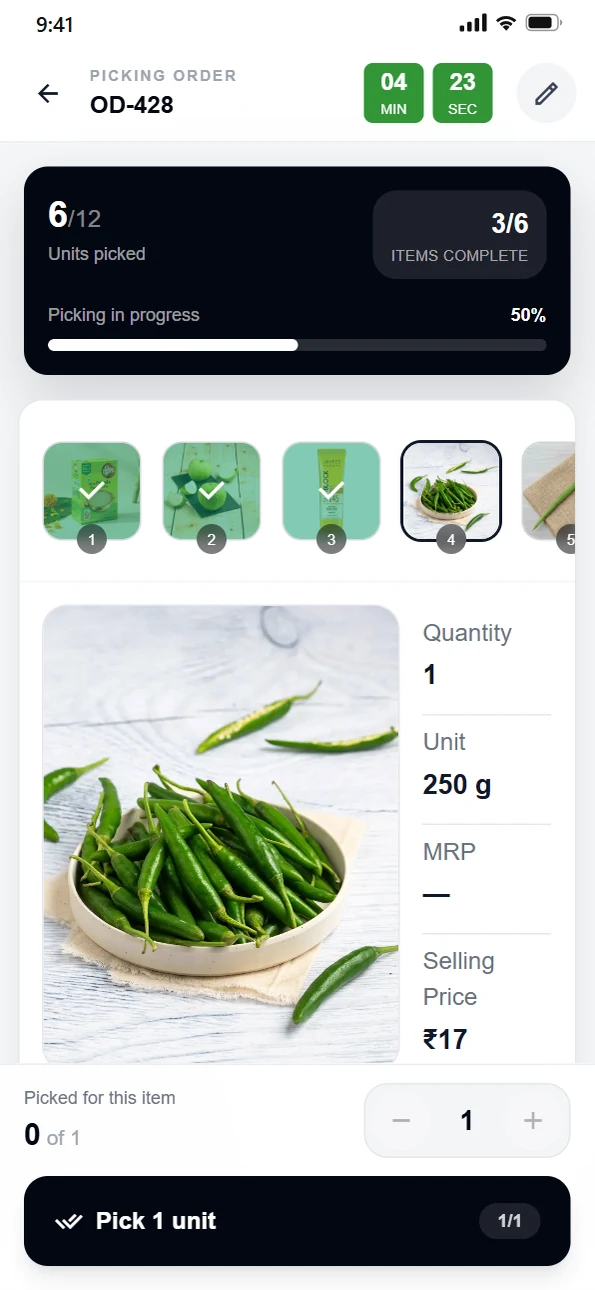
- A new order goes to a picker's phone with the items and their locations.
- The picker marks each item as picked, or flags it as out of stock.
- A packer checks the items against the order and packs them, cold items in an insulated bag.
- The order is marked ready and a delivery partner is assigned.
Measure time from order to ready. If it is slow, the problem is inside the store: layout, labels or too few pickers at peak.
Rotate stock and watch expiry
A dark store sells a lot of short-life products: milk, bread, curd, fruit, ready-to-eat food. Expired stock is pure loss, and an expired item delivered to a customer is worse.
- First expiry, first out. Place new stock behind older stock, and pick the earliest expiry first.
- Check dates daily on dairy, bakery and fresh produce, and weekly on everything else.
- Mark down items close to expiry or remove them from the app before they become a complaint.
- Order little and often for short-life items, using yesterday's sales as the guide.
Plan staff by shift
Orders in quick commerce come in waves: breakfast, lunch, after-office and late evening. Plan people around the waves, not around a nine-to-six day.
| Role | What they do | When you need more |
|---|---|---|
| Pickers | Pick items for each order | Morning and evening peaks |
| Packers | Check, pack and hand over orders | Same peaks; the ratio depends on basket size; watch for orders waiting at packing |
| Inward and stock staff | Receive supplier deliveries, shelve stock, check expiry | Quiet hours, before peaks |
| Delivery partners | Deliver orders, collect cash, confirm with OTP | Peaks, weekends and rainy days |
| Store manager | Watches dispatch times, stock gaps and staff | Every shift |
Step 6: Set a delivery promise you can keep
Do not promise "10 minutes" unless you can deliver it every time. A promise you break hurts more than a slower one you keep. Start with what you can do on a busy evening, such as 30 minutes, and improve as you learn.
To keep the promise:
- Keep the delivery area small, 2 to 3 km to begin with.
- Staff for peaks: mornings and evenings need more pickers and delivery partners than afternoons. Our guide on hiring and managing delivery staff covers pay models and cash.
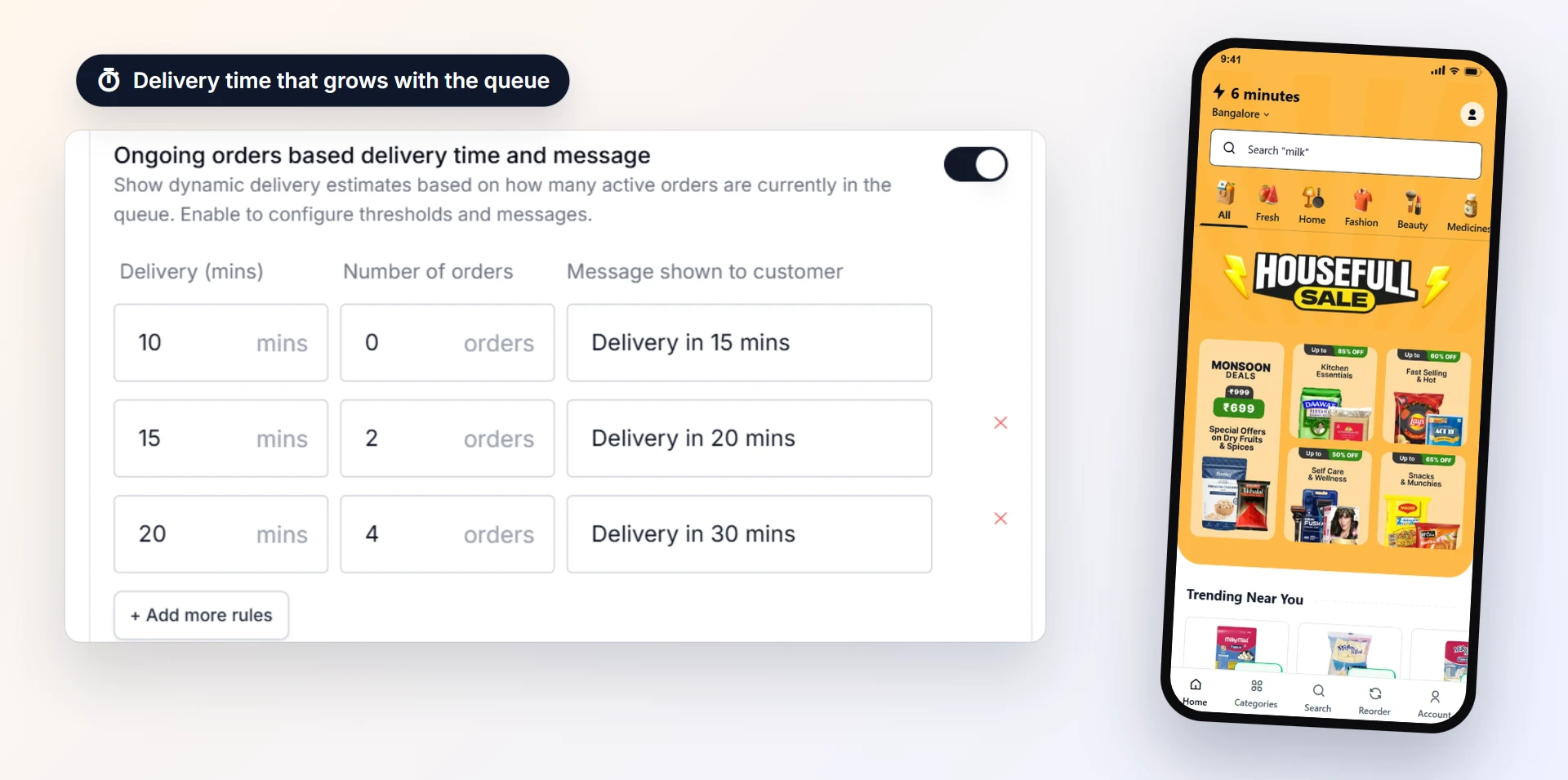
- Let promised times change with load. When orders pile up, the time shown at checkout should go up, so customers are not surprised.
- Assign orders automatically to the nearest free delivery partner, rather than by phone.
- Set a minimum order or a small delivery fee, so tiny orders do not cost more to deliver than they earn. See how to set delivery charges.
Step 7: Get the software right
A dark store is a software business as much as a warehouse. You need:
| Tool | What it does |
|---|---|
| Customer website and app | A fast, quick-commerce layout, instant search, reorder from past orders (choosing an app) |
| Picker and packer app | Orders to pickers, item by item, with out-of-stock flags |
| Delivery app | Orders, maps, OTP confirmation and cash collection for delivery partners |
| Automatic assignment | Each order goes to the right delivery partner without phone calls |
| Delivery areas and fees | Drawn on a map, with fees by distance and a free delivery threshold |
| Live stock | Items disappear from the app the moment they run out |
Your own app matters a lot in quick commerce, because customers order again and again, often daily. A push notification such as "Fresh mangoes in stock" can bring them back without paying for an ad.
Step 8: Win your first customers locally
A dark store has no shop front, so nobody walks past it. Your first customers come from the streets around it.
- Flyers in the societies inside your delivery area, with your app link and a first-order offer.
- A launch offer that rewards the second order, not just the first, because repeat orders are what make a dark store work.
- Society and resident groups, where allowed: one clear post about delivery times and what you stock.
- Referral rewards, so each happy customer brings a neighbour.
- Push notifications for the moments people need you: morning milk, evening snacks, weekend stock-ups.
Step 9: Do the per-order maths
Before you open, work out what one order earns. Here is a simple worked example; replace every number with your own.
| Line | Worked example |
|---|---|
| Average order value | ₹450 |
| Average margin across the basket (20%) | ₹90 |
| Delivery cost per order | − ₹35 |
| Picking and packing labour per order | − ₹12 |
| Packaging | − ₹6 |
| Payment fees and cash handling | − ₹8 |
| Left per order for rent, power and profit | ₹29 |
If rent, power and other fixed costs come to ₹2,00,000 a month, this store needs about 6,900 orders a month, or around 230 a day, just to break even. Try your own numbers in the break-even calculator. That is why average order value, orders per delivery partner and stock waste matter so much: small changes in each move the break-even point a long way.
Step 10: Watch the numbers that matter
Margins in quick commerce are thin, so watch these from the first week:
- Average order value. Small baskets are a major risk; nudge them up with a free delivery threshold and bundles.
- Orders per delivery partner per hour. A major driver of delivery cost.
- Time from order to dispatch. Inside-the-store efficiency.
- Out-of-stock rate on orders. Every missing item is a reason to try another app.
- Repeat customers in month two and three. The real test of whether the store works.
Mistakes that sink new dark stores
Promising a time you cannot keep. Customers forgive slow; they do not forgive late after a promise.
Too many products, too early. A huge range spreads stock thin and lengthens picking. Start focused.
Paper picking lists. They work for a few orders a day and break down as volume grows. Use an app from the start.
Ignoring the cold chain. Warm milk and melted ice cream earn refunds and one-star reviews.
Opening before proving demand. Prove online orders from a shop first, then move them to a dark store.
Your launch checklist
- Space chosen for density, access, parking and power backup
- FSSAI registration or licence, GST and shop registration in place
- Top products identified and placed nearest packing
- Every shelf and bin labelled with a location code
- Cold room or freezers next to packing, with insulated bags
- Picker and packer app and delivery app set up and tested
- Delivery area, fees, minimum order and a delivery promise you can keep
- Staffing planned for morning and evening peaks
- A daily review of out-of-stock items, dispatch time and repeat customers
Start with one store and a small area, prove that customers come back, then open the next store in the next dense neighbourhood.
Questions people ask
What is a dark store?
How big should a dark store be?
How many products should a dark store stock?
Can a local business compete with the big quick commerce apps?
Do I need a licence for a dark store?
What software does a dark store need?
Sources
- 7,500 dark stores, 100+ cities: quick commerce fuels a new urban asset class (Savills India data), Storyboard18
- Swiggy Instamart experiments with physical retail, Inc42
- Order on revised turnover thresholds for registration and licensing (13 March 2026), FSSAI
Facts were checked against these sources on 19 Oct 2026. Rules and prices change: check the source before you rely on a figure. Read our editorial standards, or write to hi@zepio.io to report a mistake.