
On this page
- Why delivery charges matter so much
- Step 1: Work out your real cost per delivery
- Step 2: Choose a charging method
- Step 3: Set a free delivery threshold or a minimum order
- Step 4: Decide how cash on delivery is priced
- Step 5: Add other fees, and show every charge early
- Step 6: Pay your delivery partners in a way that matches your fees
- Step 7: Review your charges every quarter
- Examples by type of business
- Mistakes to avoid
- Your delivery charges checklist
- How Zepio helps
To set delivery charges, first work out what one delivery really costs you. Then pick a method that matches how your customers are spread: a flat fee, a fee by distance, a fee by area, or a fee by weight for heavy orders. Finally, add a free delivery threshold or a minimum order so small orders do not lose you money, and show every fee clearly before payment.
This guide works through each step with real numbers you can replace with your own.
Why delivery charges matter so much
Delivery is an easy place to lose money quietly. A ₹300 order that earns ₹45 of margin and costs ₹40 to deliver earns almost nothing. Get the delivery charge wrong across hundreds of orders and a busy business can still run at a loss.
The right delivery charge does three jobs at once:
- Covers what delivery costs you, on average, across your orders.
- Nudges customers towards larger baskets, through a free delivery threshold.
- Stays fair and easy to understand, so it does not scare people off at checkout.
Step 1: Work out your real cost per delivery
It is tempting to copy what other shops charge. Start with your own numbers instead.
If you run your own delivery team, add up:
- Pay per trip or per hour for the delivery person, including any incentives.
- Fuel for the distance travelled, there and back.
- Orders per trip. If one trip delivers three orders, each order carries a third of the cost.
If you use a delivery service or courier, the cost per order is their rate, plus any cash on delivery fee they charge. Our guide on shipping products across India explains how courier rates are set.
| Worked example | Amount |
|---|---|
| Delivery partner pay for a 4 km round trip | ₹50 |
| Fuel for 4 km | ₹10 |
| Cost of the trip | ₹60 |
| Orders delivered in that trip | 2 |
| Cost per delivery | ₹30 |
Work this out for a busy hour and a quiet hour. In quiet hours, trips carry fewer orders and each delivery costs more.
Step 2: Choose a charging method
There are five common ways to charge for delivery. Many businesses combine two of them, such as area plus weight.
Flat fee
A flat delivery fee is one price for every order in your delivery area, such as ₹30.
- Best for: small areas, around 2 to 3 km, where every delivery costs about the same.
- Easy for customers to understand.
- Risk: far-away orders cost you more than you charge.
By distance
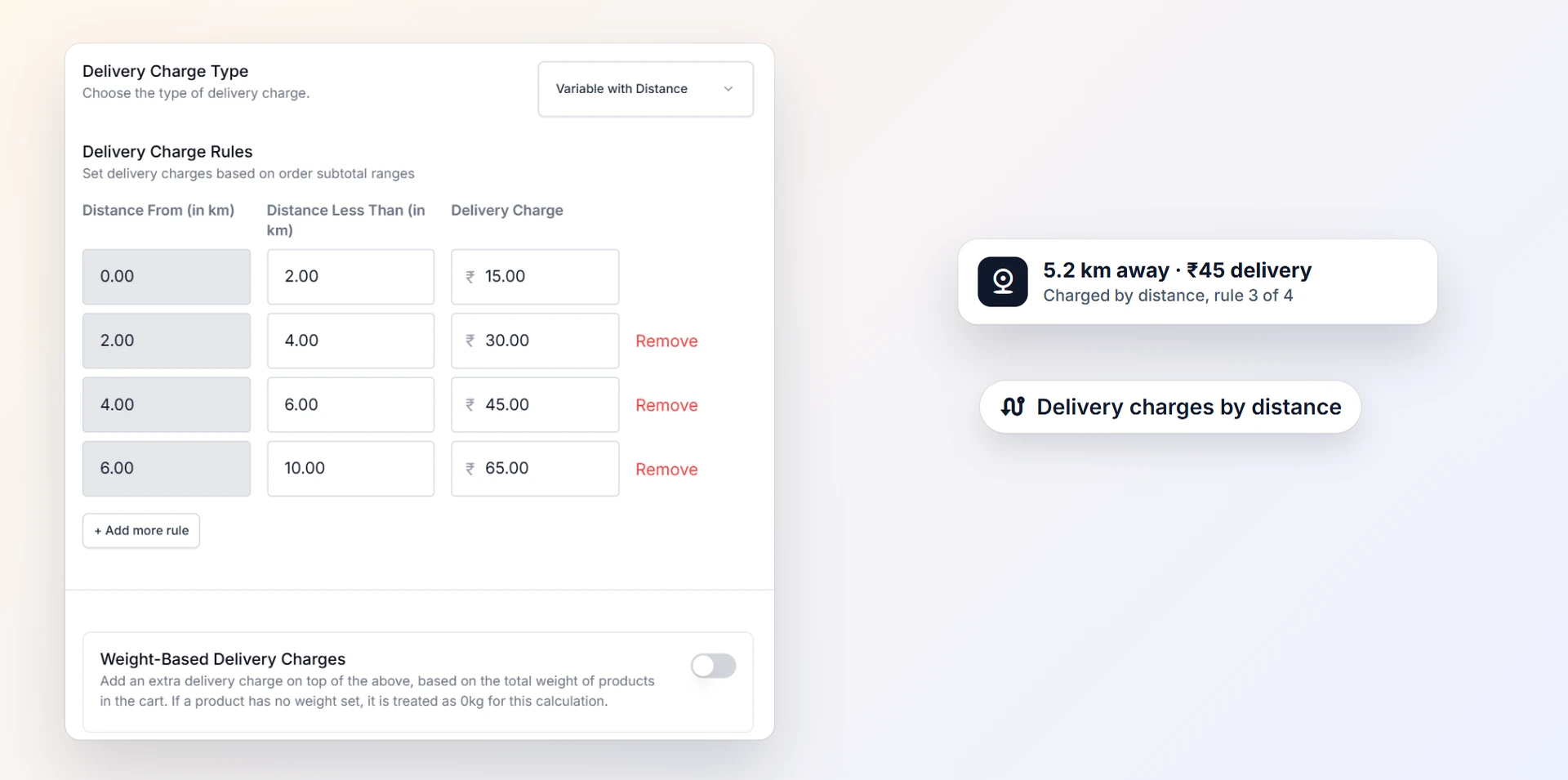
A distance-based delivery fee depends on how far the customer is from your shop, worked out from their delivery location.
| Distance | Delivery fee |
|---|---|
| 0 to 2 km | ₹20 |
| 2 to 5 km | ₹40 |
| 5 to 8 km | ₹60 |
- Best for: larger areas where customers are spread around you.
- Fair, because longer trips pay more.
By area
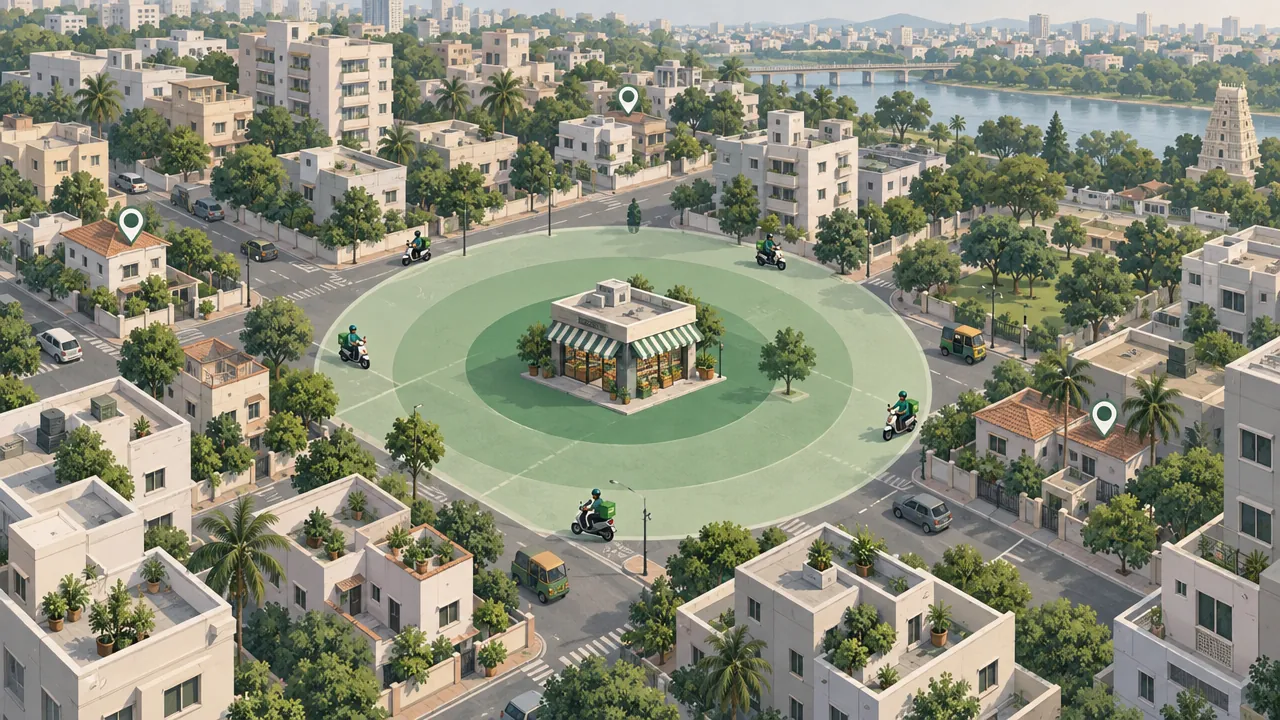
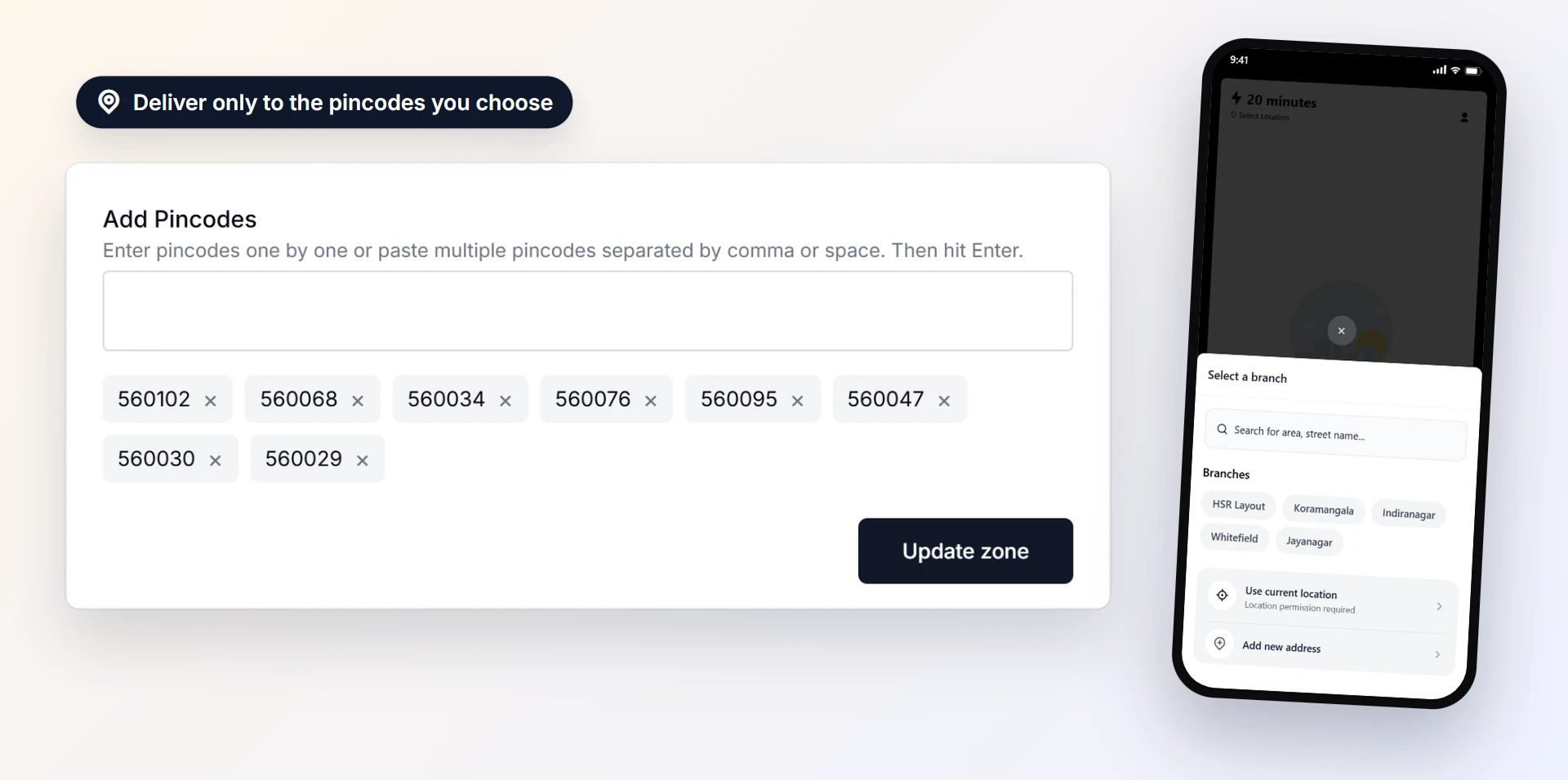
Charging delivery by area means you draw areas on a map, or list pin codes, and give each area its own delivery fee.
- Best for: cities where distance does not tell the whole story. A society 3 km away across a busy junction can take longer than one 5 km away on a clear road.
- Lets you exclude areas you cannot serve well, instead of accepting orders you will deliver late.
- Works with distance fees: a fee by distance inside each area.
By weight
A weight charge is an extra delivery fee for heavy orders, based on the order's total weight and added to the normal fee.
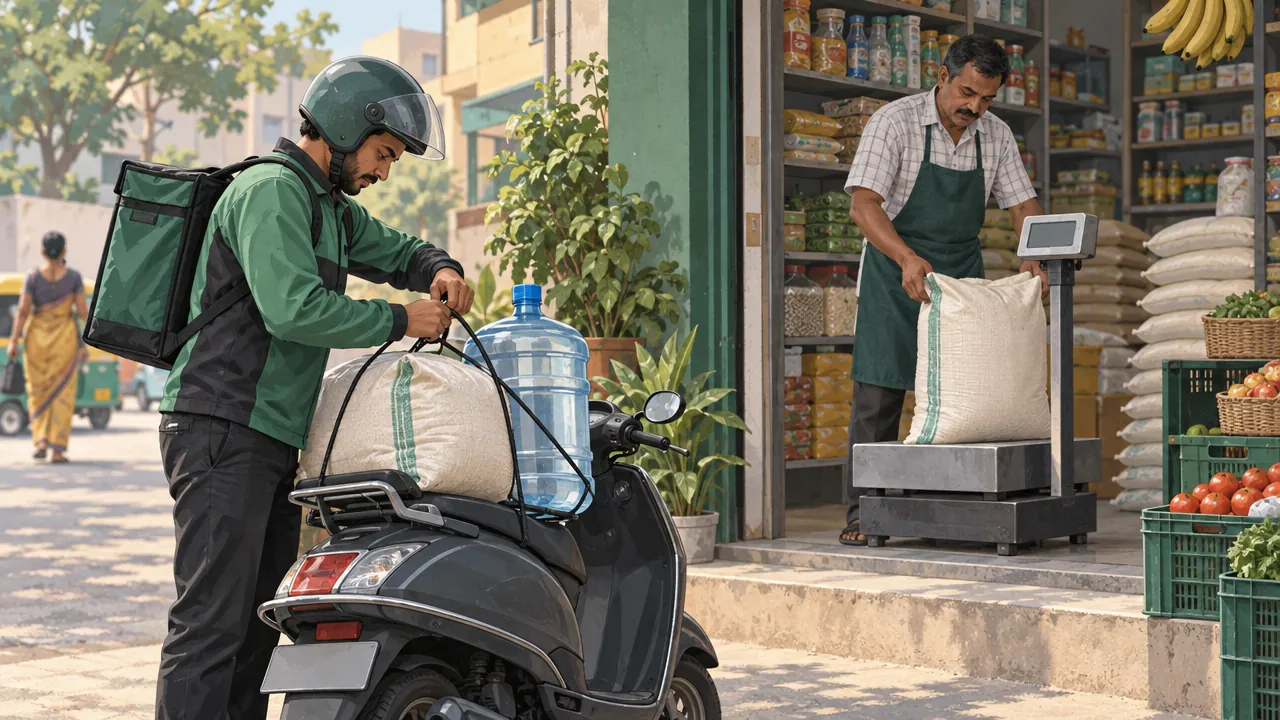
- Best for: groceries in bulk, water cans, furniture, building supplies, pet food.
- Volumetric weight for large but light items: length × width × height in centimetres, divided by a set number. Most of Shiprocket's courier partners and Blue Dart's air services divide by 5,000 (Shiprocket, Blue Dart); Blue Dart's surface services count 27,000 cubic centimetres as 10 kg, which works out to dividing by 2,700. Charge on whichever is higher, actual or volumetric weight.
By order value
Some businesses charge less delivery as the order grows: ₹40 below ₹300, ₹20 from ₹300 to ₹499, free above ₹500. This is a gentler version of a single free delivery threshold, and it nudges customers up one step at a time.
Which method to choose
| Method | Best for | Watch out for |
|---|---|---|
| Flat fee | Small areas, around 2 to 3 km | Far-away orders cost more than you charge |
| By distance | Customers spread around you | Roads and junctions can make a short trip slow |
| By area | Cities with slow and fast neighbourhoods | Needs areas drawn or pin codes listed |
| By weight | Heavy or bulky orders | Products need weights entered |
| By order value | Nudging bigger baskets | Small orders can still lose money |
Step 3: Set a free delivery threshold or a minimum order
Free delivery sells. It also loses money on small orders. A free delivery threshold gives customers a reason to add more to the cart while making sure each free-delivery order at least covers its own delivery.
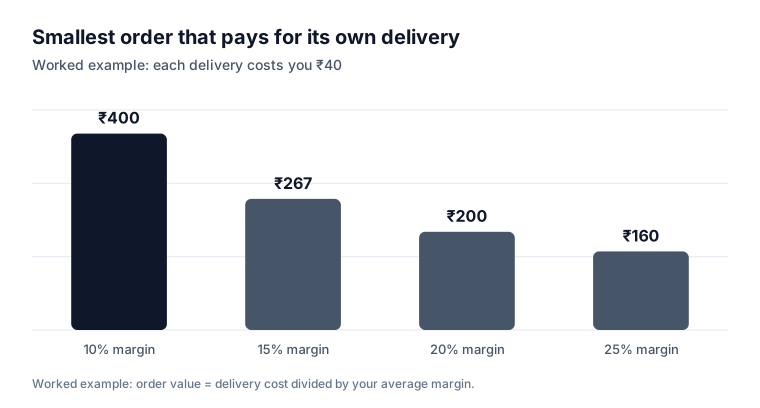
How to pick the threshold:
- Find your average margin on an order. Say 15%. A profit margin calculator helps.
- Find your cost per delivery. Say ₹40, for a quiet hour when a ₹60 trip carries one or two orders.
- Divide: ₹40 ÷ 15% ≈ ₹267. Orders above this cover their own delivery.
- Set the threshold a little higher, such as ₹299, to leave room for discounts and payment fees.
A minimum order value is stricter: below it, customers cannot check out at all. Use it when very small orders are common and always unprofitable, as in quick commerce. A gentler choice is a small order fee below a cart value, instead of a hard minimum.
Step 4: Decide how cash on delivery is priced
Cash orders cost more to handle: the delivery person waits while the customer finds change, cash must be collected and settled every day, and some cash orders are refused at the door. Across Indian e-commerce, 25% to 30% of cash on delivery orders come back undelivered, against 2% to 3% of prepaid orders (Razorpay); your own rate may be lower, because short trips remove some causes, so measure it.
Common approaches:
- A slightly higher delivery fee for cash on delivery than for online payment.
- A lower fee for online payment, framed as a saving rather than a penalty.
- No cash on delivery above a certain order value, where a refusal hurts most.
- A part payment online before dispatch for large orders.
Online payments carry a gateway fee too; Razorpay's standard rate, for example, is 2% plus GST on the fee (Razorpay). Include it when you compare the two. Read how to reduce fake cash on delivery orders for more.
Step 5: Add other fees, and show every charge early
Some businesses add small fees for specific costs:
| Fee | When it makes sense |
|---|---|
| Packaging fee | Food containers, gift wrap, special packing |
| Small order fee | Below a set cart value, instead of a hard minimum |
| Late-night or rain fee | When delivery is harder and delivery partners are paid more |
| Handling fee | Fragile, frozen or oversized items |
Whatever you charge, customers should see it before they pay, with a short reason. In Baymard Institute's survey of US online shoppers, extra costs such as shipping, tax and fees were the top reason for abandoning checkout, at 40% of abandonments. A surprise fee also erodes trust in your next order; our guide on recovering abandoned carts covers the other reasons shoppers leave.
- Say "Free delivery above ₹299" on your home page, product pages and in the cart.
- Show how much more they need to add for free delivery: "Add ₹45 more for free delivery".
- Let them check whether you deliver to their area as early as possible, before they build a cart.
- Put your delivery areas, fees and times on a shipping and delivery policy page. A shipping policy generator gives you a draft.
Step 6: Pay your delivery partners in a way that matches your fees
How you pay your delivery team should match how you charge customers, or your margins drift. Our guide on hiring and managing delivery staff compares pay models with worked numbers:
- Fixed amount per delivery: simple, and fits a flat or area fee.
- Per kilometre, or a base plus extra distance: fits distance-based fees.
- A share of the delivery fee: rises and falls with what the customer pays.
Add peak-time incentives rather than raising every fee, if you struggle to find delivery partners at busy hours.
Step 7: Review your charges every quarter
Fuel, pay rates and order patterns change. Every three months:
- Recalculate your cost per delivery for busy and quiet hours.
- Check how many orders fall below the free delivery threshold, and how many sit just above it.
- Look at cancelled carts at the delivery fee step.
- Adjust one thing at a time, and watch the effect for a month.
Examples by type of business
| Business | A sensible starting set-up |
|---|---|
| Grocery | Small area, distance fee, free delivery above a threshold, weight charge for bulk staples and water |
| Restaurant or cloud kitchen | Distance fee in a tight area, packaging fee shown separately, small order fee |
| Bakery | Distance fee, cream cakes local only, delivery date chosen at checkout |
| Furniture or appliances | Area fees, weight or volumetric charges, scheduled delivery days |
| Pharmacy | Small area, flat fee, free above a threshold, fast slots for urgent orders |
| Quick commerce | Very small area, minimum order or small order fee, peak-time fee if needed |
Mistakes to avoid
Copying a competitor's fee. Their costs are not yours.
Free delivery on everything. It looks generous and loses money on small orders.
A delivery area that is too big. One order per trip is the most expensive kind of delivery.
Hidden fees at the last step. They lose the order and the customer's trust.
Never reviewing. A fee set two years ago may not cover today's costs.
Your delivery charges checklist
- Cost per delivery worked out for busy and quiet hours
- Delivery area set, and areas you cannot serve excluded
- A charging method chosen: flat, distance, area, weight or order value
- Free delivery threshold of at least cost per delivery divided by margin
- Cash on delivery priced, and any limits set
- Every fee shown in the cart with a reason
- Delivery policy page published
- Delivery partner pay matched to your fee structure
- A reminder to review every quarter
How Zepio helps
In Zepio you can draw delivery areas on a map or list pin codes, set fees by distance inside each area with different prices for cash and online payment, add weight charges using actual or volumetric weight, set a free delivery threshold, and add extra fees such as packaging within cart value ranges you choose. Start simple with a flat fee in a small area, and refine as your orders grow.
Questions people ask
How much should I charge for local delivery?
Should I charge delivery by distance or by area?
What is a good free delivery threshold?
Should cash on delivery cost more than online payment?
How do I charge delivery for heavy or bulky items?
Is it better to offer free delivery on every order?
Sources
- Explain the different types of weight terminology used in the platform, Shiprocket Support
- Conditions of carriage (volumetric weight), Blue Dart
- Razorpay pricing, Razorpay
- Cash on delivery and its challenges, Razorpay
Facts were checked against these sources on 19 Oct 2026. Rules and prices change: check the source before you rely on a figure. Read our editorial standards, or write to hi@zepio.io to report a mistake.