
On this page
- Step 1: Choose how you will ship
- Step 2: Understand how a courier rate is set
- Step 3: Pack in the smallest safe box
- Step 4: Enter real weights and sizes
- Step 5: Check what you are allowed to ship
- Step 6: Plan for cash on delivery
- Step 7: Handle failed deliveries and returns
- Step 8: Keep customers informed
- What to charge customers for shipping
- Mistakes to avoid
- Your shipping checklist
- How Zepio helps
To ship products across India as a small business, use a courier aggregator or your own courier accounts, understand how zones and billed weight set each rate, pack in the smallest safe box, enter the real weight and size of every parcel, plan for cash on delivery payouts and returns, and check the restricted items list before you ship.
A courier aggregator is a service that connects your store to several courier companies through one account, shows their rates for each parcel, and books the one you choose. This guide explains how courier pricing works, how to cut it, how to handle cash on delivery and returns, and what to check before your first shipment.
For deliveries in your own town, your own delivery team can be faster; our guides on setting delivery charges and hiring and managing delivery staff cover that side.
Step 1: Choose how you will ship
| Option | How it works | Good for |
|---|---|---|
| Courier aggregator | One account; compare and book many couriers on each order | Starting out; mixed destinations; no volume commitment |
| Direct courier accounts | Your own contract with a courier such as Delhivery or Blue Dart | Steady volume, where you can negotiate rates |
| India Post | Post office counters and services across the country | Pin codes your couriers do not serve |
| Local same-day services | Book a bike delivery within your city | Urgent orders in your own city |
You can start with an aggregator and add a direct account for your busiest route once volume grows.
Step 2: Understand how a courier rate is set
Two things set most courier rates: the zone and the billed weight.
Zones. Couriers group routes into zones. Shiprocket's zone definitions, for example:
| Zone | Route |
|---|---|
| A: Within city | Pickup and delivery pin codes in the same city |
| B: Within state or region | Pickup and delivery pin codes in the same state or region |
| C: Metro to metro | Both pin codes in metro cities |
| D: Rest of India | Everywhere else, except the North East and J&K |
| E: Special zone | One or both ends in the North East, J&K, Kerala or Himachal Pradesh |
Shiprocket says the zone affects both the forward charge and the return (RTO) charge, and the delivery time. Each courier sets its own zones, so check theirs.
Billed weight. Couriers charge on the higher of two weights: the actual weight of the packed parcel, and its volumetric weight, worked out from the box size. Shiprocket describes it as length × breadth × height in centimetres divided by 5,000 for most of its courier partners, and treats 0.5 kg as the minimum weight for a shipment. Blue Dart's conditions also divide by 5,000 for air, and count 27,000 cubic centimetres as 10 kg for surface, which works out to dividing by 2,700. Our guide on setting delivery charges explains volumetric weight in more detail for local delivery.
Step 3: Pack in the smallest safe box
Because large, light boxes are billed on their size, the box often decides the bill as much as the product does.
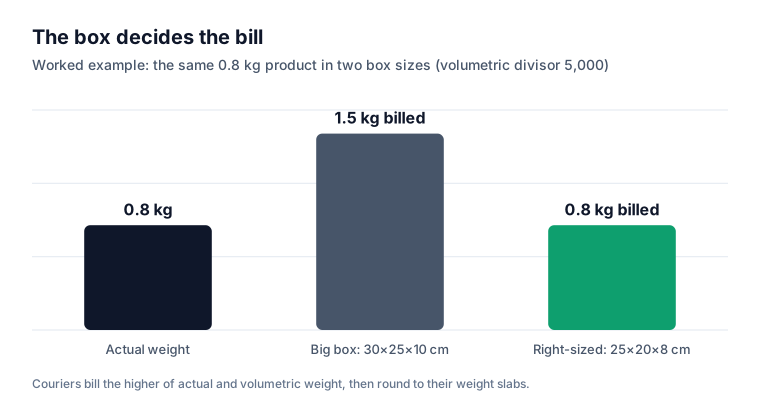
| Worked example | Big box | Right-sized box |
|---|---|---|
| Actual packed weight | 0.8 kg | 0.8 kg |
| Box size | 30 × 25 × 10 cm | 25 × 20 × 8 cm |
| Volumetric weight (÷ 5,000) | 1.5 kg | 0.8 kg |
| Chargeable weight (the higher of the two) | 1.5 kg | 0.8 kg |
Couriers then charge in weight slabs, so check how yours rounds. The point stands: a box sized to the product can drop a parcel into a lower slab.

Packing rules that save money and returns:
- Keep three or four box or mailer sizes that fit your common orders.
- Use mailer bags for soft items such as clothing, which weigh little and take little space.
- Protect fragile items with bubble wrap or paper so they do not move when you shake the box.
- Seal with good tape across every seam, and use tamper-evident tape for valuable items.
- Weigh every parcel after packing, on a digital scale, and enter that weight.
- Put the invoice and a return note inside, and the label flat on the largest side.
Step 4: Enter real weights and sizes
Couriers can re-weigh parcels. If the weight or size you entered is lower than what they measure, they can charge the difference as a weight discrepancy.
- Enter the packed weight, not the product weight from your catalogue.
- Enter the box dimensions for every order.
- For large or costly parcels, take a photo of the packed parcel on the scale with the label visible.
- Raise a dispute through your courier or aggregator when a charge is wrong, with your photo.
Step 5: Check what you are allowed to ship
Every courier has a list of items it will not carry, or will carry only with conditions. Shiprocket's list, for example, includes:
- Dangerous goods: lithium batteries, flammable liquids and adhesives, bleach, and any aerosols, liquids or powders classified as dangerous for air transport.
- Restricted items: precious stones, gems and jewellery; cash and bearer cheques; and foodstuff and liquor.
Warning: If you sell food, perfumes, cosmetics in aerosol cans or electronics with batteries, ask your courier in writing which of your products they will carry, and by air or surface, before your first order.
Step 6: Plan for cash on delivery
Couriers collect cash on delivery orders and pay it to you later, on a remittance cycle.
- Shiprocket says COD amounts reach your bank account 8 to 9 days after delivery.
- Faster payout costs extra: Shiprocket's Early COD offers payout from 2 days after delivery, for a fee.
- Refused COD orders come back at your cost, so verify phone numbers, confirm orders before dispatch and take part payment on larger orders. Our guide on reducing fake cash on delivery orders covers each step.
Build the remittance delay into your cash flow, especially before festivals when you buy more stock.
Step 7: Handle failed deliveries and returns
Failed deliveries. When a courier cannot deliver, it raises a non-delivery report (NDR): the customer was not reachable, the address was wrong, or the customer refused. Check NDRs every day, contact the customer, and ask for a re-attempt before the parcel is sent back.
Returns. Returned parcels (RTO) are charged too, and Shiprocket says the zone affects the return charge as well as the forward one. Keep RTO low with clear product photos and descriptions, a confirmation step for COD orders and a fair, clear returns policy. A return policy generator gives you a draft; for clothing, an exchange-first approach keeps more sales.
Step 8: Keep customers informed
Keep customers informed, so they know when to expect the parcel and are home to receive it.
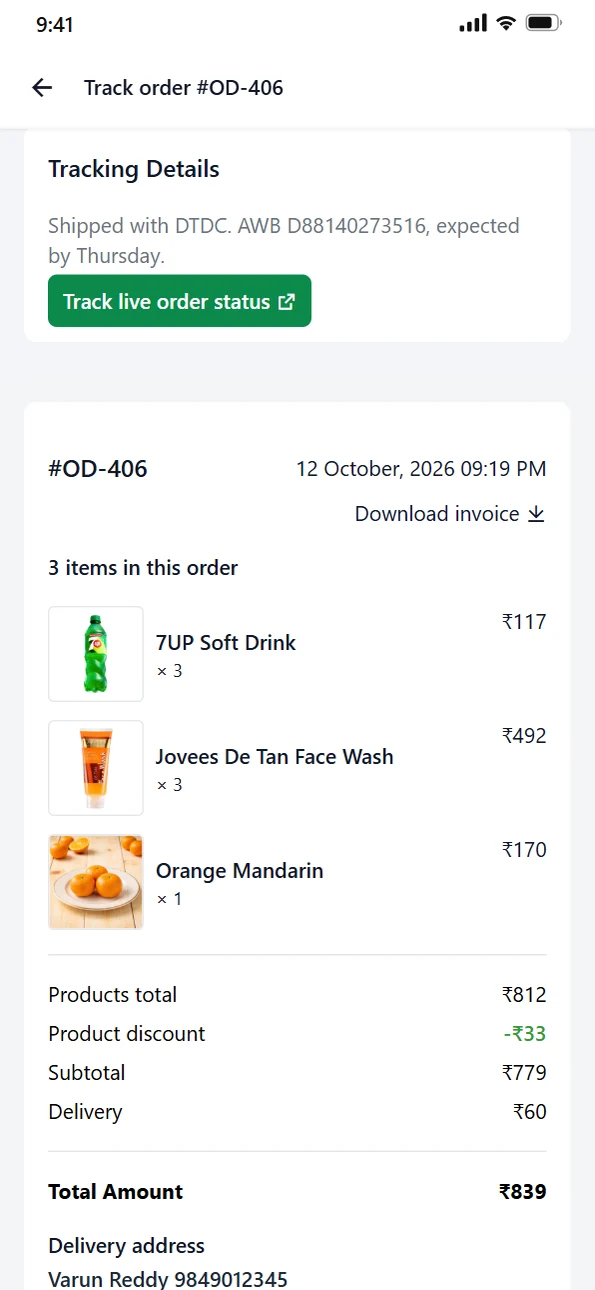
- Send the tracking link as soon as the parcel is booked.
- Show tracking inside your store, on the order page, not only on the courier's site.
- Send updates when the parcel is out for delivery.
- Set honest delivery estimates by zone on your product and checkout pages.
What to charge customers for shipping
- Free shipping above an order value, with a flat fee below it, is simple and gives customers a reason to add to their basket.
- Flat shipping everywhere is easy to explain but loses money on far zones.
- Zone or weight-based shipping is fairest for heavy or bulky products.
Whichever you choose, show it before checkout. Extra costs such as shipping were the top reason for abandoning checkout, leaving aside shoppers who were just browsing, in Baymard Institute's survey of US shoppers; our guide on recovering abandoned carts shows the research.
Mistakes to avoid
One big box for everything. You pay for air.
Entering catalogue weights instead of packed weights. Weight discrepancy charges follow.
Not checking the restricted list. Parcels get held, returned or penalised.
Forgetting the COD remittance delay. With Shiprocket, for example, cash arrives 8 to 9 days after delivery.
Ignoring NDRs. Every one is a last chance before a paid return trip.
Hiding shipping costs until the last step. Shoppers leave.
Your shipping checklist
- A courier aggregator or courier accounts set up, with pickup address and bank details
- Shipping zones and billed weight understood for your common routes
- Three or four box and mailer sizes; a digital scale
- Packed weight and box size entered for every order
- Your products checked against each courier's restricted list
- COD remittance cycle built into your cash flow
- NDRs checked daily, and a returns policy published
- Tracking links sent and shown in your store
- Shipping fees shown before checkout
How Zepio helps
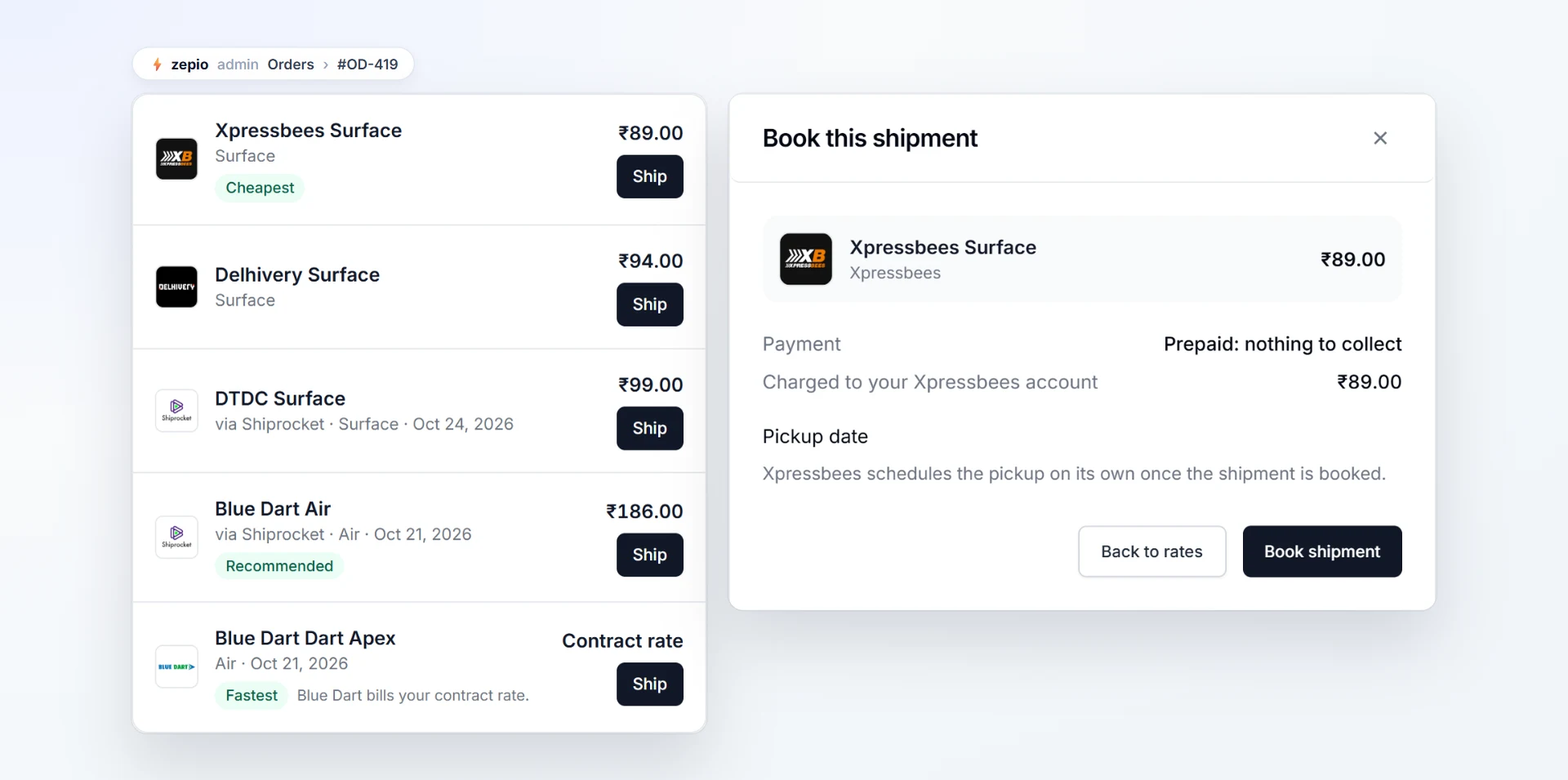
In Zepio you connect your own accounts with Shiprocket, Delhivery, Blue Dart, Xpressbees, Ekart, Shadowfax or DTDC. Each order shows the rates from the couriers that quote live, side by side, and you book the one you want, print the label, request a pickup where the courier takes requests, and cancel if needed. Tracking updates come back onto the order and into your customer's order page. You ship on your own accounts at your own rates; Zepio adds no margin on shipping.
Start with an aggregator, measure your boxes, enter honest weights and watch your COD and returns. Shipping costs come down with good habits as much as with a cheaper courier.
Questions people ask
What is the cheapest way for a small business to ship across India?
What is volumetric weight?
What are shipping zones in India?
When do I get money for cash on delivery orders shipped by courier?
Should I use a courier aggregator or sign up with couriers directly?
What happens if the courier says my parcel weighs more than I entered?
Sources
- Explaining shipping zones: how zones affect fulfilment and rates, Shiprocket Support
- Explain the different types of weight terminology used in the platform, Shiprocket Support
- When will I receive my COD payment?, Shiprocket Support
- Early COD, Shiprocket
- Which products are prohibited or dangerous to ship via Shiprocket?, Shiprocket Support
- Conditions of carriage (volumetric weight), Blue Dart
Facts were checked against these sources on 20 Oct 2026. Rules and prices change: check the source before you rely on a figure. Read our editorial standards, or write to hi@zepio.io to report a mistake.