

On this page
- What the rules require
- Why a clear policy helps you sell
- Step 1: Decide what can be returned
- Step 2: Choose a return window per category
- Step 3: Set the conditions
- Step 4: Decide how refunds are paid, and when
- Step 5: Decide who pays for return shipping
- A template you can adapt
- Step 6: Put the policy where customers see it
- Step 7: Run returns without losing money
- Mistakes to avoid
- Your returns policy checklist
- How Zepio helps
A return and refund policy should say, in plain words: what can be returned, within how many days, in what condition, who pays for return shipping, how the refund is paid and how fast, and how to start a return. In India, the Consumer Protection (E-Commerce) Rules, 2020 require online sellers to disclose this clearly, and you cannot refuse returns for defective, deficient, spurious, not-as-described or late items, whatever your policy says.
A return and refund policy is the page on your website that tells customers when they can send a product back and what they get in return. This guide covers what the rules require, how to choose a return window, a template you can adapt and how to run returns without losing money.
What the rules require
If you sell your own stock, the Consumer Protection (E-Commerce) Rules, 2020 call you an inventory e-commerce entity, which includes single-brand retailers (E-Commerce Rules, rule 3). The key duties:
| Rule | What it says |
|---|---|
| Rule 7(1)(a) | Show accurate information about return, refund, exchange, warranty and guarantee, delivery and shipment, including the cost of return shipping |
| Rule 7(4) | Do not refuse to take back goods that are defective, deficient, spurious or not as described, or delivered late (except for force majeure) |
| Rule 4(5) | Have a grievance officer who acknowledges complaints within 48 hours and resolves them within one month |
| Rule 4(8) | No cancellation charges after an order is confirmed, unless you bear similar charges when you cancel |
| Rule 4(10) | Pay accepted refunds within a reasonable period |
Source: Consumer Protection (E-Commerce) Rules, 2020.
Under the Consumer Protection Act, 2019, refusing to take back defective goods and refund them within the period stated on the bill, or within 30 days if no period is stated, is an unfair trade practice (Mondaq).
Warning: In 2024 the Ernakulam District Consumer Commission held that printing "Goods once sold will not be taken back or exchanged" on bills is an unfair trade practice, and ordered the seller to remove it (LiveLaw). Do not use blanket no-return lines.
Why a clear policy helps you sell
Many customers look for the returns policy before they buy, especially when fit or quality is uncertain. In Baymard Institute's research, 13% of shoppers' reasons for abandoning an order, not counting those just browsing, were that the returns policy wasn't satisfactory (Baymard). A clear, fair policy turns "what if it doesn't fit?" into a reason to order. Our guide to recovering abandoned carts covers the other reasons shoppers leave.
Step 1: Decide what can be returned
Split your products into groups:
| Group | Examples | Typical approach |
|---|---|---|
| Returnable for any reason | Clothes, shoes, accessories, home decor | Return or exchange within a set number of days |
| Exchange only | Sized items where resale is easy | Exchange for another size or colour |
| Returnable only if defective or wrong | Food, cosmetics once opened, innerwear, customised items | Report a problem within a short time with a photo |
| Not returnable for change of mind | Perishables, personalised gifts, digital downloads | Say so clearly, but still accept defective or wrong items |
Step 2: Choose a return window per category
The rules do not fix a number of days. Look at what customers expect in your category. Flipkart's returns policy is one benchmark (Flipkart):
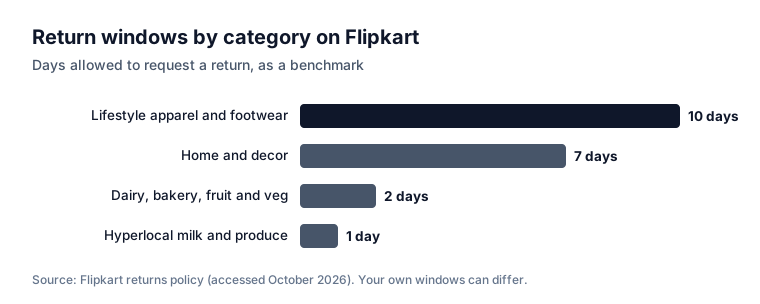
Start the window from the delivery date, not the order date. Amazon's seller guidance says to count from the estimated delivery date (Amazon).
Step 3: Set the conditions
Write exactly what a returnable item must look like:
- Unused, unwashed, with original tags and packaging
- All accessories and free gifts included
- For food: report within a set time of delivery, with a photo of the problem
- For electronics: with the box, charger and invoice
Ask for photos at the time of the request. They make disputes quicker to settle.
Step 4: Decide how refunds are paid, and when
| Option | When to use it |
|---|---|
| Refund to the original payment method | The default for online payments |
| Refund to the customer's store wallet | Faster; good when the customer agrees |
| Exchange | Size or colour changes |
| Bank transfer or UPI | Cash on delivery orders |
State a timeline you can keep, such as "within 7 days of receiving the returned item". The e-commerce rules ask for refunds within a reasonable period.
Note: Do not confuse this with failed payments. When a customer's account is debited but the payment fails, RBI's turnaround-time rules apply: for example, a UPI payment to a merchant that fails must be auto-reversed within 5 days of the transaction, or the customer gets compensation (RBI). Your payment gateway handles this, separately from your returns policy.
Step 5: Decide who pays for return shipping
- Defective, damaged or wrong items: you pay. Arrange a pickup or refund the courier cost.
- Change of mind: you can ask the customer to pay, but you must say how much, as the e-commerce rules require the cost of return shipping to be disclosed.
One common approach is free exchanges and a small fee for change-of-mind returns. Whatever you choose, write it down.

A template you can adapt
Example: Returns and refunds What you can return: Clothes, footwear and accessories within 7 days of delivery, unused, with tags and original packaging. Food items cannot be returned for change of mind; if something arrives damaged, spoiled or wrong, tell us within 24 hours with a photo and we will replace or refund it. Not returnable: Innerwear, personalised items and items marked "non-returnable" on the product page, unless they arrive defective or wrong. How to return: Go to My Orders, choose the item and the reason, and add photos. We will arrange a pickup within 2 working days. Return shipping: Free for defective, damaged or wrong items. For other returns, ₹____ is deducted from the refund. Refunds: To your original payment method or your store wallet, within 7 days of receiving the item. For cash on delivery orders, by UPI or bank transfer. Exchanges: Free size exchange once per order, subject to stock. Cancellations: No cancellation charge. Once an order has shipped, refuse the delivery or request a return. Questions: Contact our grievance officer, ____, at ____. We acknowledge complaints within 48 hours.
A return policy generator can produce a first draft from your answers. Have a lawyer check it if you sell high-value items.
Step 6: Put the policy where customers see it
- A Returns and refunds page linked in the footer.
- A one-line summary on every product page: "Free 7-day returns" or "Non-returnable unless damaged".
- A link near the pay button at checkout.
- In the order confirmation message.
Our guide to writing product descriptions shows how to put the return summary on product pages.
Step 7: Run returns without losing money
- Track the return rate by product. A product with many returns often points to a description, size chart or quality problem.
- Inspect before refunding for change-of-mind returns.
- Offer exchanges first for size issues; you keep the sale.
- Watch for repeat returners and fake cash-on-delivery orders: see how to reduce fake COD orders.
For clothing in particular, see our guide to starting an online clothing business, which covers size charts.
Mistakes to avoid
"No returns, no refunds" for everything. It is not allowed for defective or late goods, and it scares buyers.
A vague window. "Returns accepted for a few days" leads to arguments. Give a number and say when it starts.
Hiding return shipping costs. The rules require them to be disclosed.
Slow refunds. A refund that takes weeks becomes a complaint and a bad review.
Different rules on different pages. Keep the policy page, product pages and checkout consistent.
Your returns policy checklist
- Product groups: returnable, exchange only, defective-only, non-returnable
- Return window per group, starting from delivery
- Conditions for a valid return, with photos requested
- Refund methods and a timeline you can keep
- Who pays return shipping, and how much
- Grievance officer named, with contact details
- Policy linked in the footer, on product pages and at checkout
- Return rate tracked by product
How Zepio helps
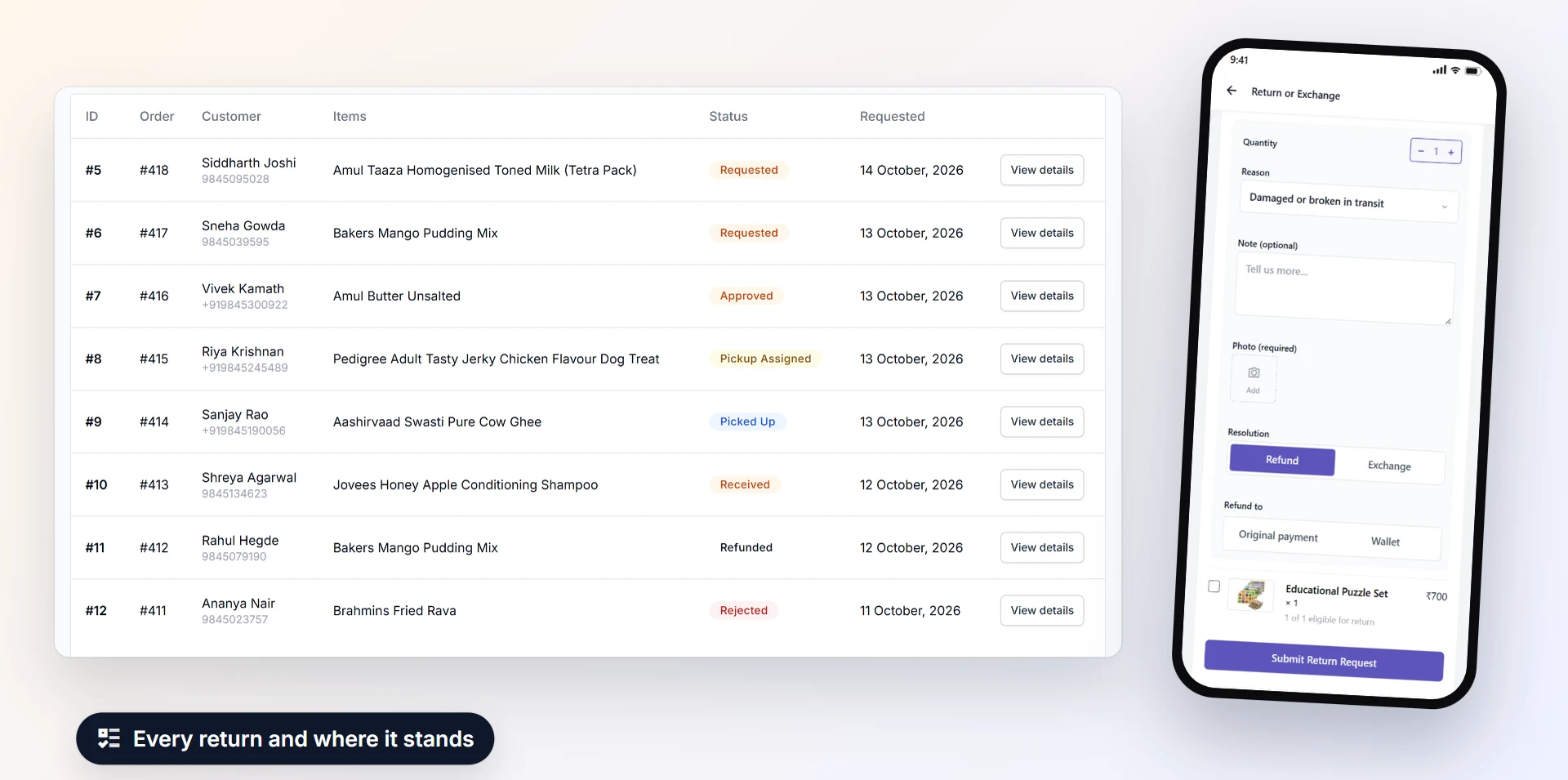
Zepio's Return Plus handles the whole process on your own website and app. Set which products are returnable or exchangeable and their return windows, give customers a list of return reasons, and approve or reject each request. Pickups can go to your own delivery team, a courier partner or the customer can ship it back, and refunds go to the original payment method or the customer's wallet, or as an exchange for the same item or another variant.
Write the policy you would want as a customer, say it clearly everywhere, and keep to it.
Questions people ask
Is a return policy mandatory for an online store in India?
Can I have a no-return policy?
How many days should my return window be?
How quickly must I refund customers?
Who pays for return shipping?
Sources
- Consumer Protection (E-Commerce) Rules, 2020, LegitQuest (text of the rules)
- The Consumer Protection Act, 2019: An Overview, Mondaq (Kanth & Associates)
- Ernakulam District Commission: 'goods once sold' notice is an unfair trade practice, LiveLaw
- Harmonisation of turn around time and customer compensation for failed transactions, Reserve Bank of India
- Cart abandonment rate statistics, Baymard Institute
- How to manage product returns on Amazon, Amazon Seller Blog
- Returns policy, Flipkart
Facts were checked against these sources on 22 Oct 2026. Rules and prices change: check the source before you rely on a figure. Read our editorial standards, or write to hi@zepio.io to report a mistake.