

On this page
- How people actually read product pages
- The template
- Step 1: Start with the buyer's question
- Step 2: Lead with the benefit
- Step 3: Give the facts in bullets
- Step 4: Answer the doubts before they become returns
- Step 5: Include what the rules require
- Step 6: Write for search too, without stuffing
- Words to avoid
- A finished example
- Mistakes to avoid
- Your product description checklist
- How Zepio helps
To write product descriptions that sell, lead with the benefit to the buyer, then answer every question they would ask you in person: size, material, how to use it, delivery and returns. Keep it short and easy to scan, with bullet points and plain words, and stay honest. A description that removes doubt sells better than one full of adjectives.
A product description is the text on a product page that explains what the product is and why someone should buy it. This guide gives a template you can reuse, before-and-after examples for Indian products, and the details some products must show by law.
How people actually read product pages
People scan before they read. In Nielsen Norman Group's well-known study, 79% of test users always scanned any new page, and only 16% read word by word (Nielsen Norman Group). When the researchers rewrote a site's text, the gains were large:
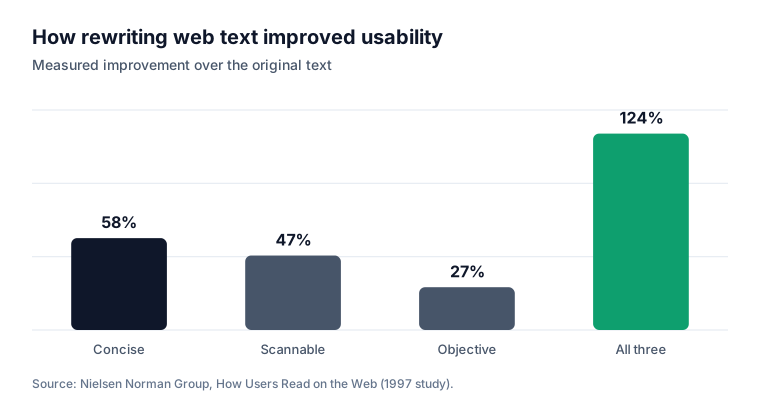
That study is from 1997, but NN/g's later eye-tracking work found the same scanning patterns on desktop and mobile, and advises putting the most important points first and starting headings with the words that carry the most information (Nielsen Norman Group).
Product pages also have room to improve. Baymard Institute's research across 344 leading e-commerce sites found that 51% had product pages rated "mediocre" or worse, and notes that nearly all users go through a product page before buying (Baymard).
The template
Use the same structure for every product. Customers learn where to look.
| Part | What to write | Length |
|---|---|---|
| Product name | What it is, plus the detail that matters: size, flavour, colour, material | One line |
| Opening line | The main benefit, in the customer's words | One sentence |
| Key points | The 3 to 6 facts buyers ask about most | Bullets |
| Details | Size, weight, material or ingredients, care or storage, what is in the box | Short table or list |
| Delivery and returns | When it arrives and what happens if something is wrong | One or two lines, with a link |
| Who it is for (optional) | Occasions, gifting, age | One line |
Step 1: Start with the buyer's question
Before writing, list the questions customers ask you on the phone or at the counter. Those are your key points.
| Product | Questions buyers ask |
|---|---|
| Cotton kurti | Will it shrink? Is it see-through? What size am I? Can I return it? |
| Mango pickle | How spicy? Which oil? How long does it last? Will it leak in transit? |
| Birthday cake | How many people does it serve? Eggless? Can you write a name? Delivery time? |
| Dog food | Which age and breed? Main ingredient? How long does a bag last? |
Step 2: Lead with the benefit
The first sentence should say why this product is worth buying, not repeat the name.
Example: Before: "Cotton kurti. Good quality. Beautiful design." After: "A breathable cotton kurti for hot days at the office, with a lining so it is not see-through."
Example: Before: "Homemade mango pickle, very tasty." After: "Sun-cured raw mango pickle made in cold-pressed mustard oil, medium spicy, the way it is made at home in Andhra."
Step 3: Give the facts in bullets
Bullets are easy to scan. Put the most important fact first.
- Size: Medium fits chest 38 inches; see the size chart.
- Fabric: 100% cotton, lined.
- Care: Hand wash cold; dry in shade.
- Length: 44 inches.
- In the box: Kurti only (dupatta not included).
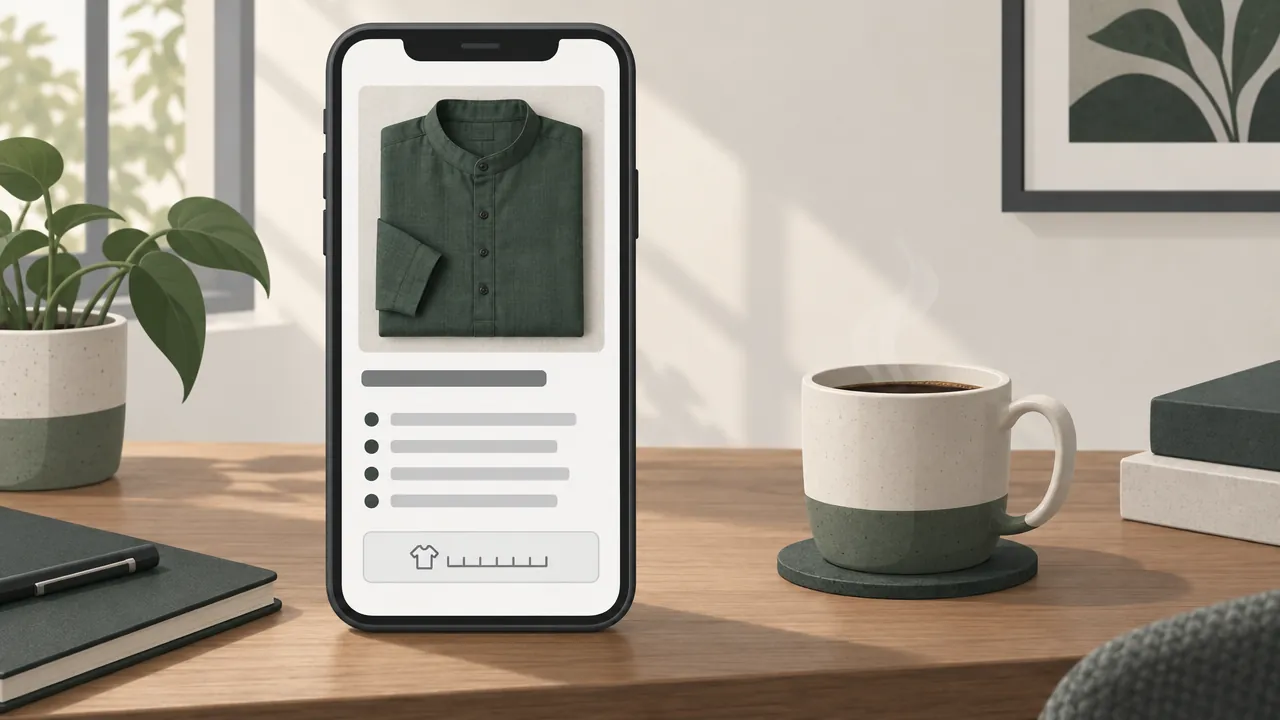
Baymard's testing found that 42% of users try to judge a product's size from its images (Baymard). State size and dimensions in words too, and show an image with something for scale.
Step 4: Answer the doubts before they become returns
A return can come from a gap between what the buyer imagined and what arrived. Close the gap:
- Colour: "The colour may look slightly lighter in daylight than on screen."
- Fit: "Runs small; if between sizes, choose the larger."
- Taste: "Medium spicy, sour and salty."
- Freshness: "Baked on the day of delivery; best eaten within 2 days."
Link to your returns policy from every product page. Our guide on writing a return and refund policy explains what to include.
Step 5: Include what the rules require
Some products must show certain information online.
- Packaged food: Regulation 4(2) of FSSAI's Labelling and Display Regulations, 2020 says that when food is sold through e-commerce, the mandatory label information must be provided to the customer before sale, except batch number and dates (FSSAI). List ingredients, net quantity, the veg or non-veg symbol and your FSSAI number. See also FSSAI registration for a home food business.
- Prices: the Consumer Protection (E-Commerce) Rules, 2020 require sellers who own their stock to display the total price prominently, with a breakup of charges such as delivery and tax (Rule 7) (E-Commerce Rules).
- Packaged goods: if you sell pre-packed goods, ask your accountant or a legal metrology consultant which declarations you must show online.
Step 6: Write for search too, without stuffing
Search engines read your descriptions. Use the words customers search for naturally, once or twice, in the name and the first lines. "Eggless chocolate truffle cake, 1 kg" is clearer than "Chocolate Delight".
Google's guidance on helpful content asks whether a page provides original information and a substantial, complete description (Google). Your own words, answering your customers' questions, do that better than a copied manufacturer text. Google's product structured data for merchant listings needs at least the product name, an image and an offer with price and currency (Google); your store software should add it for you. Our guide to SEO for an online store covers the rest.
Words to avoid
| Avoid | Why | Use instead |
|---|---|---|
| "Best quality", "premium", "amazing" | Every seller says it; it proves nothing | The fact behind it: "100% cotton", "cold-pressed oil" |
| "100% guaranteed" | A promise you may not be able to keep | Your real return or replacement policy |
| "Limited stock!" when it is not | Misleading | Stock numbers only if true |
| Long paragraphs | Hard to scan on a phone | Bullets |
A finished example
Example: Eggless chocolate truffle cake, 1 kg Rich, moist chocolate cake layered with dark chocolate ganache, made without eggs. Serves 8 to 10.
- Eggless; contains milk and wheat
- Fresh cream; keep refrigerated, best within 2 days
- Message on the cake: add it at checkout, up to 25 characters
- Delivered the same day for orders before 2 pm; choose a time slot at checkout Photos show the 1 kg cake. Colour of decorations may vary slightly.
Product photos do half the work; see how to take product photos with a phone.
Mistakes to avoid
Copying the same text across variants. Each size or flavour should say what is different.
Writing for yourself. "Our signature SKU-114" means nothing to a buyer.
Hiding the important facts at the bottom. Size, ingredients and delivery belong near the top.
Over-promising. It turns into returns and bad reviews.
Your product description checklist
- Name says what it is plus the key detail
- Opening line states the main benefit
- 3 to 6 bullets answer buyers' common questions
- Size, weight, material or ingredients, care and what is in the box
- Delivery time and a link to the returns policy
- Mandatory food label details for packaged food
- Search words used naturally in the name and first lines
- No vague adjectives or claims you cannot back up
How Zepio helps
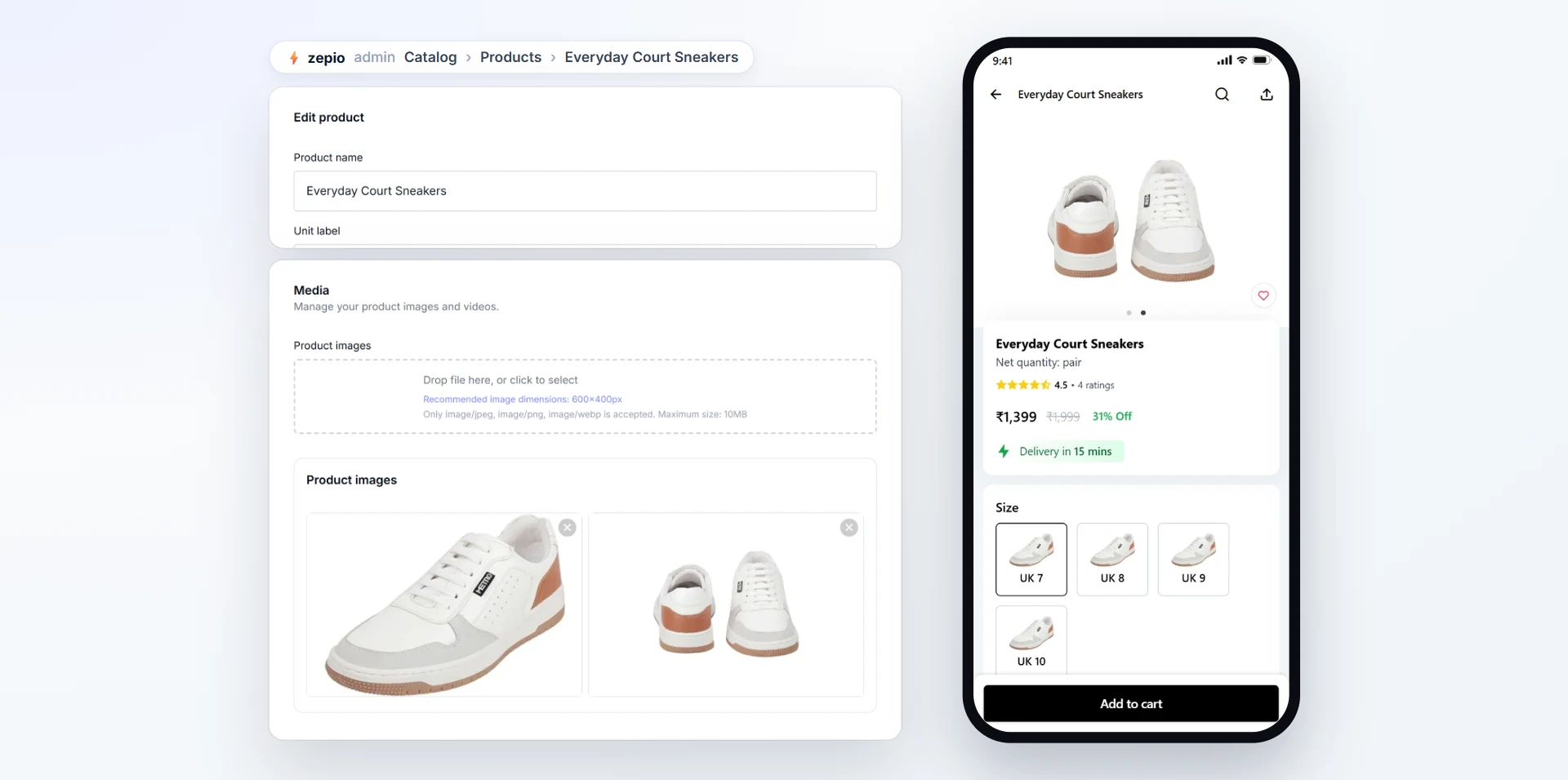
On a Zepio store, every product page has room for what buyers need: variants such as size and colour with their own images, product attributes shown as a neat list, custom product fields such as a message on a cake, product videos, and veg, non-veg and egg markers for food. The SEO settings let you set a search title and description for each product, or add automatic prefixes and suffixes to every title.
Write what a good shop assistant would say, in the order a buyer needs it. That is what sells.
Questions people ask
How long should a product description be?
What should a product description include?
Can I copy the manufacturer's description?
Do product descriptions help SEO?
What must food product descriptions include in India?
Sources
- How Users Read on the Web, Nielsen Norman Group
- F-Shaped Pattern of Reading on the Web, Nielsen Norman Group
- Product Page UX research, Baymard Institute
- The current state of e-commerce product page UX, Baymard Institute
- Consumer Protection (E-Commerce) Rules, 2020, LegitQuest (text of the rules)
- Merchant listing structured data, Google Search Central
- Creating helpful, reliable, people-first content, Google Search Central
- Compendium: Food Safety and Standards (Labelling and Display) Regulations, 2020, FSSAI
Facts were checked against these sources on 22 Oct 2026. Rules and prices change: check the source before you rely on a figure. Read our editorial standards, or write to hi@zepio.io to report a mistake.