

On this page
A home food business in India needs FSSAI basic registration if its yearly turnover is up to ₹1.5 crore, under limits that took effect on 1 April 2026. You apply online on FSSAI's FoSCoS portal using Form A, pay ₹100 a year, and declare that you follow FSSAI's basic hygiene rules. Registrations issued from 1 April 2026 do not need renewal.
FSSAI registration is the basic permission from the Food Safety and Standards Authority of India for small food businesses. It is different from an FSSAI licence, which larger businesses need. This guide covers who needs which, what changed in 2026, the documents, the steps and what to do after you are registered.
What changed in 2026
On 13 March 2026, FSSAI issued an order raising the turnover limits for each category, effective 1 April 2026 (FSSAI). FSSAI's press release says the registration limit went from ₹12 lakh to ₹1.5 crore, with no pre-inspection and instant registration for small businesses (FSSAI).
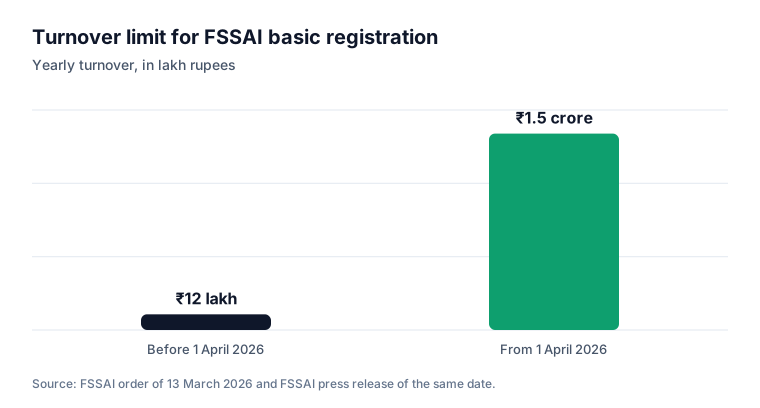
| Category | Turnover from 1 April 2026 |
|---|---|
| Basic registration | Up to ₹1.5 crore |
| State licence | Above ₹1.5 crore and up to ₹50 crore |
| Central licence | Above ₹50 crore |
Source: FSSAI order of 13 March 2026.
Three more points from FSSAI's FAQs (FSSAI):
- Perpetual validity: registrations and licences issued on or after 1 April 2026 stay valid unless suspended, cancelled or surrendered. There is no renewal.
- Fees: the fee is still per year, and you can choose to pay for any number of years at once. Existing businesses moving to a new category because of the new limits pay no migration fee.
- Existing businesses: the new limits apply to applications made on or after 1 April 2026; FSSAI says existing businesses will be given time to migrate on FoSCoS.
Warning: Older guides still quote the old ₹12 lakh limit and "valid for 1 to 5 years". Both are out of date.
Who needs FSSAI registration
Any business that makes, sells, stores or delivers food. For home businesses this includes:
- Home bakers selling cakes, cookies and brownies (starting a home bakery)
- Home kitchens and cloud kitchens selling meals (starting a cloud kitchen)
- Tiffin and dabba services (starting a tiffin service)
- Pickles, papads, masalas, snacks and sweets made at home (starting a pickle business)
FSSAI's application form for registration, Form A, lists "Home based canteens/dabba wallas" as a type of business (FSSAI Licensing Regulations). Home kitchens can and should register.
Note: FSSAI's FAQs say street vendors registered under the Street Vendors Act, 2014 are deemed registered. That does not cover a home kitchen; you still apply yourself.
What you need before you apply
| Item | Details |
|---|---|
| Photo ID | Form A asks for a copy of photo ID such as a driving licence, passport, ration card or voter ID |
| Address of the kitchen | The home where food is made |
| What you make | The food categories you will sell |
| Fee | ₹100 a year (Schedule 3 of the licensing regulations) |
Some state food departments may ask for extra documents such as a photo or address proof. Check the list shown on FoSCoS when you apply.
How to apply on FoSCoS, step by step
- Go to FoSCoS (foscos.fssai.gov.in), FSSAI's Food Safety Compliance System, and choose to apply for a new registration.
- Select your state and the kind of business. For a home kitchen, choose the food service or manufacturing category that matches what you make.
- Check the eligibility result. With turnover up to ₹1.5 crore, it should say Registration.
- Fill in Form A: your name, address, food categories and expected turnover.
- Upload documents and pay the fee for the number of years you choose.
- Submit and note the application number.
Regulation 2.1.1(5) also asks you to display your registration certificate prominently where you work. Under the licensing regulations, the authority must grant or reject a registration within 7 days, or within 30 days if it orders an inspection. If it does neither, the business may start (FSSAI Licensing Regulations). FSSAI's March 2026 press release says the reforms will bring instant registration without pre-inspection for small businesses; until FoSCoS reflects that, the 7-day rule above is the legal backstop.
The hygiene rules you agree to
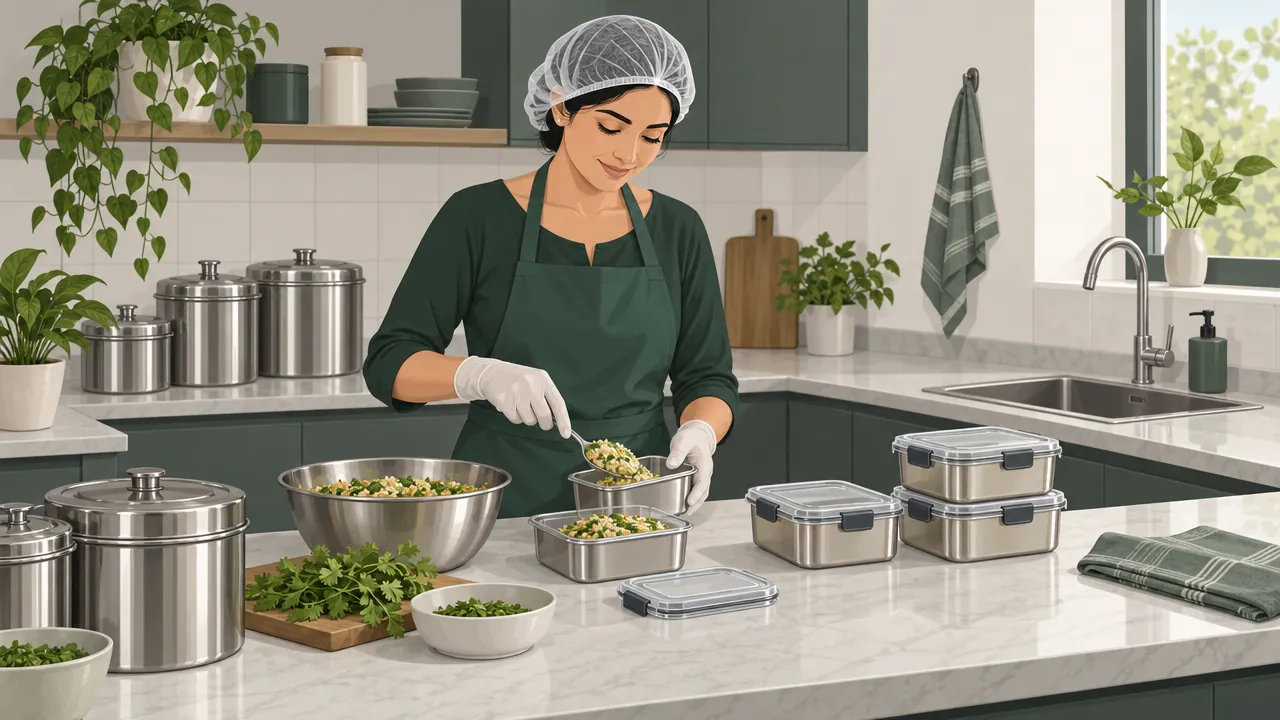
When you register, you declare that you follow Schedule 4, Part I of the licensing regulations, the general hygiene rules for small food businesses (FSSAI Licensing Regulations). In plain words:
- Keep the kitchen and utensils clean; keep food covered and away from pests.
- Use clean aprons, gloves and head covering while preparing food.
- Nobody with an infectious illness handles food.
- Use safe drinking water for cooking and washing.
After you are registered
Show your number wherever you sell
FSSAI's 2022 directions, which are awaiting final notification, say sellers on e-commerce platforms must display their licence or registration (FSSAI); for packaged food, the Labelling and Display Regulations already require the label details, including your FSSAI number, to be shown before sale. Put your number on your website or app, your menu, your WhatsApp catalogue and your packaging.
Label packaged food properly
If you sell packaged food online, such as jars of pickle or boxes of cookies, FSSAI's Labelling and Display Regulations say the mandatory label information must be shown to the customer before sale, except batch number and dates (FSSAI). Put the ingredients, the veg or non-veg symbol, the net quantity and your FSSAI number on the product page.
Menus: veg and non-veg symbols and allergens
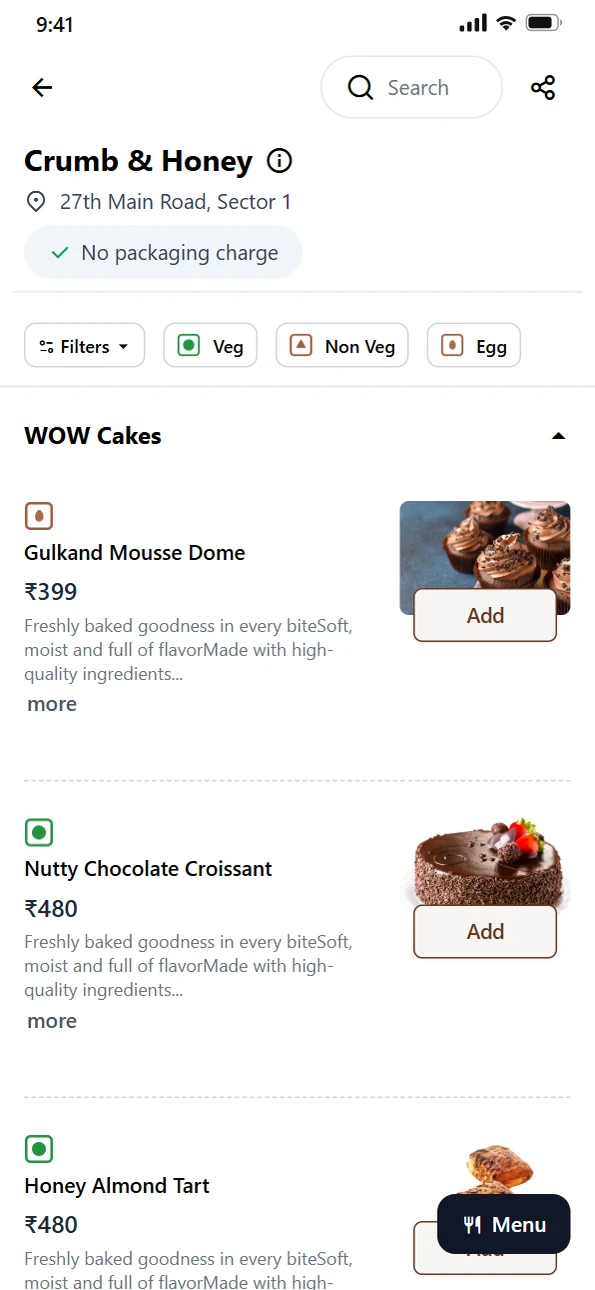
The same regulations require food service businesses to show allergen information and the veg or non-veg logo against items on their menus. The veg logo is a green filled circle inside a square with a green outline; the non-veg logo is a brown filled triangle inside a square with a brown outline.
Upgrade when you grow
When turnover goes above ₹1.5 crore, move to a State licence on FoSCoS. Keep a simple record of monthly sales so you know where you stand.
Registration vs licence at a glance
| Basic registration | State licence | |
|---|---|---|
| Turnover | Up to ₹1.5 crore | ₹1.5 crore to ₹50 crore |
| Form | Form A | Form B |
| Fee | ₹100 a year | Higher; depends on the business |
| Validity (issued from 1 April 2026) | Perpetual, fee paid yearly | Perpetual, fee paid yearly |
| Typical home business | Home bakers, tiffin services, home kitchens | Larger kitchens and food brands |
Mistakes to avoid
Using the old ₹12 lakh limit. Small businesses may think they need a licence and pay a consultant for the wrong thing.
Not showing the number online. Your website, app and packaging should all carry it.
Wrapping food in newspaper. FSSAI's Packaging Regulations, 2018 say newspaper must not be used to store or wrap food (Food Packaging Forum). See our guide to food packaging for delivery.
Forgetting the fee years. Validity is perpetual, but the fee is per year. Keep the fee paid for the years you trade.
Choosing the wrong food category. Pick every category you actually make, so you are covered when you add products.
Your FSSAI checklist
- Turnover estimated: up to ₹1.5 crore means basic registration
- Photo ID and kitchen address ready
- Applied on FoSCoS with Form A and the right food categories
- Fee paid for the years you chose
- Certificate displayed in the kitchen
- FSSAI number on website, app, menu and packaging
- Veg or non-veg symbol and allergens on menu items
- Sales tracked so you know when to move to a licence
How Zepio helps
Once you are registered, Zepio gives you your own website and app to sell from, with 0% commission on your sales. Mark items as veg, non-veg or egg, set opening hours or order cut-off times per product, add your FSSAI number to your store pages, and take orders for delivery or pickup with online payment or cash.
Register once, keep your kitchen clean and show your number. Then you can sell your home food with confidence.
Questions people ask
Do I need FSSAI registration to sell food from home?
How much does FSSAI registration cost?
How long is FSSAI registration valid?
Is the FSSAI limit still ₹12 lakh?
Do I need to show my FSSAI number when selling online?
Sources
- Order: Implementation of revised turnover threshold for food businesses (13 March 2026), FSSAI
- FAQs on FSS (Licensing and Registration of Food Businesses) Amendment Regulations, 2026, FSSAI
- MoHFW approves major regulatory reforms (press release, 13 March 2026), FSSAI
- Compendium: Food Safety and Standards (Licensing and Registration of Food Businesses) Regulations, FSSAI
- Compendium: Food Safety and Standards (Labelling and Display) Regulations, 2020, FSSAI
- Direction under Section 16(5) on licensing and registration (2022), FSSAI
Facts were checked against these sources on 22 Oct 2026. Rules and prices change: check the source before you rely on a figure. Read our editorial standards, or write to hi@zepio.io to report a mistake.