

On this page
- The turnover thresholds
- Rule 1: Selling goods to other states needs GST
- Rule 2: Marketplaces with an enrolment number
- Rule 3: Your own website follows the normal threshold
- Which route fits you
- When registering anyway makes sense
- Track your turnover every month
- Mistakes to avoid
- Your selling-without-GST checklist
- How Zepio helps
Yes, you can sell online without GST in India, within limits. If you supply only goods, your yearly turnover is under the threshold (₹40 lakh in most states) and you sell only within your own state, you do not have to register. On marketplaces you can use an enrolment number instead of a GSTIN since 1 October 2023. On your own website, the normal threshold rules apply. Shipping goods to another state generally needs GST registration whatever your turnover.
GST registration gives a business a GSTIN, the number it uses to charge GST, file returns and claim input tax credit. This guide explains when a small online seller can skip it, when it cannot, and what changes as you grow. It is a plain-language summary, not tax advice; the rules were checked against CBIC notifications in October 2026.
The turnover thresholds
A business does not have to register until their aggregate turnover in a financial year crosses a threshold. CBIC's registration flyer sets them out (CBIC):
| What you supply | Threshold | Lower threshold in |
|---|---|---|
| Goods only | ₹40 lakh | ₹20 lakh in Arunachal Pradesh, Manipur, Meghalaya, Mizoram, Nagaland, Puducherry, Sikkim, Telangana, Tripura and Uttarakhand |
| Services, or goods and services | ₹20 lakh | ₹10 lakh in Manipur, Mizoram, Nagaland and Tripura |
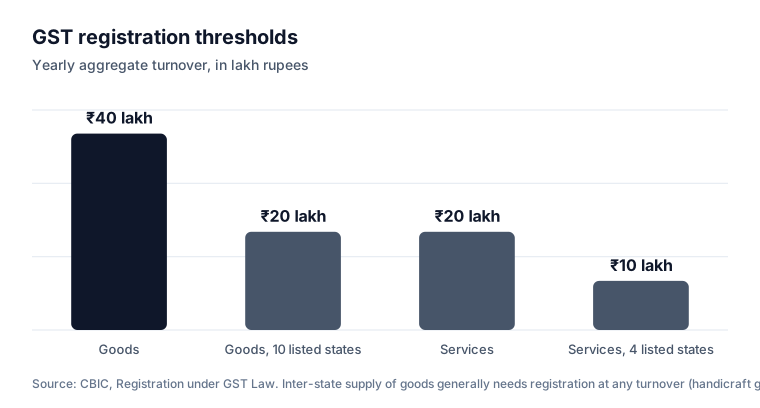
The ₹40 lakh limit for goods comes from Notification 10/2019-Central Tax, effective 1 April 2019. It does not apply to people who must register compulsorily under section 24, or to sellers of ice cream, pan masala and tobacco products (CBIC).
Note: Aggregate turnover is worked out for all of India and, under section 2(6) of the CGST Act, includes exempt supplies made under the same PAN. Ask your accountant how it is worked out for your business.
Rule 1: Selling goods to other states needs GST
This rule matters most online, because a website or marketplace can reach buyers anywhere. CBIC's flyer says that if a supplier supplies outside the state, it must register irrespective of turnover, with the compulsion relaxed for some categories such as handicraft goods and services (CBIC).
So a home baker in Pune selling within Maharashtra can stay below the threshold without GST. A clothing seller in Jaipur shipping kurtis to customers in Delhi and Bengaluru generally cannot. If you plan to ship across India, read our guide on shipping products across India and talk to an accountant about registering early.
Rule 2: Marketplaces with an enrolment number
Before October 2023, anyone selling goods through a marketplace that collects TCS had to register for GST. Notification 34/2023-Central Tax changed that from 1 October 2023. Sellers whose turnover is below the threshold can now sell goods through e-commerce operators without registration, if they (CBIC):
- Make no inter-state supply of goods.
- Sell through e-commerce operators in only one state or union territory.
- Have a PAN.
- Declare their PAN, business address and state on the GST portal before selling.
- Get an enrolment number from the GST portal, only one, for the single state you sell in, and give it to the marketplace.
Meesho announced in October 2023 that it would let such sellers join with an enrolment ID instead of a GSTIN, with their products sold only within their state (Inc42). Check each marketplace's current seller rules before you sign up.
Mistake: Thinking the enrolment number lets you sell anywhere in India. It is for one state only, with no inter-state sales.
Rule 3: Your own website follows the normal threshold
When you sell your own products on your own website or app, the marketplace rules do not apply in the same way. CBIC's flyer says TCS does not apply where a person supplies his own product through his own website (CBIC). CBEC's e-commerce FAQ makes the same point: there is no requirement to collect tax at source when someone sells their own products through their website (CBEC FAQ).
Section 24(x) of the CGST Act makes registration compulsory only for e-commerce operators who must collect TCS (CBIC), so the usual questions decide whether you register:
- Is your turnover above the threshold?
- Do you ship goods to other states?
- Do you fall into another compulsory category under section 24?
If all three answers are no, you can sell from your own website within your state without a GSTIN. Our guide on creating a website for your small business covers getting one.

Which route fits you
| Your situation | GST registration needed? |
|---|---|
| Home business, goods only, under ₹40 lakh, delivering only within your state from your own website | Generally no |
| Same, selling on a marketplace in one state with an enrolment number | Generally no |
| Shipping goods to customers in other states | Generally yes, whatever your turnover |
| Turnover above the threshold | Yes |
| Selling ice cream, pan masala or tobacco products | Yes once turnover crosses ₹20 lakh (₹10 lakh in Manipur, Mizoram, Nagaland and Tripura) under section 22; the ₹40 lakh limit does not apply |
| Want to claim input tax credit or sell to businesses who want GST invoices | Registering voluntarily may help |
When registering anyway makes sense
Staying unregistered is simpler, but it has costs:
- No input tax credit. You cannot claim back GST you pay on packaging, equipment or stock.
- Business customers may want GST invoices.
- Growth across states needs registration.
The composition scheme is a middle path for small registered businesses: a lower, fixed tax rate and simpler returns, with limits on what you can do. Since 1 October 2023, composition taxpayers can also sell goods through marketplaces within their state, and marketplaces must block their inter-state sales (Notification 36/2023-Central Tax, CBIC). Ask your accountant whether it suits you.
Track your turnover every month
Whether or not you register, keep a simple monthly record:
| Month | Sales in your state | Sales to other states | Running total for the year |
|---|---|---|---|
| April | |||
| May |
When the running total nears the threshold, or the first order from another state arrives, it is time to register. A GST calculator helps you work out prices once you do.
Mistakes to avoid
Charging GST without a GSTIN. If you are not registered, you cannot collect GST from customers.
Shipping one order to another state "just this once". Inter-state supply of goods generally triggers registration.
Using an enrolment number on marketplaces in two states. It is limited to one.
Ignoring the restricted items. Ice cream, pan masala and tobacco products do not get the ₹40 lakh exemption.
Relying on old articles. Articles written before October 2023 say marketplace sellers must always register; that changed on 1 October 2023.
Your selling-without-GST checklist
- Turnover estimated against your state's threshold
- Deliveries limited to your own state
- On marketplaces: PAN declared and enrolment number taken for one state
- On your own website: delivery areas set to your state only
- No GST charged on invoices while unregistered
- Monthly sales recorded with a running yearly total
- Accountant consulted before shipping to other states or crossing the threshold
How Zepio helps
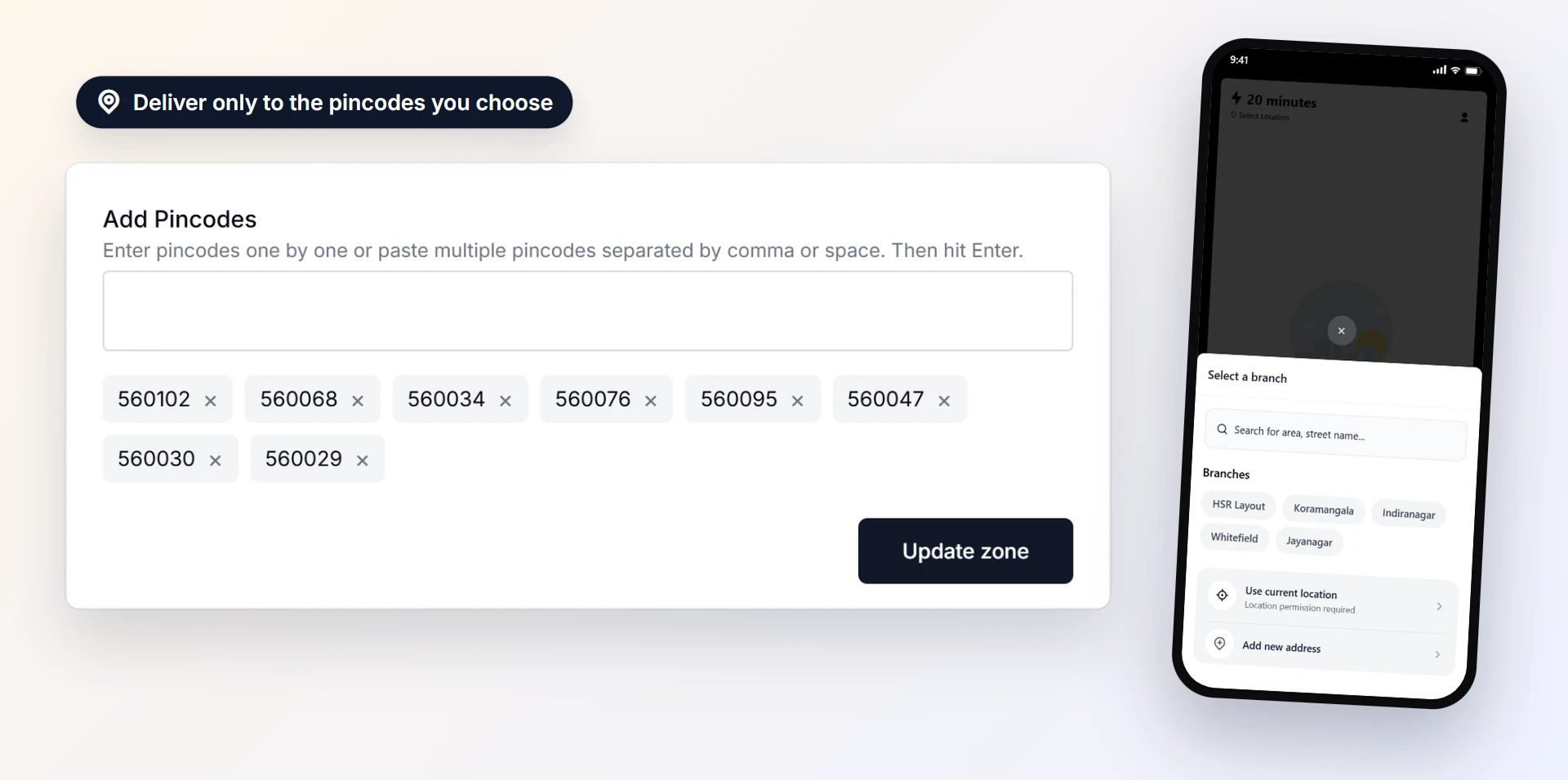
With Zepio you sell from your own website and app, with 0% commission on your sales. You decide where you deliver, by pincode list or by zones drawn on a map, so you can keep orders inside your state while you are unregistered. Tax settings let you charge GST only when you are registered, and when you do register you can add tax rates, HSN codes and tax invoices.
Stay within your state, track your turnover and register when the rules say you must. Selling online without GST is allowed, as long as you know where the lines are.
Questions people ask
Can I sell online without GST registration?
What is the GST limit for online sellers?
Can I sell on Meesho, Amazon or Flipkart without GST?
Can I ship to other states without GST?
Do I need GST to sell on my own website?
Sources
- Notification No. 34/2023-Central Tax, CBIC (via GST Council)
- Notification No. 10/2019-Central Tax, CBIC (via GST Council)
- Notification No. 36/2023-Central Tax, CBIC (via GST Council)
- Registration under GST Law (flyer), CBIC (via GST Council)
- GST Sectoral Series: E-Commerce (FAQ), CBEC (via GST Council)
- Meesho opens platform to non-GST sellers, Inc42
Facts were checked against these sources on 22 Oct 2026. Rules and prices change: check the source before you rely on a figure. Read our editorial standards, or write to hi@zepio.io to report a mistake.