


On this page
- Step 1: Know your full cost per order
- Step 2: Understand markup vs margin
- Step 3: Choose a pricing method
- Step 4: Check the price against the market
- Step 5: Use price endings and bundles wisely
- Step 6: Follow the price rules in India
- Step 7: Review prices regularly
- Mistakes to avoid
- Your pricing checklist
- How Zepio helps
To price your products, add up the full cost of one order, not just what the product cost you: packaging, delivery, payment fees, returns and marketing. Choose the margin you need, work out the price with cost ÷ (1 − margin), then check it against competitors and what customers value. In India, never sell a pre-packed product above its MRP, and show the total price with every charge before checkout.
Pricing is deciding what to charge so that each sale covers its costs, pays you and still feels fair to the customer. This guide gives a step-by-step method, worked examples in rupees and the rules on MRP and price display.
Step 1: Know your full cost per order
A frequent pricing mistake is pricing from the product cost alone. Selling online adds costs at every step.
| Cost | What it includes |
|---|---|
| Product cost | What you paid the supplier, or ingredients and materials if you make it |
| Packaging | Boxes, jars, tape, labels, bags, inserts |
| Delivery | Your delivery partner's pay or the courier charge, if you do not charge it separately |
| Payment fee | The payment gateway's fee on online payments, plus GST on that fee |
| Returns allowance | A small amount per order to cover returns, damage and wastage |
| Marketing per order | Ad spend ÷ orders, discounts and free gifts |
| Fixed costs | Rent, salaries, your own pay, software: spread over expected orders |
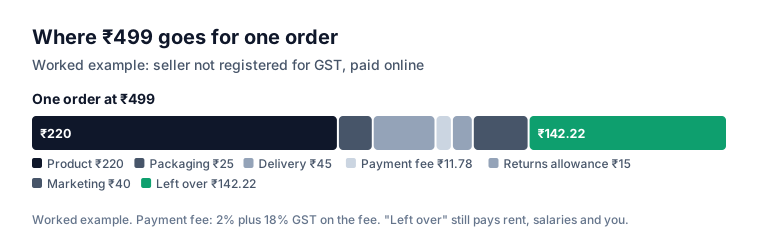
Here is a worked example of what goes into a ₹499 price for a seller who is not registered for GST:
| Item | Amount |
|---|---|
| Product | ₹220 |
| Packaging | ₹25 |
| Delivery | ₹45 |
| Payment fee (2% of ₹499 plus 18% GST on the fee) | ₹11.78 |
| Returns allowance | ₹15 |
| Marketing per order | ₹40 |
| Left over for fixed costs and profit | ₹142.22 |
For a clothing example, see the kurti breakdown in our guide to starting an online clothing business. On paper the "margin" over product cost looks like ₹279. After every cost, ₹142.22 is left, and rent and salaries still come out of that.
Step 2: Understand markup vs margin
These two words are often mixed up, and the mix-up costs money.
- Markup = (price − cost) ÷ cost
- Margin = (price − cost) ÷ price
Shopify's guide uses the same formulas (Shopify). For a product that costs ₹300:
| Selling price | Profit | Markup | Margin |
|---|---|---|---|
| ₹400 | ₹100 | 33.3% | 25% |
| ₹450 | ₹150 | 50% | 33.3% |
| ₹500 | ₹200 | 66.7% | 40% |
| ₹600 | ₹300 | 100% | 50% |
Mistake: Adding 40% to cost and thinking you have a 40% margin. ₹300 plus 40% is ₹420, which is a margin of only about 28.6%.
To hit a target margin, use: selling price = cost ÷ (1 − target margin). For ₹300 and a 40% margin: ₹300 ÷ 0.6 = ₹500. A markup calculator and a profit margin calculator do the arithmetic for you.
Step 3: Choose a pricing method
| Method | How it works | Use it when |
|---|---|---|
| Cost-plus | Full cost plus a fixed margin | You sell many similar products; you need a quick, safe price |
| Competitive | Price close to what others charge | Customers compare easily: groceries, branded goods |
| Value-based | Price by what the product is worth to the customer | Handmade, custom, premium or hard-to-find products |
Cost-plus pricing remains the most widespread pricing method, according to Utpal Dholakia writing in Harvard Business Review (HBR). It is simple and protects you from losses. But pricing only from cost can leave money on the table when customers would happily pay more, which is the case for value-based pricing (HBR).
A practical approach for a small business: use cost-plus to set the floor, then look at competitors and customer value to decide how far above the floor you can go.

Step 4: Check the price against the market
- Look at three to five competitors selling something similar, including delivery charges.
- Note what makes yours different: fresher, handmade, faster delivery, better packaging. Each is a reason to charge more.
- Ask a few regular customers what they would expect to pay.
- If you must be cheaper than everyone, check that the price still covers every cost in Step 1.
Step 5: Use price endings and bundles wisely
Prices ending in 9. In three field experiments, Anderson and Simester found that a price ending in 9 increased demand in all three experiments, and the increase was stronger for new items (Kellogg School). Results vary by product and customer, so test it.
Bundles and sizes. A 500 g and a 1 kg pack, or a "family pack", let customers choose and can raise the average order value. Make sure the larger pack still covers its own costs.
Free delivery thresholds. "Free delivery above ₹499" is a price decision too. Our guide on setting delivery charges shows how to choose the threshold. For discounts, see discount and coupon ideas, which shows how many extra sales a discount needs just to break even.
Step 6: Follow the price rules in India
| Rule | What it means for you |
|---|---|
| No sale above MRP | Under Legal Metrology rules, no retailer may sell a pre-packed product above its retail sale price. In September 2023, a consumer commission in Tumakuru held that a restaurant billing ₹20 bottles at ₹24.14 was an unfair trade practice (Bar & Bench) |
| MRP includes all taxes | MRP must be declared in rupees inclusive of all taxes, as restated in the 2021 amendment in force from 1 April 2022 (TaxGuru). Do not add GST on top of MRP |
| Total price shown online | Under the Consumer Protection (E-Commerce) Rules, 2020, sellers who own their inventory must show the total price in a single figure with a breakup of charges such as delivery (E-Commerce Rules) |
| No hidden charges at the end | The Central Consumer Protection Authority's Dark Patterns Guidelines, notified on 30 November 2023, name drip pricing as a dark pattern (SCC Online) |
If you are registered for GST, a GST calculator helps you show tax-inclusive prices correctly.
Step 7: Review prices regularly
Costs change. Review prices:
- Every three months, or when a supplier raises prices.
- When fuel or courier rates change, if delivery is built into the price.
- When a product sells out too fast (you may be too cheap) or barely sells (too expensive, or poorly shown).
A break-even calculator tells you how many orders a month you need to cover fixed costs at a given price.
Mistakes to avoid
Pricing from product cost only. Packaging, delivery, payment fees and returns come out of the same rupee.
Confusing markup and margin. A 40% markup is not a 40% margin.
Copying the cheapest competitor. They may be losing money, or have lower costs than you.
Adding charges at checkout. It drives people away and is named as a dark pattern.
Never raising prices. Review in small steps, so you are never forced into one large jump.
Your pricing checklist
- Full cost per order worked out, including packaging, delivery, payment fee, returns and marketing
- Target margin chosen; price = cost ÷ (1 − margin)
- Price checked against 3 to 5 competitors and what makes yours different
- No pre-packed product priced above MRP
- Total price and every charge shown before checkout
- Price endings and pack sizes tested
- Prices reviewed every three months
How Zepio helps
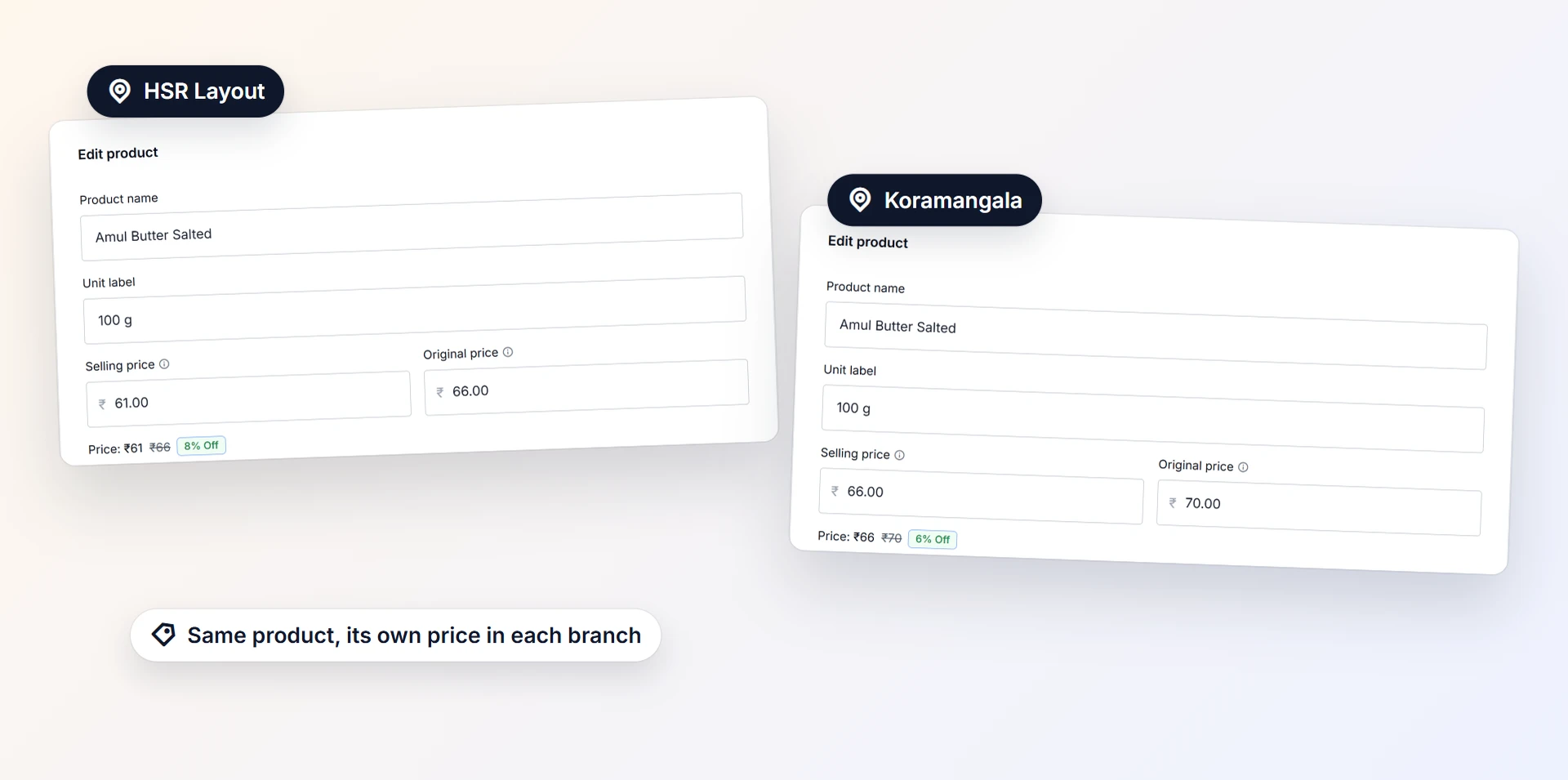
On Zepio you set prices per product and variant, and per branch if you have several outlets. Delivery charges, free delivery thresholds and other fees such as packaging or handling are shown to the customer before they pay, with cart-value bands you control. The discount engine lets you run offers with usage limits and schedules, so promotions do not quietly eat your margin. Reports show sales by item, so you can see which prices work.
Know your full cost, choose your margin, and check the market. Then price with confidence, and review it every few months.
Questions people ask
How do I calculate the selling price of a product?
What is the difference between markup and margin?
What is a good profit margin for a small business?
Can I sell above MRP?
Should my prices end in 9?
Sources
- Markup vs. Margin: What's the Difference?, Shopify
- When Cost-Plus Pricing Is a Good Idea, Harvard Business Review
- A Quick Guide to Value-Based Pricing, Harvard Business Review
- Effects of $9 price endings on retail sales: evidence from field experiments, Kellogg School of Management
- Consumer Protection (E-Commerce) Rules, 2020, LegitQuest (text of the rules)
- Key highlights: Legal Metrology (Packaged Commodities) Amendment Rules, 2021, TaxGuru
- Consumer commission fines restaurant for selling water and beverages above MRP, Bar & Bench
- CCPA notifies guidelines for prevention and regulation of dark patterns, 2023, SCC Online
Facts were checked against these sources on 22 Oct 2026. Rules and prices change: check the source before you rely on a figure. Read our editorial standards, or write to hi@zepio.io to report a mistake.