
On this page
The best discount and coupon ideas for a small business are targeted and limited: a first-order coupon for new customers, free delivery above a threshold to raise order value, bundles and gifts instead of price cuts, and win-back offers for customers who stopped ordering. Before any discount, work out how many extra sales it needs to pay for itself: at a 40% margin, a 10% discount needs 33% more units just to break even.
A discount lowers the price for some or all customers; a coupon is a code or link that unlocks it. Both can bring sales, and both can quietly eat your profit. This guide shows the maths, 12 offers that work for small businesses and the rules to follow in India.
First, the maths: what a discount really costs
A discount comes straight out of your margin. To earn the same rupee profit, you must sell more:
Extra units needed = discount ÷ (margin − discount)
With a 40% margin (after the product cost and other variable costs):
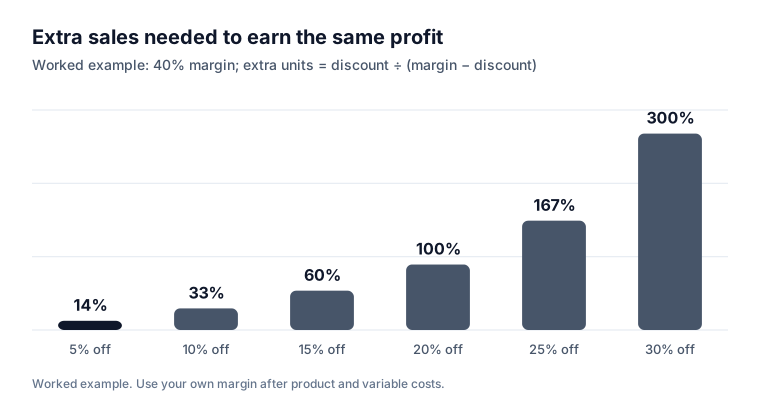
| Discount | Extra units needed to earn the same profit |
|---|---|
| 5% | 14% |
| 10% | 33% |
| 15% | 60% |
| 20% | 100% |
| 25% | 167% |
| 30% | 300% |
Example: A ₹1,000 item costs you ₹600, so you make ₹400. At 10% off, you make ₹300. If you used to sell 4 a day (₹1,600 profit), you now need ₹1,600 ÷ ₹300 = 5.33 sales a day to earn the same: one-third more.
A discount calculator and a profit margin calculator help with your own numbers. Our guide on pricing your products explains margins.
How customers see discounts
Research gives some useful guidance:
- Rupees or percent? A study in the Journal of Retailing (1998) found that a price cut framed in currency seemed more significant on a high-priced product, and framed in percent on a low-priced one. It also found coupons were evaluated more favourably than equivalent straight discounts (Journal of Retailing). On a ₹2,000 jacket, "₹300 off" sounds bigger than "15% off"; on a ₹100 snack, "20% off" sounds bigger than "₹20 off".
- The power of free. Research on the zero-price effect found that people perceive the benefits of free products as higher than the price difference alone would suggest (Marketing Science). "Free delivery" or "free gift" can beat a small percentage off.
- Extra costs drive people away. In Baymard's survey of US shoppers, extra costs such as shipping, tax and fees were the top reason for abandoning a checkout, at 40% (leaving out shoppers who were just browsing) (Baymard).
- Show the saving clearly. Baymard found 18% or more of sites make at least one mistake displaying discounts on the product page, including not highlighting the percent or amount off (Baymard).
12 discount and coupon ideas
To win new customers
1. First-order coupon. "WELCOME: ₹100 off your first order over ₹499." One use per customer, minimum order value set.
2. Referral reward. The friend gets a discount on the first order and the referrer gets credit after it is completed. See how to start a referral program.
3. App-install offer. Free delivery on the first app order. See how to get more app downloads.
To raise the order value
4. Free delivery threshold. "Free delivery above ₹499." It tackles extra costs, the top reason in Baymard's survey for abandoning checkout, and nudges the cart up. Our guide to setting delivery charges shows how to pick the number.
5. Gift with purchase. A small free item above an order value. Customers value free things highly, and it costs you the item, not a percentage of the whole cart.
6. Buy X get Y. "Buy 2 get 1 free" on items with good margins or that you need to clear.
7. Bundles. A fixed set at a slightly lower price than the items separately: kurta and dupatta, cake and candles.
To bring customers back
8. Win-back coupon. For customers who have not ordered in 60 or 90 days: "COMEBACK: free delivery on your next order."
9. Reward points. A small percentage back as points on every order, spent on the next. See getting repeat customers.
10. Birthday or anniversary offer. A personal coupon, valid for a week.
To move stock or fill quiet hours
11. Daily deal. One product at a special price until stock or time runs out, for real.
12. Quiet-day offer. A restaurant's Tuesday lunch offer or a store's weekday free delivery.
Make coupons easy to use
- Short, memorable codes: WELCOME, COMEBACK, FREEDEL, DIWALI26.
- Apply them automatically where you can. Baymard found that 83% of sites do not apply discounts and promo codes automatically, and its test users appreciated sites that applied valid discounts for them (Baymard).
- Show the saving next to the price and in the cart.
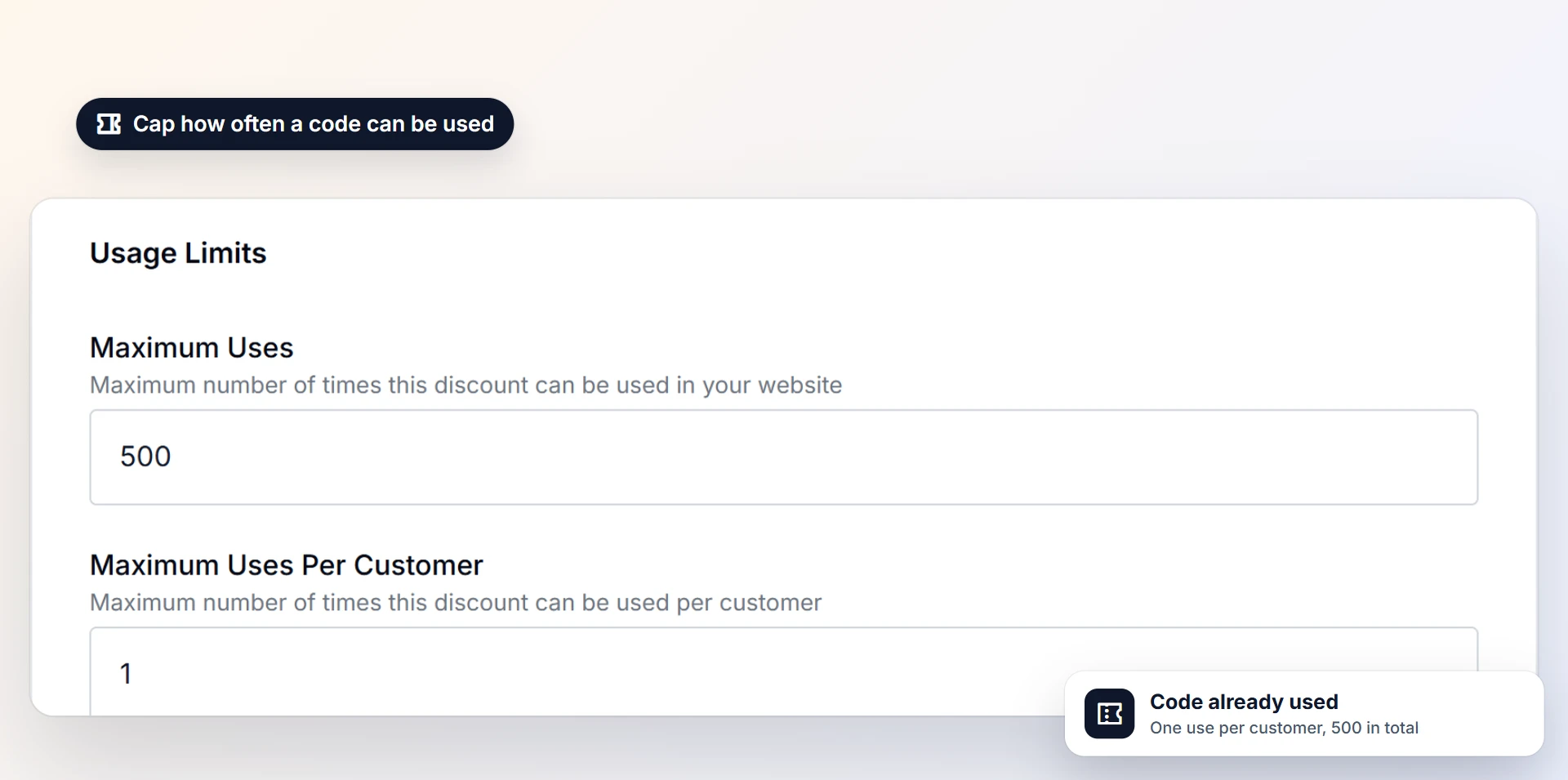
- Set limits: one use per customer, a minimum order, an end date.
- Track each code: orders, revenue and discount given.
Follow the rules in India
| Rule | What it means |
|---|---|
| "Free" must be free | The 2022 guidelines on misleading advertisements say goods cannot be described as free if the consumer has to pay anything other than the unavoidable cost of responding and of delivery, and advertisers must have enough supply to meet foreseeable demand (SCC Online). The ASCI Code says products shall not be described as free where there is any direct cost other than delivery, freight or postage, and any such cost must be clearly stated (ASCI) |
| No drip pricing | The Dark Patterns Guidelines (30 November 2023) name drip pricing, hiding parts of the price until the end (AZB & Partners) |
| No basket sneaking | Adding items or charges to the cart without consent is also listed (AZB & Partners) |
| No false urgency | Countdown timers and "only a few left" must be true |
| No fake "was" prices (good practice) | Show a crossed-out price only if you really sold at it |
Measure every offer
For each discount, note:
- Orders and revenue that used it.
- Total discount given.
- New customers it brought, and whether they ordered again.
- Average order value with and without it.
Drop offers that only give money to customers who would have bought anyway.
Mistakes to avoid
Discounting without the maths. A 20% discount at a 40% margin needs twice the sales to break even.
Site-wide sales all the time. Customers can learn to wait for the next one.
Unlimited coupons. Codes get shared on coupon sites; set limits.
"Free" with a catch. It breaks the rules and annoys customers.
Hiding the conditions. Show the minimum order and end date upfront.
Your discount checklist
- Break-even worked out for each discount percentage
- Each offer aimed at a group: new, regular, lapsed or a quiet time
- Free delivery threshold and gift-with-purchase considered before percentage cuts
- Short codes with per-customer limits, minimum order and end date
- Saving shown clearly on product, cart and checkout
- No fake "free", drip pricing, false urgency or fake "was" prices
- Orders, revenue and discount tracked per code
How Zepio helps
Zepio's discount engine has five types: amount off an order, buy X get Y, buy for an amount and get a product, free shipping, and product discounts. Each can have usage limits, per-customer limits and a schedule, and can be limited to certain variants or branches. Add daily deals that unlock deal prices at a cart value, scratch cards, cashback slabs, reward points and refer and earn from the same admin, on your own website and app, with 0% commission on your sales.
Discount with a purpose, put a limit on it, and measure it. That is how offers bring customers without giving away your profit.
Questions people ask
What discount should a small business offer?
Is it better to give a percentage or a rupee discount?
How do I calculate if a discount is worth it?
Can I call something 'free' in my offer?
What are good coupon code ideas?
Sources
- Cart abandonment rate statistics, Baymard Institute
- 10 sales UX best practices, Baymard Institute
- How to display price discounts on the product page, Baymard Institute
- The effects of framing price promotion messages on consumers' perceptions and purchase intentions, Journal of Retailing (University of Illinois record)
- Zero as a special price: the true value of free products, Marketing Science (Duke Scholars record)
- A new dawn for dark patterns, AZB & Partners
- Guidelines for prevention of misleading advertisements and endorsements, 2022, SCC Online
- The ASCI Code, Advertising Standards Council of India
Facts were checked against these sources on 22 Oct 2026. Rules and prices change: check the source before you rely on a figure. Read our editorial standards, or write to hi@zepio.io to report a mistake.