
On this page
- Is an online clothing business right for you?
- Step 1: Pick a niche
- Step 2: Decide how you will get your stock
- Step 3: Find suppliers and check quality
- Step 4: Register your business and follow the rules
- Step 5: Shoot photos and write size charts that sell
- Step 6: Price every piece for every cost
- Step 7: Choose where to sell
- Step 8: Plan shipping, returns and exchanges
- Step 9: Get your first 100 orders
- Mistakes new clothing sellers make
- Your launch checklist
- How Zepio helps
To start an online clothing business from home, pick a narrow niche, buy a small range from suppliers you have checked in person or by sample, register for GST before you ship to other states, and price every piece after shipping, payment fees and returns. Then shoot clear photos with a real size chart, sell from your own website, and let Instagram and WhatsApp bring customers to it.
An online clothing business is a business that sells garments to customers over the internet and delivers them by courier or its own delivery, instead of from a shop counter. This guide goes through each step in order, with the 2026 GST rates, a worked pricing example and the mistakes that cost new sellers the most.
Is an online clothing business right for you?
Clothing is one of the easiest things to start selling from home, because the stock is light, does not spoil and ships easily. It is also crowded, so the businesses that last usually do one thing better than everyone else: a fit, a fabric, a price point or a community.
It suits you if:
- You know a kind of customer well, such as working women who want cotton office wear, new mothers, or college students on a budget.
- You enjoy styling and photographing clothes, because photos sell clothing online.
- You can answer messages and pack orders every day, even when sales are slow.
It is harder if you want to carry every size, colour and style from day one. That ties up money in stock that may never sell.
Step 1: Pick a niche
A niche is the one customer and one kind of clothing you serve first. "Women's clothing" is not a niche. "Cotton kurtas for working women, sizes S to 3XL, under ₹1,500" is.

| Niche | Who buys | Watch out for |
|---|---|---|
| Ethnic wear (kurtas, sarees, sets) | Women buying for work, festivals and weddings | Seasonal peaks; stock up before festivals |
| Kidswear | Parents, often repeat buyers as children grow | Many sizes; soft, safe fabrics |
| Plus-size | Customers that mainstream brands underserve | Fit matters more than anywhere; test patterns |
| Modest or occasion wear | A specific community or event | Smaller audience, but loyal |
| Handloom and regional crafts | Buyers who value the story and the weave | Limited quantities; tell the maker's story |
| Basics (tees, loungewear) | Everyone | Hardest to stand out on price |
Pick the niche where you already understand the customer, or already have a source of good stock. You can widen it later.
Step 2: Decide how you will get your stock
There are four common ways to stock an online clothing business. Each has a different cost and risk.
| Model | How it works | Money needed up front | Risk |
|---|---|---|---|
| Buy wholesale and resell | Buy finished pieces from wholesalers or manufacturers | Medium | Unsold stock |
| Make your own designs | Design, buy fabric and get pieces stitched by a tailor or small unit | Medium to high | Fit and quality control |
| Made to order | Stitch each order after it is placed | Low | Slow delivery; harder to scale |
| Resell without holding stock | A supplier ships orders for you | Lowest | You do not control quality or delivery time |
A low-risk start is to buy small quantities wholesale, then add a few of your own designs once you know what sells.
Step 3: Find suppliers and check quality
Start close to home. Wholesale markets and manufacturers in your own city let you feel the fabric, check the stitching and agree on prices in person. Larger garment clusters also supply resellers; Tiruppur, for example, accounted for nearly 60% of India's knitwear exports in FY26, according to the Tiruppur Exporters Association, as reported by Construction World.
Before you place a bulk order:
- Order samples of every style you plan to sell, in at least two sizes.
- Wash one sample the way your customer will. Check shrinking, colour bleeding and pilling.
- Measure the samples against the supplier's size chart. Sizes differ between suppliers.
- Ask the minimum order quantity (MOQ) and whether sizes and colours can be mixed within it.
- Agree on what happens to defective pieces: replacement, credit or refund.
- Get a proper invoice with GST, so you can claim input tax credit once you are registered.
Tip: Keep two suppliers for your best sellers. When one runs out before a festival, the other keeps you selling.
Step 4: Register your business and follow the rules
You do not need a company to start. Many people begin as a sole proprietor with a current account in the business name. Two rules matter from day one.
GST. The GST law requires registration for anyone making inter-state taxable supplies, whatever their turnover. If you ship to customers in other states, register before your first sale. If you sell only within your state, registration is needed once you cross your state's turnover limit. Selling through a marketplace that collects tax at source also needs registration under the same section; ask your accountant about the exceptions for sellers within one state.
The rates on readymade garments changed on 22 September 2025:
| Value of one piece, before GST | GST rate |
|---|---|
| Up to ₹2,500 | 5% (PIB) |
| Above ₹2,500 | 18% (Lok Sabha reply, via TaxGuru) |
The limit applies to each piece's value before GST. A lehenga worth ₹3,000 before tax carries 18% even if it is the only item in the order. Ask an accountant to set up your invoices and returns from the start.
Online selling rules. The Consumer Protection (E-Commerce) Rules, 2020 expect an online seller to show clear details to customers, including:
- Your legal name and address, and how to contact you.
- A grievance officer and how complaints are handled.
- Your return, refund and exchange policy, and delivery terms.
A return policy generator and a shipping policy generator give you drafts to adapt and have checked.
Step 5: Shoot photos and write size charts that sell
Customers cannot touch the fabric, so your photos and size chart do the work of a trial room.
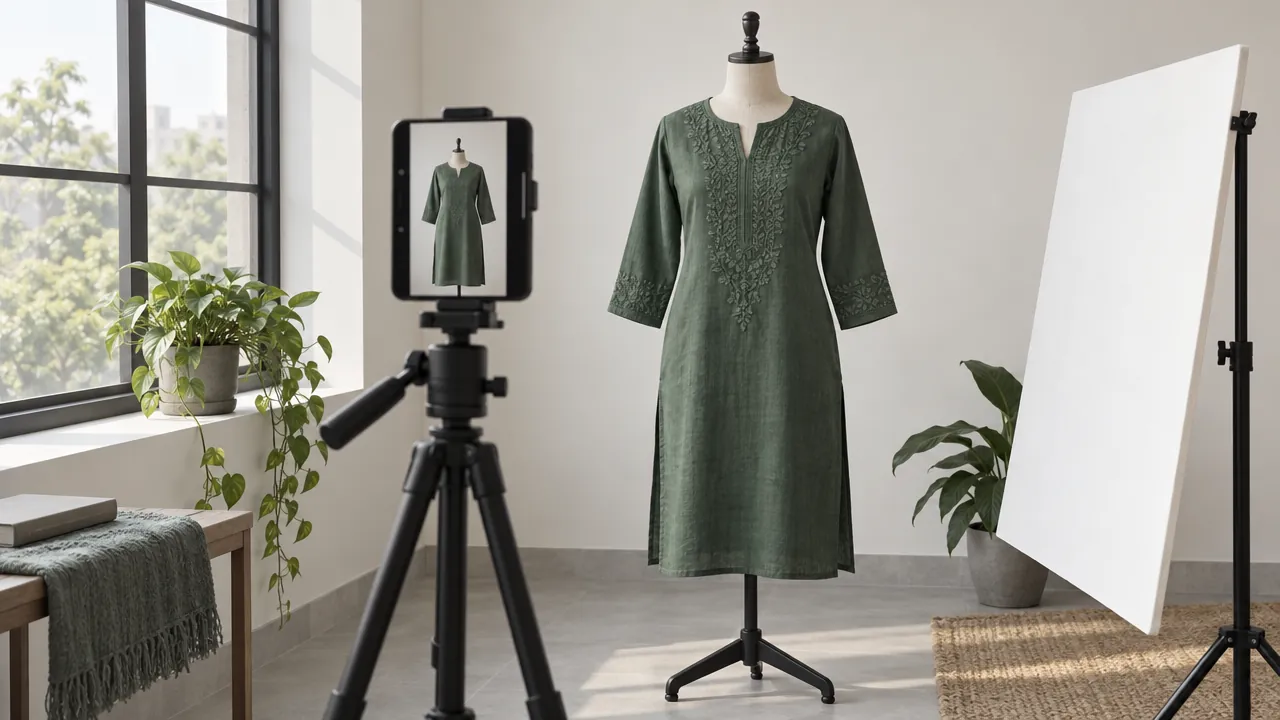
Photos:
- Shoot in daylight near a window, against a plain wall.
- Show every colour separately, so the customer sees the exact shade they will receive.
- Take four or five photos per piece: front, back, a close-up of the fabric and stitching, and the piece worn or on a dress form.
- Add a short video of the fabric moving if you can. It answers "how does it fall?"
Size charts:
- Give garment measurements (chest, waist, length) in inches and centimetres, measured on your own stock.
- Say how the piece fits: relaxed, regular or fitted.
- State the model's height and the size they wear in each photo.
Warning: Never copy a size chart from a supplier's catalogue without measuring. A chart that does not match the garment is a return waiting to happen.
Step 6: Price every piece for every cost
Online clothing has costs a shop does not: shipping, payment fees and returns. Price each piece after all of them.
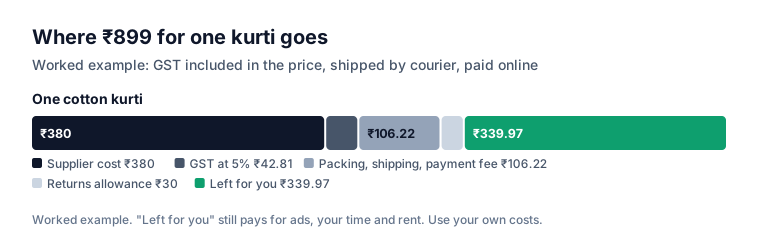
| Worked example: one cotton kurti | Amount |
|---|---|
| Selling price, including GST | ₹899.00 |
| GST at 5% included in the price (₹899 × 5 ÷ 105) | ₹42.81 |
| Cost from the supplier | ₹380.00 |
| Packaging (mailer bag, tag, thank-you card) | ₹20.00 |
| Shipping to the customer (an assumption; use your courier rate) | ₹65.00 |
| Payment gateway fee (2% plus 18% GST, Razorpay's standard rate) | ₹21.22 |
| Allowance for returns and exchanges (an assumption) | ₹30.00 |
| Left for ads, your time and profit | ₹339.97 |
This is a worked example; use your own numbers. The GST line is what you collect on the sale; your accountant will offset the GST you paid on purchases against it.
Three rules help:
- Never price on cost alone. Cost plus a fixed margin forgets shipping and returns.
- Keep prices just under round numbers that matter to your customer, such as ₹999 rather than ₹1,050.
- Watch the ₹2,500 line. The limit is on each piece's value before GST: a piece worth ₹2,600 before tax carries 18% instead of 5%. Make sure the price works at that rate.
A profit margin calculator and a GST calculator help you test prices.
Step 7: Choose where to sell
You can sell in more than one place. Each does a different job.
| Where | What it is good for | What to watch |
|---|---|---|
| Your own website and app | Repeat customers, your brand, full margin, customer details | You bring the visitors |
| Showing new arrivals, reels of the fabric, building a following | Orders in DMs get lost; send people to your website | |
| Talking to regulars, sharing new stock with people who opted in | Typing every order by hand does not scale | |
| Marketplaces | Shoppers who are already searching | Commission and fees set by each marketplace; the customer belongs to the marketplace |
Use Instagram and WhatsApp to show your clothes and talk to people, and send them to your own website to order. Every order on your own website keeps the full sale and the customer's details, which is how you reach them again. Our guide on creating a website for a small business covers the options.
Step 8: Plan shipping, returns and exchanges
Shipping and returns decide whether a clothing customer orders again.
Shipping. You can ship through a courier aggregator or a courier's own account, or deliver locally yourself. Our guide on shipping products across India covers rates, zones, packaging and courier choice.
Exchanges first. When a customer returns clothing for the wrong size, an exchange keeps the sale; a refund loses it.
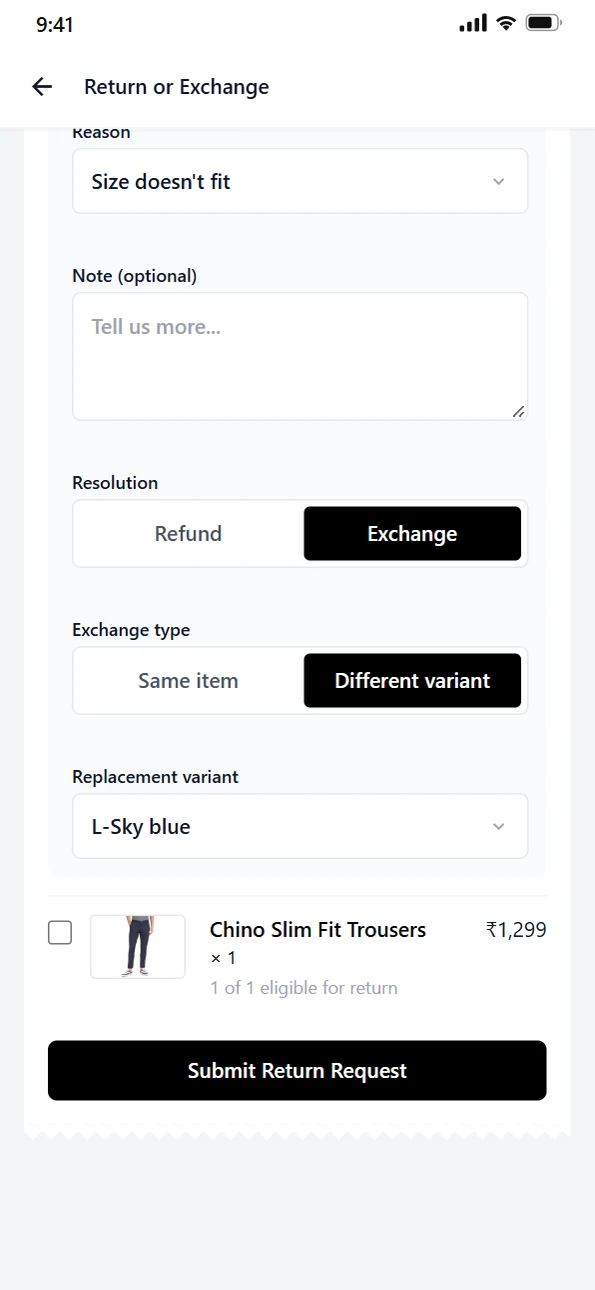
Set clear rules:
- A return window, such as 7 days from delivery.
- Condition: unworn, unwashed, with tags.
- What is not returnable, such as innerwear or customised pieces, stated before purchase.
- Who pays return shipping, and whether exchanges ship free.
Cash on delivery. Many customers still want to pay cash on delivery, and refused clothing orders are expensive. Our guide on reducing fake cash on delivery orders explains confirmation messages, part payment and limits.
Step 9: Get your first 100 orders
- Tell everyone you know, with a link to your website, not just photos.
- Post new arrivals as reels: the fabric moving, a quick try-on, the details up close.
- Ask your first customers for a photo wearing the piece, with their permission, and share it.
- Offer a small first-order discount on your website, not a deep sale that sets the wrong price in people's minds.
- Follow up after delivery: ask if the fit was right. The answers improve your size chart.
- Restock your best sellers fast, and drop what does not move after a few weeks.
Keeping those first customers matters as much as finding them; our guide on getting repeat customers covers reward points, reminders and reorders.
Mistakes new clothing sellers make
Buying too much stock too early. Start with a few styles in small quantities and restock what sells.
Copying the supplier's photos. Every other reseller uses them too. Shoot your own.
No real size chart. A wrong size is a return you could have prevented.
Pricing without shipping and returns. A piece that looks profitable can lose money after both.
Forgetting the ₹2,500 GST line. A piece just over it carries 18% instead of 5%.
Taking every order in Instagram DMs. Orders, payments and sizes get lost. Send people to your website.
Your launch checklist
- One niche and one customer chosen
- Samples ordered, washed and measured; two suppliers for best sellers
- GST registration done if you ship to other states
- Contact details, grievance officer and return, refund and exchange policy published
- Your own photos for every colour, and a measured size chart for every style
- Every piece priced after GST, shipping, payment fees and a returns allowance
- Website live, with Instagram and WhatsApp pointing to it
- A courier set up, and an exchange process ready
- A plan to restock best sellers and drop slow ones
How Zepio helps
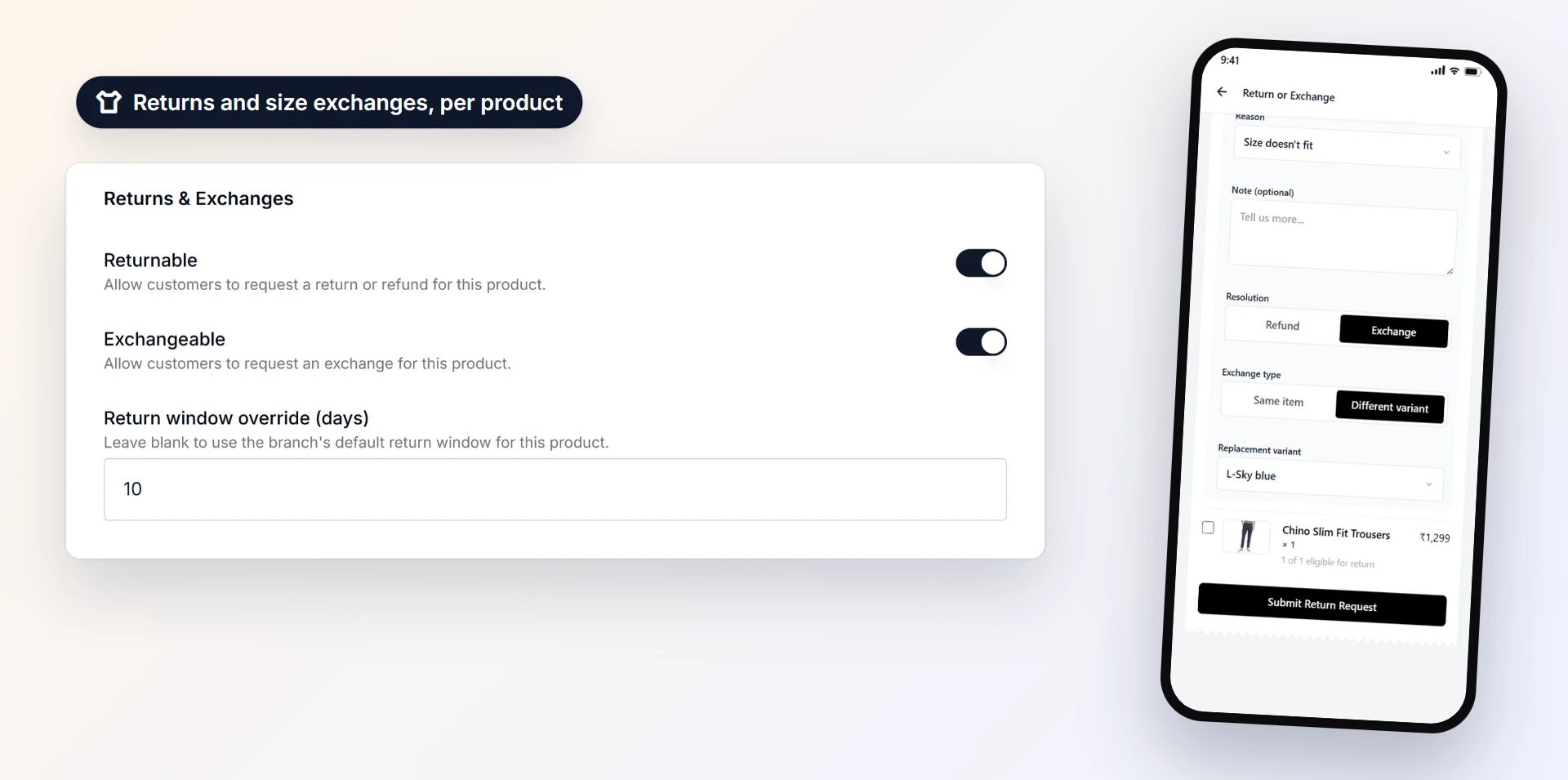
With Zepio you get your own clothing website and Android app with sizes and colours as variants and separate photos for each colour. Customers can ask to exchange for a different size, you set a return window per product, and you book couriers from the order screen.
Start with a small range you believe in, photograph it honestly, and let the customers who love the fit tell you what to stock next.
Questions people ask
Can I start an online clothing business from home with little money?
Do I need GST registration to sell clothes online?
What is the GST rate on clothes in India?
Where can I buy clothes wholesale to sell online?
How do I reduce returns in an online clothing business?
Should I sell on marketplaces or on my own website?
Sources
- GST reforms in textiles, apparel and logistics (17 September 2025), Press Information Bureau, Government of India
- GST on garments above ₹2,500 raised to 18% (Lok Sabha reply), TaxGuru
- CGST Act, section 24: compulsory registration in certain cases, CBIC
- Consumer Protection (E-Commerce) Rules, 2020 (Gazette copy), PRS Legislative Research
- Tiruppur posts record ₹460 bn exports in FY26, Construction World
- Razorpay pricing, Razorpay
Facts were checked against these sources on 20 Oct 2026. Rules and prices change: check the source before you rely on a figure. Read our editorial standards, or write to hi@zepio.io to report a mistake.