
On this page
- Do you need your own delivery team?
- Step 1: Work out how many people you need
- Step 2: Find the right people
- Step 3: Choose a pay model that matches your delivery fees
- Step 4: Add incentives for the hours that matter
- Step 5: Handle cash carefully
- Step 6: Train for the first week
- Step 7: Run the daily routine
- Step 8: Track a few numbers every week
- Rules, insurance and records
- Mistakes to avoid
- Your delivery team checklist
- How Zepio helps
To hire and manage delivery staff, find people through local referrals, check their licence, vehicle papers and ID, pay in a way that matches how you charge customers, add incentives for peak hours, cap and settle cash every shift, and track a few numbers every week: deliveries per hour, on-time rate and cash differences. Start with a few people for your busiest hours and grow the team with your orders.
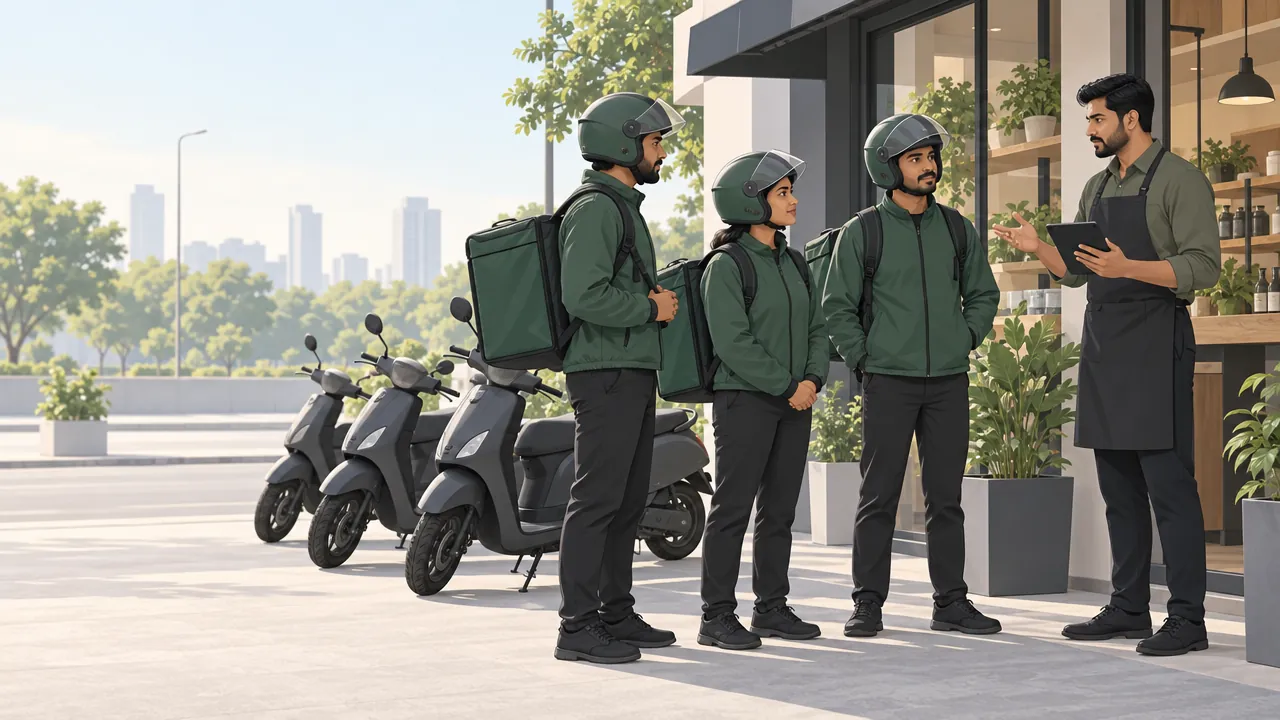
Delivery staff (often called delivery boys or delivery partners) are the people who take orders from your shop to your customers on two-wheelers or bicycles, employed by you or working with you per order. This guide covers hiring, pay models with worked numbers, cash handling, daily routines and the rules to check, for any local business that runs its own deliveries.
Do you need your own delivery team?
Your own team makes sense when deliveries are local and frequent:
| Situation | Better choice |
|---|---|
| Many orders a day within a few kilometres | Your own delivery team |
| Food, groceries, meat or medicines that must arrive within an hour | Your own delivery team |
| A few local orders a day | A local delivery service, booked per order |
| Orders to other cities | A courier (how to ship across India) |
Your own team gives you control over speed, how your customers are treated and the cash collected. It also makes you responsible for hiring, pay, safety and cash.
Step 1: Work out how many people you need
Look at your orders by hour for two weeks. Many local businesses have peaks, such as morning for groceries and milk and evening for food.
- Count orders in your busiest hour.
- Measure how many deliveries one person completes in an hour in your area, including the trip back.
- Divide. If your peak hour has 12 orders and one person completes 3 an hour, you need 4 people at that hour.
- Cover quieter hours with fewer people, or with staff who also pack orders.
Start slightly short rather than overstaffed, and add people as orders grow.
Step 2: Find the right people

- Referrals from your current staff, regular customers and nearby shops come with someone who can vouch for them.
- Local job portals and community groups for wider reach.
- A notice at your counter: customers often know someone looking for work.
What to check before hiring:
- Driving licence, valid for the vehicle they will ride.
- Vehicle registration and insurance, if they use their own two-wheeler.
- ID and address proof, and a phone number that works.
- A bank account in their own name for payouts.
- A reference from a previous job, if possible.
Keep copies of every document. Before the first shift, take a short ride together around your delivery area.
Step 3: Choose a pay model that matches your delivery fees
How you pay your delivery staff should follow how you charge customers, or your margins drift. Our guide on setting delivery charges explains the customer side.
The common pay models, with worked numbers for three trip distances:
| Pay model | 2 km trip | 5 km trip | 8 km trip | Suits |
|---|---|---|---|---|
| Fixed amount per delivery (₹35) | ₹35 | ₹35 | ₹35 | Small areas with a flat delivery fee |
| Per kilometre (₹7 a km, one way) | ₹14 | ₹35 | ₹56 | Customers spread out; distance-based fees |
| Base plus distance (₹25 for the first 3 km, ₹6 a km after) | ₹25 | ₹37 | ₹55 | Mixed short and long trips; fair on both |
| A share of the delivery fee (80% of a ₹20 / ₹40 / ₹60 fee) | ₹16 | ₹32 | ₹48 | Pay that rises and falls with what customers pay |
These are worked examples, not market rates; pay in your city may be higher or lower.
Fixed salary suits businesses with steady orders all day and fixed shifts, or staff who also pack and serve at the counter. A common middle ground is a small base plus per-delivery pay, so earnings rise with orders but there is a floor.
Step 4: Add incentives for the hours that matter
Incentives help you fill peak hours and keep good people without raising every delivery's pay.
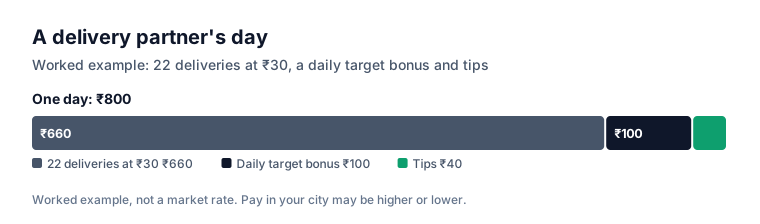
- Daily target bonus: an extra amount for reaching a set number of deliveries, such as ₹100 for 20.
- Peak-hour bonus: a little more per delivery during lunch, dinner or rain.
- Weekly attendance bonus: for working all scheduled shifts.
- Monthly loyalty bonus: for staying with you, since training new people costs time.
- Tips: let customers tip in the app, and pass tips on in full or at a share you state clearly.
Tip: Write every incentive down in one place, with the exact rule. Disputes start when people remember the rule differently.
Step 5: Handle cash carefully
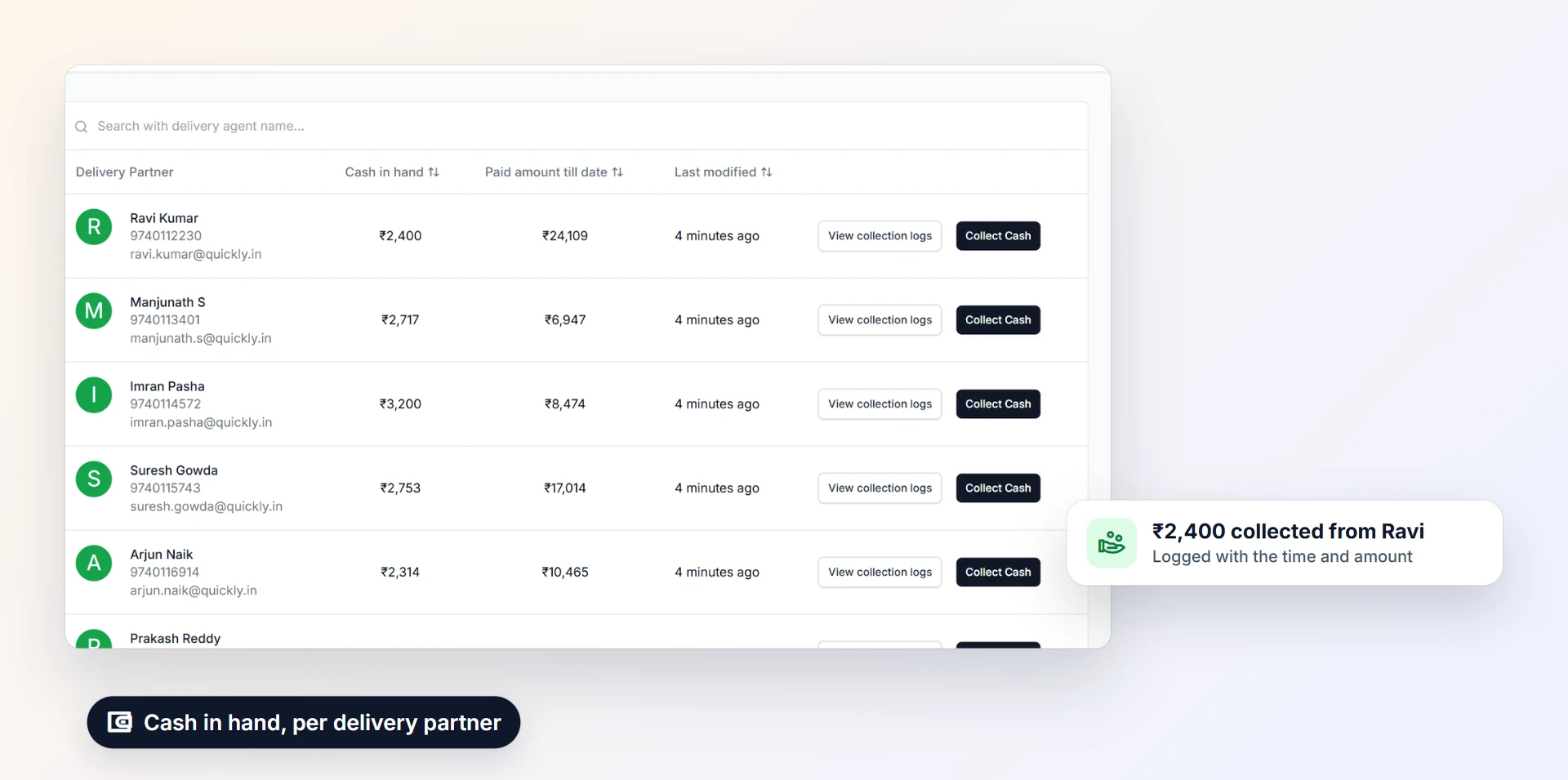
Cash on delivery means your staff carry your money. A clear routine protects both of you.
- Record every cash collection against its order, in the delivery app, not on paper.
- Cap the cash one person can carry, such as ₹5,000, after which they settle before taking more cash orders.
- Settle at the end of every shift, counting cash against the record together.
- Accept UPI at the door, with a QR code on the invoice, so customers without change can pay and less cash changes hands.
- Allow partial deposits when someone has to settle mid-shift.
Our guide on reducing fake cash on delivery orders covers how to cut refused cash orders too.
Step 6: Train for the first week
A short induction prevents many early problems:
- The delivery app: accepting orders, navigation, marking picked up and delivered.
- Delivery OTP: always ask for it before handing over, so an "I never got it" dispute is easy to settle.
- Cash and UPI: recording, change, and what to do if a customer refuses to pay.
- Handling the order: insulated bags for food, keeping meat and fish separate, upright cakes.
- Talking to customers: a call before arriving at a hard-to-find address, politeness at the door.
- Safety: a helmet on every trip, no phone use while riding, and permission to delay in heavy rain.
Warning: Never pressure delivery staff to meet an unrealistic delivery time. Promise customers a time your team can meet safely, and adjust it when orders pile up.
Step 7: Run the daily routine
- Shifts and breaks planned around your peaks, published a week ahead.
- Online and offline status in the delivery app, so you only send orders to people who are working.
- Orders assigned automatically to the nearest free person, with a manager who can reassign.
- A limit on orders per trip, so food stays hot and deliveries stay on time.
- Group orders going the same way, so one trip carries several orders.
- A live map of where everyone is during the rush.
Step 8: Track a few numbers every week
| Number | What it tells you |
|---|---|
| Deliveries per person per hour | Whether you have too many or too few people at each hour |
| On-time rate | Whether your promised delivery times are realistic |
| Cancelled or failed deliveries | Address, contact or cash on delivery problems to fix |
| Customer complaints and ratings | How each person treats your customers |
| Cash differences at settlement | Whether the cash routine is working |
| People who left | Whether pay or incentives need a look |
Talk to your team about these numbers every week, and recognise the people who do well.
Rules, insurance and records
Labour codes. India's four labour codes, on wages, industrial relations, social security and working conditions, took effect on 21 November 2025, replacing 29 central labour laws (EY). They also allow welfare schemes for gig and platform workers. The central government notified its rules under the codes on 8 May 2026 (EY). Ten states had published their own rules by 24 September 2026, and the Centre expects the rest by 31 October 2026 (Business Standard), so ask an accountant or labour consultant which rules apply in your state.
Registration. Unorganised workers, including gig and platform workers, can register on the government's e-Shram portal. Encourage your staff to do so.
Insurance. Consider accident insurance for everyone who rides for you, and check that each vehicle used for deliveries is insured.
Records. Keep documents, pay records, incentive rules and cash settlements for every person.
Mistakes to avoid
Hiring without checking documents. A missing licence or insurance becomes your problem after an accident.
Pay that does not match your delivery fees. Paying per kilometre while charging a flat fee loses money on long trips.
Cash with no cap and no daily settlement. Small differences become large ones.
Unwritten incentive rules. They cause disputes and resignations.
Promising delivery times your team cannot meet safely. It puts people at risk and disappoints customers.
No way to see who is working. Orders go to people who are on a break.
Your delivery team checklist
- Peak-hour orders counted, and team size worked out
- Licence, vehicle papers, ID, address proof and bank details checked and copied
- A pay model that matches your delivery fees, written down
- Incentives for targets, peak hours, attendance and loyalty, written down
- Tips passed on as stated
- A cash cap, every collection recorded, settlement every shift
- A first-week induction: app, OTP, cash, handling, customers, safety
- Shifts, online status, automatic assignment and a live map
- Weekly review of deliveries per hour, on-time rate, complaints and cash
- Labour code and insurance questions checked with an adviser
How Zepio helps
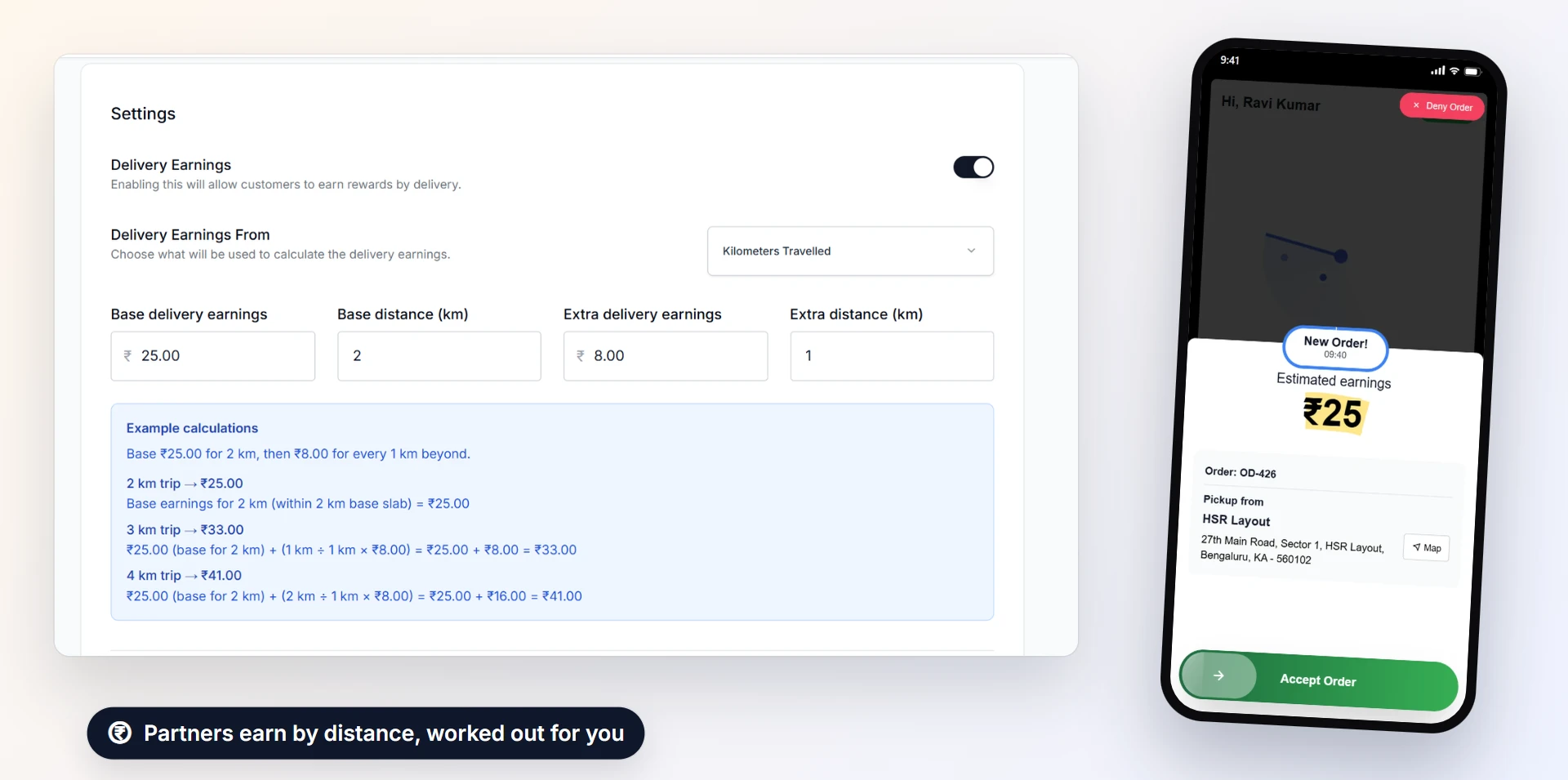
Zepio includes a delivery app for your team with full-screen order alerts, navigation and delivery OTP, plus automatic assignment of orders in waves, weighing each person's distance, current orders and idle time, with limits on orders and cash per person. You set earnings per delivery, per kilometre, base plus distance or as a share of the delivery fee, add daily, weekly and monthly incentives and tips, and see every rupee of cash collected and settled, with a live map of your whole team.
Hire carefully, pay clearly, settle cash every day and look after your team's safety. The person at the door is the part of your business many customers meet.
Questions people ask
How much should I pay a delivery boy per order?
Should delivery staff be on salary or paid per order?
What documents should I check before hiring delivery staff?
How do I stop cash going missing on delivery?
How many deliveries can one person do in an hour?
Do labour laws apply to my delivery staff?
Sources
- New labour codes implemented across the country effective 21 November 2025, EY India (alert)
- Final rules published by central government under new labour codes (May 2026), EY India (alert)
- Expects states, UTs to notify labour code rules by October 31: Centre, Business Standard
- e-Shram: national database of unorganised workers, Ministry of Labour and Employment
Facts were checked against these sources on 20 Oct 2026. Rules and prices change: check the source before you rely on a figure. Read our editorial standards, or write to hi@zepio.io to report a mistake.