

On this page
- Why milk delivery can work
- Step 1: Choose your model
- Step 2: Get the rules right
- Step 3: Keep milk cold, all the way
- Step 4: Price for a thin-margin product
- Step 5: Build dense morning routes
- Step 6: Handle accounts and payments
- Step 7: Win customers
- Mistakes to avoid
- Your milk delivery checklist
- How Zepio helps
To start a milk delivery business, source milk from a reliable dairy, co-operative or farm with testing, keep it at 4°C or colder from collection to doorstep, get FSSAI registration, and deliver on fixed early-morning routes to households who order every day. Add curd, paneer, ghee and eggs to the same delivery, because milk alone can earn thin margins.
A milk delivery business delivers fresh milk to homes every morning, usually on a monthly account, and often other dairy products along with it. This guide covers sourcing, the cold chain, the rules, pricing and how to run a profitable route.
Why milk delivery can work
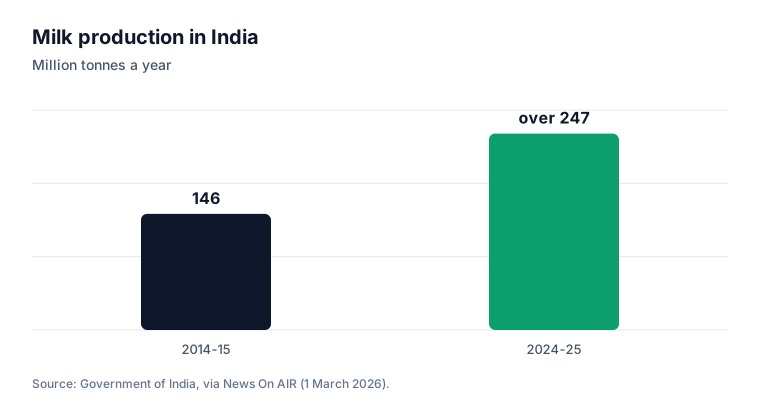
India produces a lot of milk. The government says production rose from 146 million tonnes in 2014-15 to over 247 million tonnes in 2024-25, and per-person availability was 485 grams a day in 2024-25 (News On AIR).
The opportunity is not supply. It is reliability: milk at the door before 7 am, every day, fresh and correctly billed.
Step 1: Choose your model
| Model | How it works | Watch out for |
|---|---|---|
| Resell branded packet milk | Buy from a dairy's distributor; deliver packets | Thin margin; the dairy sets the price |
| Your own brand from a dairy or co-operative | Buy bulk milk, pasteurise and pack (or get it packed) | Needs a processing facility, and FSSAI's hygiene, safety and testing rules for dairy manufacturers apply in full |
| Farm-fresh from your own animals or partner farms | Collect, chill, test, deliver in bottles | Testing, chilling and hygiene are your responsibility |
| Dairy distributorship | Official distributor for a brand in an area | Apply only through official channels |
Warning: Fake "dairy franchise" and distributorship websites have taken registration fees of ₹25,000 to ₹5 lakh from applicants. Amul sent legal notices to Google India and GoDaddy over such sites in 2019 (MediaNama). Apply only through the dairy's official website or office.
Step 2: Get the rules right
FSSAI. Milk sellers need FSSAI registration or a licence by turnover. From 1 April 2026, basic registration covers turnover up to ₹1.5 crore (FSSAI). FSSAI's FAQs say businesses making dairy products must continue complying with hygiene, safety and testing requirements under the new limits (FSSAI). If you process or pack milk, check on FoSCoS which category applies; the 2026 order replaces earlier turnover criteria. See FSSAI registration for a home food business.
Milk standards. FSSAI sets minimum fat and solids-not-fat (SNF) for each type of milk. Down To Earth reported in 2017 that FSSAI set a uniform national minimum for cow milk of 3.2% fat and 8.3% SNF (Down To Earth). Test what you sell, and label it honestly (full cream, toned, cow, buffalo).
GST. From 22 September 2025:
| Product | GST |
|---|---|
| Fresh and pasteurised milk, UHT milk | Exempt (GST Council FAQ) |
| Paneer | Exempt (Maharashtra notification) |
| Curd, lassi, buttermilk | Exempt only when not pre-packaged and labelled (Maharashtra notification) |
| Ghee and butter | 5%, down from 12% (GST Council) |
| Steel or aluminium milk cans you buy | 5%, down from 12% (GST Council) |
If you sell only exempt items such as fresh milk and paneer, you do not need GST registration; once you add taxable items such as ghee or packed curd, the turnover threshold applies; see how to sell online without GST and ask your accountant.
Step 3: Keep milk cold, all the way
Milk is highly perishable. NDDB says raw milk stays in good condition at normal temperatures only for a few hours after milking, bulk coolers hold milk at 4°C or colder for no more than 48 hours, and pasteurised milk has a shelf life of about 2 days when stored and transported refrigerated (NDDB). FSSAI's draft hygiene requirements, put into operation by a 2022 direction while they await final notification, say refrigerated products should be transported and stored at 5°C or less (FSSAI).
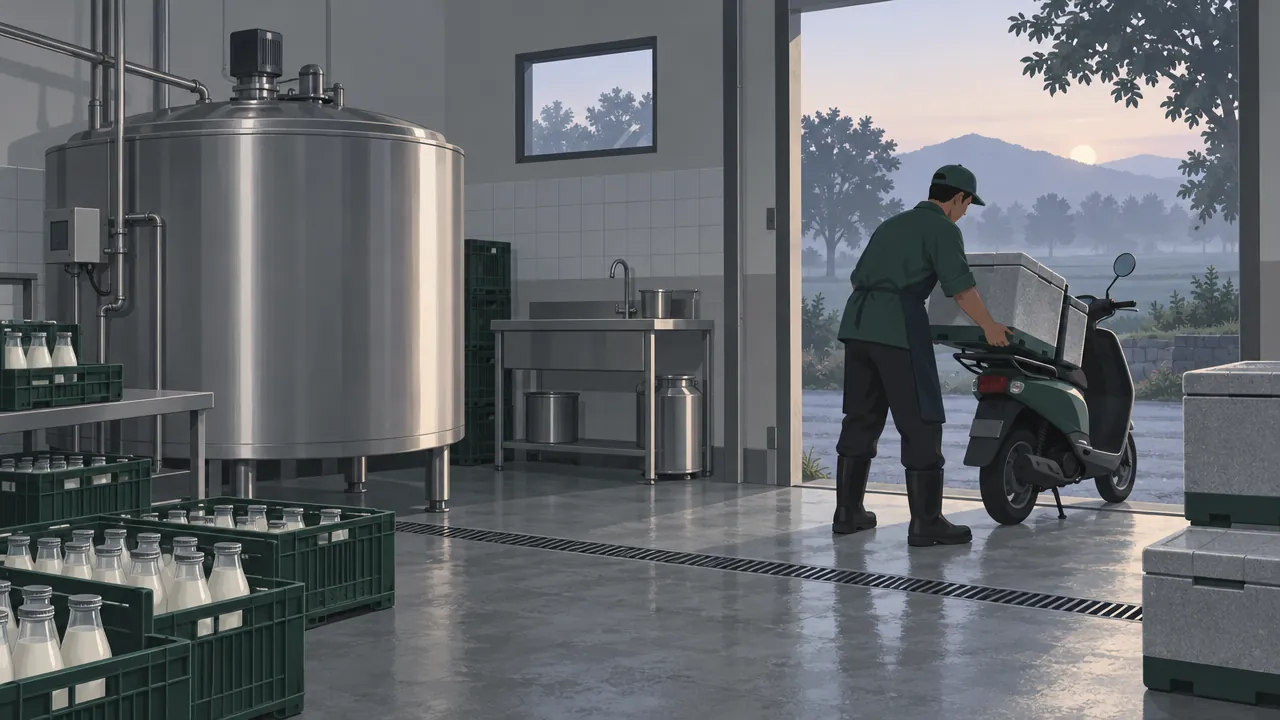
| Stage | What to do |
|---|---|
| Collection | Chill immediately; do not leave cans in the sun |
| Storage | A cooler or deep fridge at 4°C or below |
| Loading | Load just before leaving; insulated crates with ice packs |
| Delivery | Early morning; leave at the door only if the customer collects quickly |
| Returns | Never resell milk that came back warm |
Step 4: Price for a thin-margin product
Milk margins can be thin, so much of the money is in route density and add-ons.
- Price per litre or per packet, clearly shown, with the same price all month.
- A monthly bill or prepaid wallet, so you are not collecting cash every morning.
- Delivery included in the price for daily customers; a charge for one-off orders.
- Add-ons: curd, paneer, ghee, butter, eggs and bread on the same route raise the monthly bill without adding stops.
Our guide on pricing your products shows how to include delivery and payment costs.
Step 5: Build dense morning routes
A milk round is the same route every day, so planning it well pays off every morning.
- Start in one area, such as two or three apartment complexes, before expanding.
- Fixed delivery window: for example, "by 7 am".
- One route per delivery partner, ordered to avoid doubling back; see how to plan delivery routes.
- A daily delivery list with quantities, skips ("no milk on Sunday") and extra items.
- Holidays and pauses: let customers pause for travel with a day's notice.
Your delivery cost per household falls as more homes on the same street order. Ten homes in one building are cheaper to serve than ten homes in ten buildings.
Step 6: Handle accounts and payments
- Monthly billing: send each customer their deliveries and the total at month end.
- Prepaid balance: customers pay in advance and each delivery is deducted. Fewer unpaid bills.
- Online payment by UPI so you are not chasing cash. Our guide to accepting online payments compares options.
Step 7: Win customers
- Free trial week for one apartment complex.
- Sample bottles at the society gate on a Sunday morning.
- Apartment WhatsApp groups with your price and delivery time.
- Referrals: a free litre for each new household referred.
- Quality you can show: share your testing routine and where your milk comes from.
Our related guides on fruit and vegetable delivery and grocery delivery show how to add more daily essentials to the same morning route.
Mistakes to avoid
Spreading too thin. Customers across the whole city make every morning a long drive.
Weak cold chain. One batch of sour milk loses customers who were with you for months.
Cash collection every day. Use monthly bills or a prepaid wallet.
Unclear milk types. Label fat content and type honestly.
Paying for a "franchise" online. Go to the dairy's official office.
Your milk delivery checklist
- Model chosen: reseller, own brand, farm-fresh or official distributor
- FSSAI registration or licence in the right category
- Milk tested; type and fat content labelled honestly
- Cooler at 4°C or below; insulated crates and ice packs
- Prices per litre or packet fixed for the month
- Dense routes in one area, a fixed delivery window and a daily delivery list
- Monthly billing or prepaid wallet; UPI payments
- Curd, paneer, ghee and eggs added to the same route
How Zepio helps
With Zepio you sell milk and dairy products from your own website and app, with 0% commission on your sales. Customers can pay from a prepaid wallet that you credit when they pay in advance, and reorder from an Order again page, and you can show products by unit and quantity. Set delivery zones by pincode or map, run deliveries with your own team on the Zepio delivery app, and group the morning's orders into trips with the route optimiser on the Scale plan and above.
Cold milk, on time, every morning, billed correctly. Get that right and households stay with you for years.
Questions people ask
Is milk delivery a profitable business?
Do I need FSSAI registration to sell milk?
Is there GST on milk?
How cold should milk be kept during delivery?
Can I get an Amul or other dairy franchise?
Sources
- India consistently retained its top position globally in milk production, News On AIR (Prasar Bharati)
- Milkipedia, National Dairy Development Board
- FAQs on the decisions of the 56th GST Council, GST Council
- Recommendations of the 56th meeting of the GST Council, PIB / GST Council
- Notification No. 10/2025-State Tax (Rate), Government of Maharashtra
- FAQs on FSS (Licensing and Registration of Food Businesses) Amendment Regulations, 2026, FSSAI
- Order: Implementation of revised turnover threshold for food businesses (13 March 2026), FSSAI
- Direction under Section 16(5) on licensing and registration (2022), FSSAI
- Cow milk standard changed: lesser fat and solids now acceptable, Down To Earth
- Amul sues Google, GoDaddy for fraud, MediaNama
Facts were checked against these sources on 22 Oct 2026. Rules and prices change: check the source before you rely on a figure. Read our editorial standards, or write to hi@zepio.io to report a mistake.