
On this page
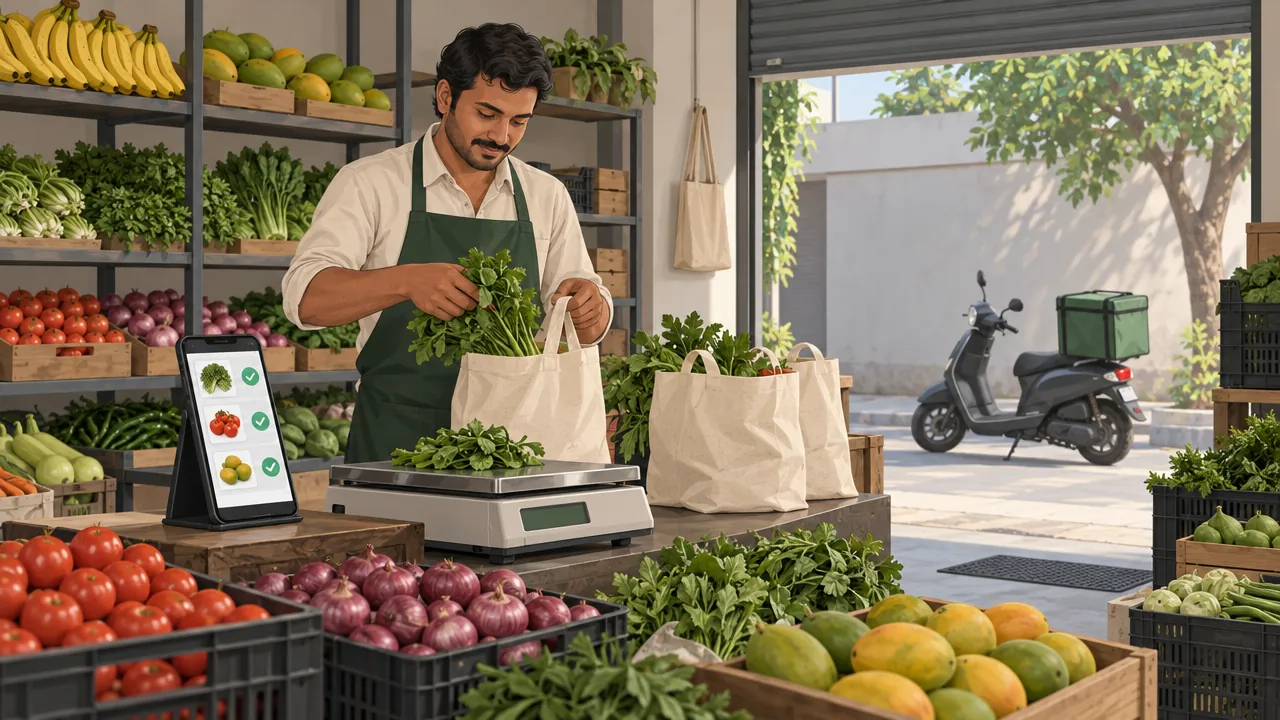
To start a fruit and vegetable delivery business, buy early at the mandi or from farmers, sell the same day, price in an allowance for wastage, and deliver in fixed morning or evening slots within a small area. Get FSSAI registration, use honest photos, and keep the range focused on what your neighbourhood buys every day.
A fruit and vegetable delivery business takes orders for fresh produce online or by phone and delivers to homes, usually the same day. It is different from a full grocery delivery business: your stock spoils in days, not months, so buying, storage and wastage decide whether you make money.
Step 1: Choose your area and customers
Start with one neighbourhood you can deliver to within 30 to 45 minutes. Dense apartment complexes are ideal: many orders, few stops.
| Customer | What they want |
|---|---|
| Families in apartments | Daily or alternate-day basics: onions, tomatoes, potatoes, greens, bananas |
| Working couples | A weekly box delivered on Sunday |
| Restaurants and tiffin services | Bulk, early morning, same items daily |
| Health-conscious buyers | Exotic vegetables, cut fruit, organic (only if certified) |
Step 2: Get the rules right
| Rule | What it says |
|---|---|
| FSSAI registration | Fruit and vegetable sellers are food businesses. From 1 April 2026, basic registration covers turnover up to ₹1.5 crore (FSSAI). See FSSAI registration for a home food business |
| GST | Fresh or chilled vegetables and fresh fruit are exempt under the rate list in force from 22 September 2025 (Maharashtra notification). Most dried fruits are taxed at 5% (GST Council) |
| Ripening | Calcium carbide is banned for ripening fruit; FSSAI permits ethylene gas as a safer alternative (News On AIR) |
| Product images online | A 2022 FSSAI direction (draft e-commerce rules awaiting final notification) asks sellers of fresh produce to provide an indicative image of the same produce for display (FSSAI) |
| Cut fruit and salads | FSSAI's catering norms (awaiting final notification) say fruit and vegetables eaten raw should be sanitised in 50 ppm chlorine before cutting (same source) |
| Bags | Since 31 December 2022, plastic carry bags must be at least 120 microns thick (PIB); cloth or paper bags avoid the question |
Step 3: Buy smart
Buying is where you make or lose money.
- Go early, while the best stock is still available.
- Check prices first. The government's e-NAM network had 1,656 mandis connected across 23 states and 4 union territories by March 2026, and its app gives free price information for 247 commodities (PIB).
- Buy to orders. Take orders the evening before for next-morning delivery, then buy close to what was ordered plus a small buffer.
- Build two or three regular suppliers, including a farmer or aggregator for staples.
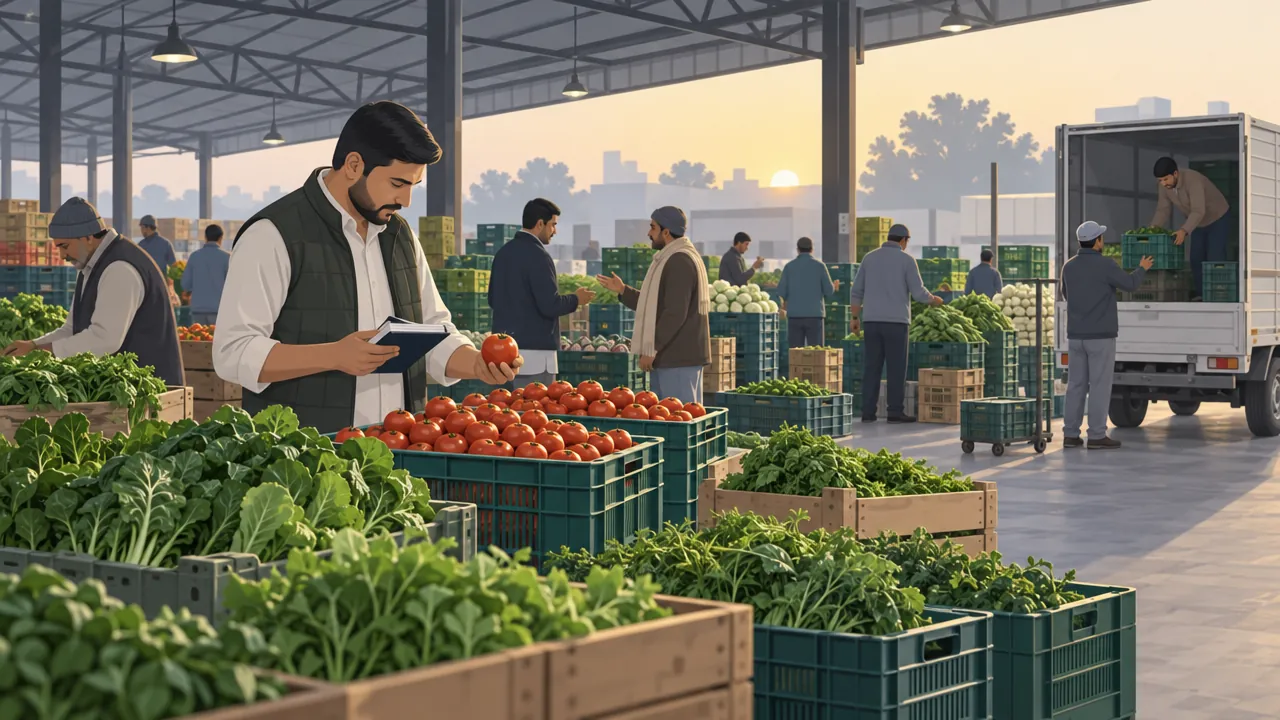
- Grade on arrival: sort into first quality, second quality (for a discounted "value pack") and waste.
Step 4: Plan for wastage
Fresh produce loses weight and quality every hour. A study by NABCONS, commissioned by the Ministry of Food Processing Industries, measured post-harvest losses of 15.05% for guava and 11.62% for tomato, and estimated yearly losses of 7.36 million tonnes of fruit and 11.97 million tonnes of vegetables across India (FreshPlaza).
Your own wastage depends on your buying and storage. Track it daily by item, and:
- Store cool and dry; keep leafy greens damp-wrapped and shaded, not wet.
- Keep ripening fruit apart from leafy greens.
- Sell oldest first.
- Run a daily deal on items that will not last another day.
- Turn seconds into value packs or sell to tiffin services and restaurants.
Step 5: Price with wastage built in
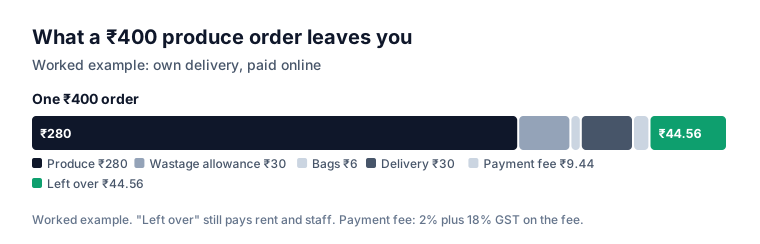
Here is a worked example of a ₹400 order:
| Item | Amount |
|---|---|
| Produce at your buying price | ₹280 |
| Wastage allowance | ₹30 |
| Bags | ₹6 |
| Delivery | ₹30 |
| Payment fee (2% plus 18% GST on the fee) | ₹9.44 |
| Left over for rent, staff and profit | ₹44.56 |
These are example figures. The lesson: without the wastage line, the price looks profitable and is not. Our guide on pricing your products explains the method, and setting delivery charges helps you choose a minimum order and a free delivery threshold.
Pricing tips for produce:
- Sell by weight with clear units (250 g, 500 g, 1 kg) and by piece where customers expect it (coconut, cabbage).
- Update prices daily or every few days; mandi prices change.
- Round prices simply; customers compare across stores.
Step 6: Deliver fresh, in slots
- Two slots a day are a simple start: morning (7 to 10 am) and evening (5 to 8 pm).
- Cut-off times: orders by 9 pm for the next morning.
- Group orders by area and deliver in one trip per area; see how to plan delivery routes.
- Pack heavy items at the bottom, soft fruit and greens on top.
- Substitutions: ask customers at checkout whether you can replace an item that runs out, or call them.
Step 7: Earn trust
Produce is bought with the eyes. Online, trust replaces that.
- Real photos of your actual produce, updated when the season changes.
- A no-questions replacement for anything that arrives bad, reported within a few hours with a photo.
- Consistent weights: weigh every bag; customers check.
- Local sourcing story: name the mandi or farms you buy from.
Our guide to getting repeat customers covers reorders and reward points. If you also deliver milk each morning, see how to start a milk delivery business.
Mistakes to avoid
Buying without orders. Unsold greens are tomorrow's waste.
Ignoring wastage in prices. It is a real cost on every order.
Too wide an area. Long trips wilt greens and raise delivery cost.
Carbide-ripened fruit. Illegal and unsafe; buy from suppliers who use ethylene or natural ripening.
Stock photos. Customers notice when the tomatoes look nothing like the picture.
Your fruit and vegetable checklist
- One neighbourhood and a clear customer group
- FSSAI registration; GST checked for any dried fruits or packed items
- Two or three suppliers; e-NAM prices checked
- Orders taken the evening before; buying close to orders
- Grading on arrival; wastage tracked daily by item
- Prices include a wastage allowance; updated regularly
- Morning and evening slots with cut-off times
- Real photos, honest weights and a replacement promise
How Zepio helps
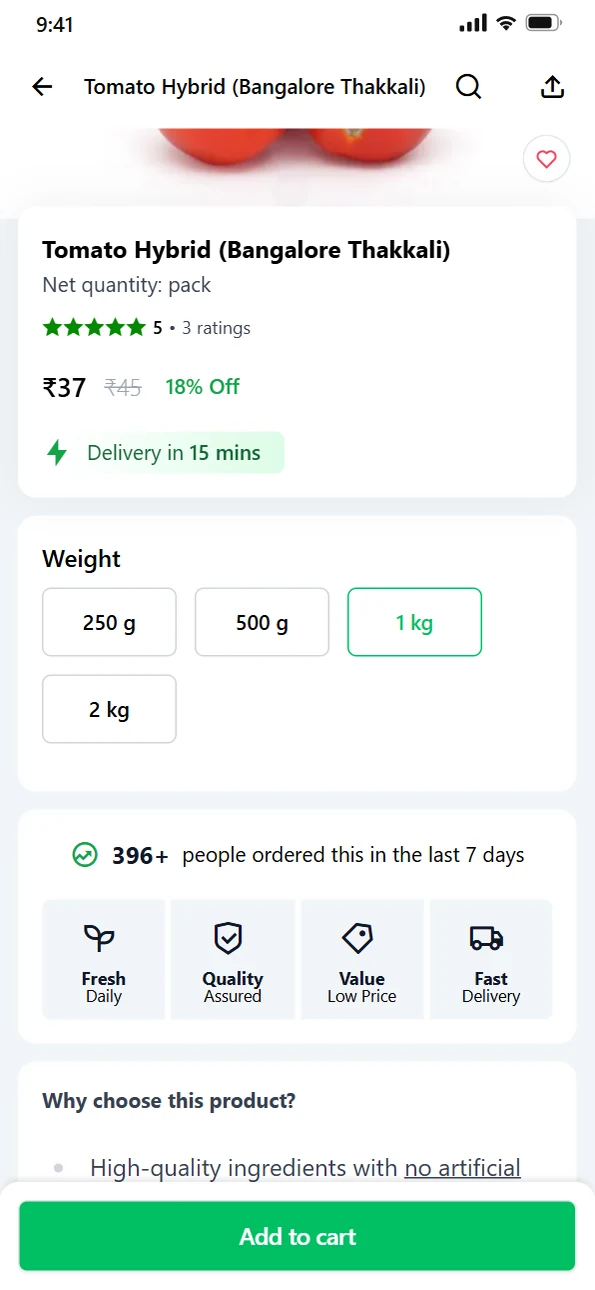
With Zepio you sell fresh produce from your own website and app, with 0% commission on your sales. Sell by weight or piece with unit labels, show a quick-commerce layout for fast browsing, set opening hours per product to close orders at your cut-off, and add items that need to move to a daily deal unlocked by a minimum cart. Deliver with your own team within the pincodes or map zones you choose, with delivery charges by distance or weight and a free delivery threshold. Low-stock alerts and bulk stock updates keep the catalogue right each morning.
Buy fresh, sell the same day, count your wastage and deliver on time. That is the whole business, done well every day.
Questions people ask
How do I start a vegetable delivery business with low investment?
Is there GST on fruits and vegetables?
Do I need FSSAI registration to sell vegetables?
How do I reduce wastage in a vegetable business?
Where can I check mandi prices?
Sources
- Notification No. 10/2025-State Tax (Rate), Government of Maharashtra
- Recommendations of the 56th meeting of the GST Council, PIB / GST Council
- National Agriculture Market (e-NAM) backgrounder, PIB
- India reports high guava and tomato losses, FreshPlaza
- FSSAI alerts fruit traders to ensure compliance with prohibition of calcium carbide in fruit ripening, News On AIR
- Direction under Section 16(5) on licensing and registration (2022), FSSAI
- Order: Implementation of revised turnover threshold for food businesses (13 March 2026), FSSAI
- Ban on single use plastic in India, PIB Research Unit
Facts were checked against these sources on 22 Oct 2026. Rules and prices change: check the source before you rely on a figure. Read our editorial standards, or write to hi@zepio.io to report a mistake.