


On this page
- Step 1: Choose your category
- Step 2: Understand hallmarking
- Step 3: Understand GST
- Step 4: Find reliable suppliers
- Step 5: Photograph every piece well
- Step 6: Price for every cost
- Step 7: Make cash on delivery safer
- Step 8: Write a clear returns policy
- Step 9: Sell where buyers look
- Mistakes to avoid
- Your jewellery business checklist
- How Zepio helps
To start a jewellery business online, choose what you sell: imitation, silver or gold. Imitation or silver pieces need less capital than gold, so they are an easier place to start. Gold jewellery must be hallmarked with a six-digit HUID in notified districts. Jewellery is taxed at 3% GST. Then build trust with excellent photos, honest descriptions and safer payment options, because buyers cannot touch the piece.
An online jewellery business sells necklaces, earrings, bangles, rings and other pieces through a website, app or social media, with delivery by courier. This guide covers choosing your category, the hallmarking rules, GST, photos, pricing and handling returns and cash on delivery.
Step 1: Choose your category
| Category | Capital needed | What to know |
|---|---|---|
| Imitation or fashion jewellery | Low | Wide range, trend-driven; quality varies by supplier |
| Silver jewellery | Medium | Higher value; buyers ask about purity |
| Handmade jewellery (beads, resin, thread, terracotta) | Low | Your own designs; limited by your time |
| Gold jewellery | High | Hallmarking, HUID, BIS registration and security |
Pick a clear style and audience: "lightweight office earrings", "oxidised silver for college students", "bridal kundan sets". A focused store is easier to market than one selling everything.
Step 2: Understand hallmarking
Hallmarking certifies the purity of precious metal. The rules, from BIS's FAQs (BIS):
| Rule | Detail |
|---|---|
| What is covered | The mandatory hallmarking order applies to gold jewellery and artefacts only |
| Where | Only in districts notified under the Mandatory Hallmarking Order, as amended from time to time |
| Exemptions | Articles under 2 grams, and jewellers with annual turnover up to ₹40 lakh, among others |
| Mandatory marks | The BIS mark, the purity, and a six-digit HUID |
| Registration | Jewellers selling hallmarked gold or silver must register with BIS; no fee is charged and registration is valid for life |
| Invoice | Showing the HUID on the invoice is voluntary at present, but the invoice must list net weight, purity and hallmarking charges separately |
BIS also says silver jewellery can be hallmarked in six grades under IS 2112:2014, and customers can verify a HUID in the BIS Care app (BIS). Check BIS's hallmarking overview for the current list of districts before you sell gold.
Note: Imitation jewellery is not covered by hallmarking. Describe it honestly: "gold-plated brass", "oxidised silver-tone alloy", never "gold" or "silver" alone.
Step 3: Understand GST
Under the rates in force from 22 September 2025, both articles of jewellery of precious metal and imitation jewellery are taxed at 3% (CMA Knowledge). If you are below the GST threshold and sell only in your state, see how to sell online without GST; shipping to other states usually needs registration.
Step 4: Find reliable suppliers
- Wholesale markets in jewellery hubs for imitation and silver.
- Manufacturers for your own designs once you know what sells.
- Ask for samples, check plating, finish, clasps and how the piece feels.
- Test for skin reactions on a few pieces if you sell plated jewellery.
- Keep supplier invoices for every batch.
Step 5: Photograph every piece well
Jewellery is small, shiny and hard to photograph, and photos decide the sale.

- Soft window light and a white card on both sides to control reflections.
- Several photos per piece: front, side, clasp, close-up of the finish.
- One photo worn on a person or a stand to show size.
- A short video turning the piece in the light.
- Large images: Google Merchant Center will require at least 500 × 500 pixels from 31 January 2027 and recommends 1500 × 1500 or larger, with no watermarks (Google).
Our guide to taking product photos with a phone shows a cheap setup.
Step 6: Price for every cost
Worked example for imitation earrings sold at ₹799, GST included, shipped by courier:
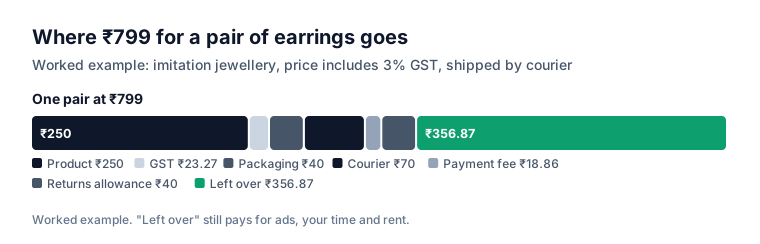
| Item | Amount |
|---|---|
| Selling price, GST included | ₹799 |
| GST at 3% (₹799 × 3 ÷ 103) | ₹23.27 |
| Product cost | ₹250 |
| Box, pouch, card | ₹40 |
| Courier | ₹70 |
| Payment fee (2% plus 18% GST on the fee) | ₹18.86 |
| Returns allowance | ₹40 |
| Left over for ads, time and profit | ₹356.87 |
Our guide on pricing your products explains the method. The "left over" looks generous, but online jewellery often needs ad spend to find buyers. Our guide to Facebook and Instagram ads for small business shows how to measure cost per order.
Step 7: Make cash on delivery safer
If you offer cash on delivery, remember that refused parcels cost you shipping both ways.
- Partial advance: take a small part payment online before dispatch on COD orders.
- Confirm high-value COD orders by phone or WhatsApp.
- Turn off COD for customers who have refused orders before.
- Prepaid incentives: free shipping or a small gift on prepaid orders.
Our guide to reducing fake cash on delivery orders covers these in detail.
Step 8: Write a clear returns policy
Jewellery returns need rules:
- Hygiene: earrings are often non-returnable once worn; say so clearly.
- Damaged or wrong pieces: always replaceable or refundable, with an unboxing photo or video.
- Return window from the delivery date.
See how to write a return and refund policy.
Step 9: Sell where buyers look
- Instagram Reels of pieces styled with outfits; see how to sell on Instagram.
- Your own website for checkout, collections by occasion and price, and reviews.
- WhatsApp broadcasts of new arrivals to past buyers who opted in.
- Festive and wedding collections planned months ahead.
Mistakes to avoid
Calling plated pieces "gold" or "silver". It misleads buyers and invites complaints.
Selling gold without hallmarking in a notified district.
Dark, blurry photos. Small pieces need sharp close-ups.
Unlimited COD on expensive pieces. Use a partial advance.
No size reference. Buyers cannot judge earrings or pendants without one.
Your jewellery business checklist
- Category and style chosen: imitation, silver, handmade or gold
- Hallmarking, HUID and BIS registration in place if you sell gold
- GST position checked (3% on jewellery)
- Suppliers tested with samples; invoices kept
- Several photos, a worn photo and a short video for every piece
- Every piece priced for GST, courier, payment fee and returns
- Partial advance or confirmation for COD orders
- Clear returns policy, including hygiene rules for earrings
How Zepio helps
Zepio includes a ready jewellery design, Gleam, with a live demo. Each piece can have several photos and a video, variants such as size or colour, and attributes such as material and plating. On the Scale plan you can add 3D models customers can turn around. Trust badges on the product page highlight your returns and payment promises, and partial payment for cash on delivery lets you collect a percentage online before dispatch, and you can switch off cash on delivery for any customer who has refused orders. All with 0% commission on your sales.
Choose your category, follow the hallmarking rules where they apply, and earn trust with photos and honest descriptions. That is how an online jewellery business grows.
Questions people ask
Do I need a licence to sell imitation jewellery online?
Is hallmarking mandatory for silver jewellery?
What is the GST on jewellery?
How do I reduce cash on delivery risk for jewellery?
Is an online jewellery business profitable?
Sources
- Hallmarking: FAQs for jewellers, Bureau of Indian Standards
- Hallmarking overview, Bureau of Indian Standards
- Hallmarking FAQ, Bureau of Indian Standards
- GST rate update September 2025: schedule-wise tables as per Notification 9/2025, CMA Knowledge
- Image link [image_link], Google Merchant Center Help
Facts were checked against these sources on 22 Oct 2026. Rules and prices change: check the source before you rely on a figure. Read our editorial standards, or write to hi@zepio.io to report a mistake.