
On this page
- How food delivery app commission works
- What comes off each order
- A worked example: one ₹500 order
- How to read your settlement report
- What one regular customer is worth
- Why the apps are still worth it
- Five ways to keep more of each order
- How to move regulars to direct ordering
- What you need for direct ordering
- Mistakes restaurants make with commission
Swiggy and Zomato do not publish a single commission rate for restaurants. Each restaurant signs its own contract. When the Competition Commission of India ordered a probe in April 2022, the National Restaurant Association of India (NRAI) had complained that commissions were 20% to 30%, and Moneylife reported rates as high as 37% for cloud kitchens (Moneylife). On top of the commission, the restaurant pays 18% GST on it (Medianama), and often funds part of the discounts customers see.
This guide breaks down what comes off each order, works through a ₹500 example, and explains how restaurants keep more of each sale without giving up the customers the apps bring.
How food delivery app commission works
A food delivery app charges a restaurant a percentage of each order in return for listing it, bringing customers, handling payments and, in most cases, delivering the food. The percentage is set in the restaurant's contract and can differ between restaurants on the same app.
What usually changes the rate:
- Who delivers. Ask your account manager whether your rate changes if you deliver yourself.
- Which offers you join. Platform discount campaigns usually ask the restaurant to fund part of the discount.
- Advertising. Paid visibility inside the app is a separate cost on top of commission.
- Your size and negotiating position. Larger brands and chains may negotiate different terms.
The commission is only the first line on a settlement sheet. To know what you really earn, you need every line.
What comes off each order
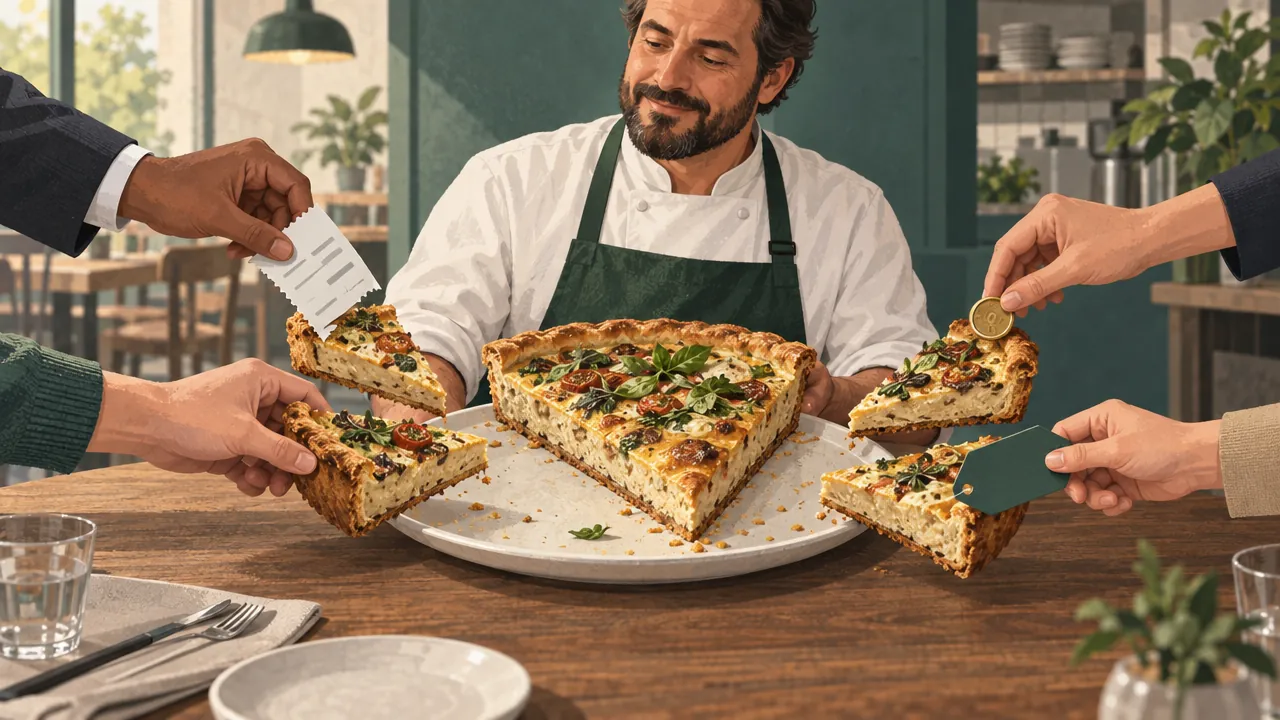
From the money a customer pays for an app order, several amounts come off before the restaurant is paid:
| Deduction | What it is | How large |
|---|---|---|
| Commission | The app's percentage of the order value | Set by your contract; reported at roughly 20% to 30% |
| GST on commission | GST on the service the app sells you | 18% of the commission (shown on your invoice) |
| Discounts you fund | Your share of offers shown to customers | Depends on the campaigns you join |
| Other charges | Payment processing, advertising, penalties for cancellations | Depends on your contract and choices |
The 5% GST on the food is different. Since 1 January 2022 (CBIC Circular 167/23/2021-GST), the app collects it from the customer and pays it to the government for orders placed through it (Tally Solutions). You report these sales but do not pay that GST again.
A worked example: one ₹500 order
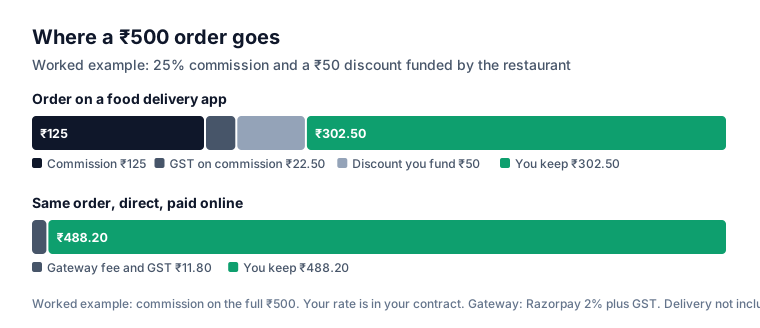
Take one order with a food value of ₹500, a 25% commission charged on the full ₹500, and a ₹50 discount the restaurant funds. Some contracts charge commission on the value after discount. Your own rate and offers will differ; change the numbers to match your settlement sheet.
| On a delivery app | Ordered directly, paid online | |
|---|---|---|
| Food value | ₹500.00 | ₹500.00 |
| Commission at 25% | − ₹125.00 | ₹0.00 |
| GST at 18% on the commission | − ₹22.50 | ₹0.00 |
| Discount funded by you | − ₹50.00 | Your choice |
| Payment processing | Per your contract (not counted here) | − ₹11.80 (2% plus 18% GST) |
| What you receive | ₹302.50 | ₹488.20 |
The direct column assumes no discount. If you offer one on direct orders, subtract it too.
On the app order, the restaurant keeps about 60% of the food value before paying for ingredients, packaging, staff and rent. If ingredients and packaging cost ₹180, the app order earns ₹122.50 towards everything else.
On the direct order, the only deduction is the payment gateway fee; the example uses Razorpay's standard rate of 2% plus 18% GST on that fee. You also pay for delivery yourself on direct orders, either your own delivery person or a local delivery service, so subtract that cost too. In this example the gap is still ₹145.70 per order after a ₹40 delivery cost, and it repeats on every order a regular customer places.
You can run your own numbers in a free marketplace commission calculator.
How to read your settlement report
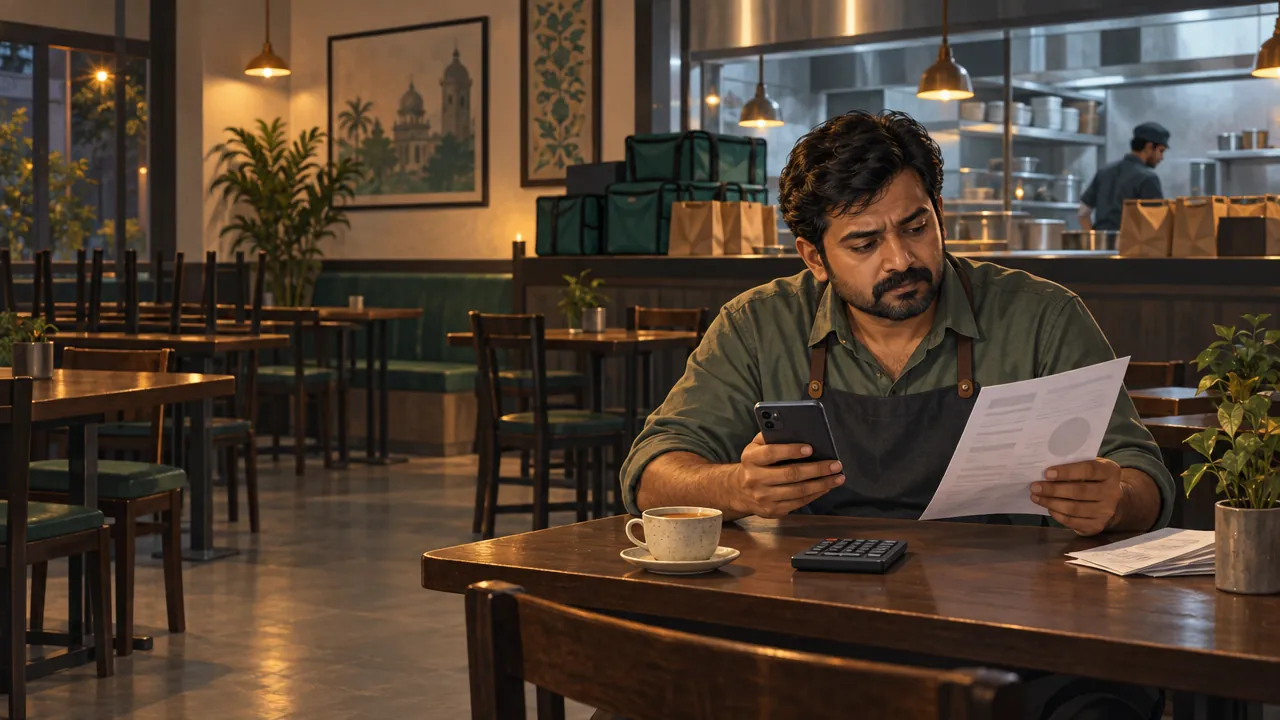
Delivery apps pay restaurants on a settlement cycle and send a report with every payout. It is worth reading line by line at least once a month.
- Start with gross order value: the total food value of the orders in the period.
- Find each deduction: commission, GST on commission, discounts funded by you, advertising, and any penalties or charges for cancellations and refunds.
- Check cancelled and refunded orders. Orders cancelled after you cooked them, or refunded for a complaint, can be costly. Check whose fault each one was recorded as.
- Add up the total deductions and divide by gross order value. This is your all-in cost of selling on the app.
- Compare month to month. If the all-in cost rises while your commission rate stayed the same, look at discounts and ads first.
Example: A kitchen with ₹4,00,000 of app sales in a month finds ₹1,00,000 of commission, ₹18,000 of GST on commission, ₹30,000 of funded discounts and ₹12,000 of ads. Its all-in cost is ₹1,60,000, or 40% of sales, not the 25% on its contract.
What one regular customer is worth
The real case for direct ordering shows up over a year, not on a single order. Take a regular who orders four times a month, ₹500 each time, using the worked example above.
| Through the app | Direct, after a ₹40 delivery cost (an assumption; use yours) | |
|---|---|---|
| Kept per order | ₹302.50 | ₹448.20 |
| Orders a year | 48 | 48 |
| Kept in a year | ₹14,520 | ₹21,514 |
Moving that one customer to direct ordering keeps about ₹7,000 more a year, before any change in food or packaging costs. Ten such regulars is about ₹70,000; a hundred is about ₹7 lakh. The numbers are a worked example, but the same arithmetic applies to any regular customer: the regulars are where commission adds up.
Why the apps are still worth it
None of this means you should leave the delivery apps. They do things that are hard and expensive to do alone:
- Discovery. Many people near you open these apps every day looking for food. That is how a new restaurant gets its first customers.
- Delivery coverage across a wide area and at any hour, without hiring a delivery team.
- Trust. Ratings and reviews let a new restaurant earn trust quickly.
Think of commission as the cost of acquiring a customer. Paying it for a first order from someone who has never heard of you can be a good deal. Paying it on the twentieth order from a customer who already loves your food is the expensive part.
Five ways to keep more of each order
1. Know your real take-home per order
Download a month of settlement reports and add every deduction: commission, GST on commission, discounts, ads and penalties. Divide by your app sales. That percentage, not the headline commission, is what the apps really cost you.
2. Price app menus for app costs
Many restaurants list slightly higher prices on delivery apps than on their own menu, to cover commission and packaging (Medianama reported this as early as 2018). Check your contract for any pricing terms before you change prices.
3. Be selective with discounts
Join only the campaigns that bring new customers you can keep. A discount you fund on every order to every customer quietly becomes a second commission.
4. Ask about your terms
Some restaurants are able to negotiate terms, especially ones with steady volume and good ratings. Ask what changes if you deliver yourself, change your offer participation, or grow volume.
5. Move regulars to direct ordering
This is the change that matters most. Every regular who orders directly instead of through the app keeps the full order value with you, minus a payment fee and your delivery cost.
How to move regulars to direct ordering
A practical setup uses both channels on purpose: delivery apps to be found, and their own website, app and WhatsApp for customers who already know them.
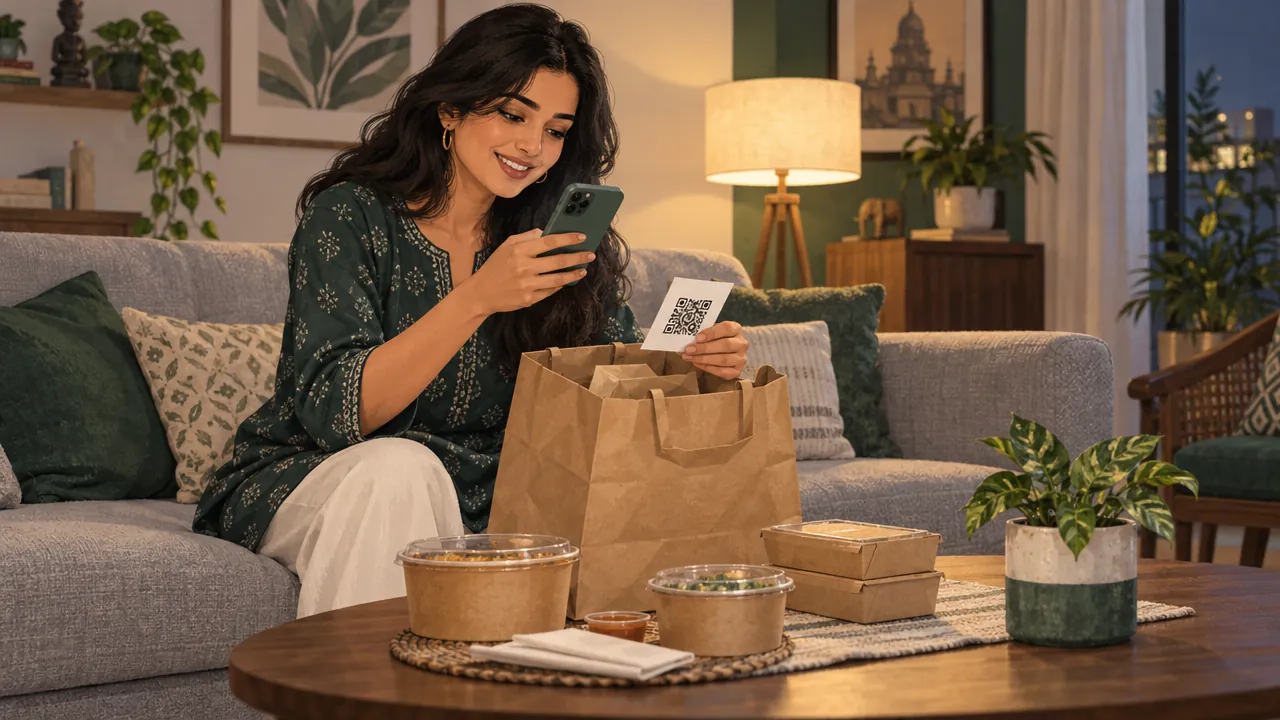
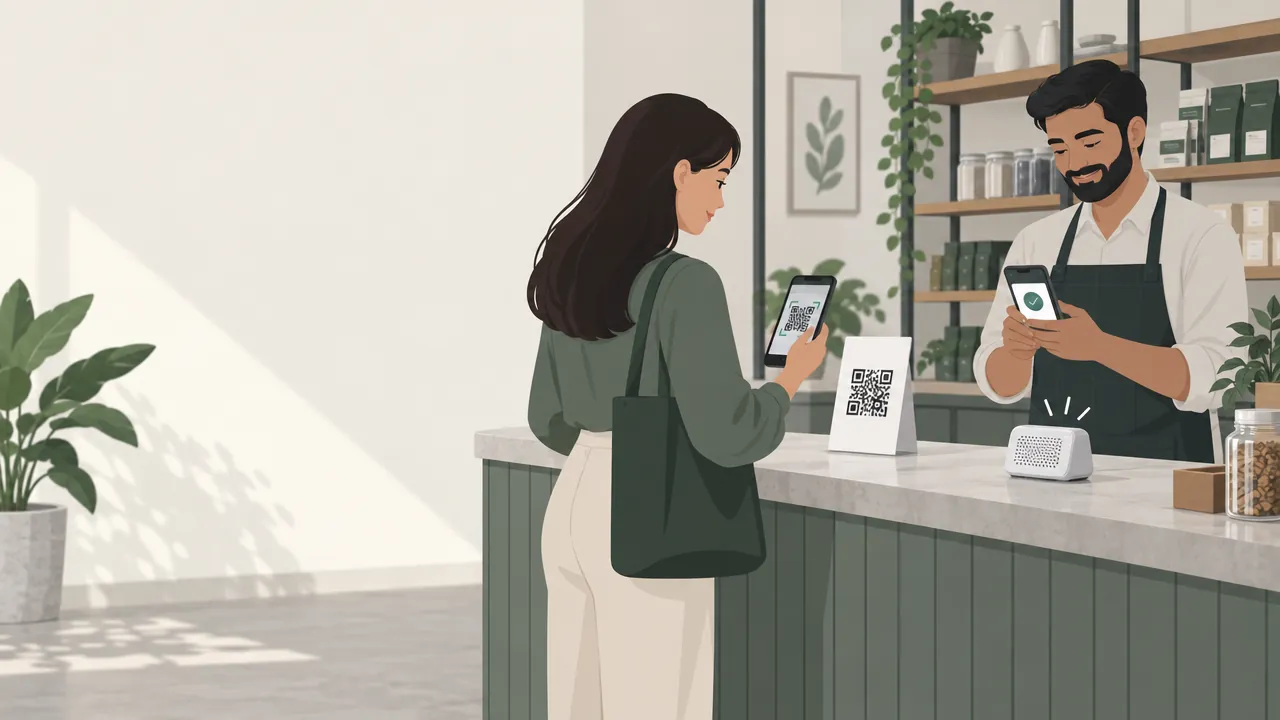
- Put a card in every app order with a QR code to your website and a reason to use it: a first-order discount, a free dessert, or dishes only available direct.
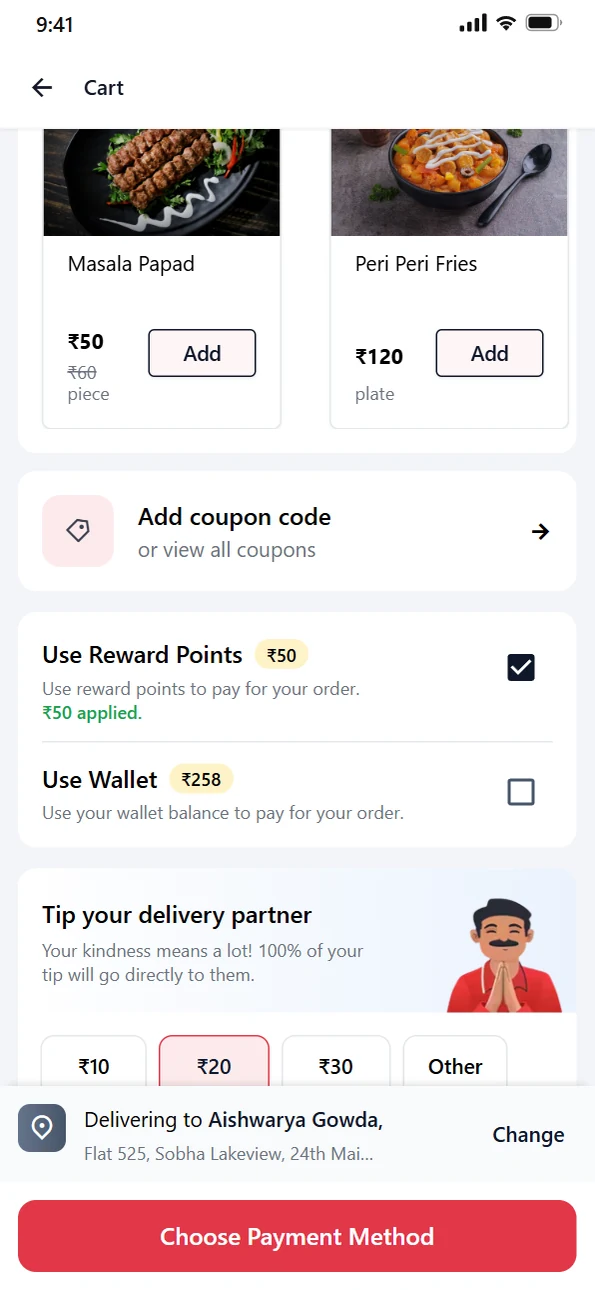
- Make direct ordering as easy as the app. A menu with photos, add-ons, clear prices, saved addresses and quick UPI payment. If it is harder than the app, people go back to the app.
- Reward repeat orders with reward points or cashback on direct orders only (more ways to get repeat customers).
- Keep a WhatsApp number for questions and for customers who prefer to message.
- Send updates about new dishes and weekend specials through your app's push notifications, not only through the delivery apps.
- Deliver well. Your own delivery has to be as reliable as the app's. Keep your direct delivery area tight and confirm each delivery with an OTP.
Expect this to build over months, not days. Track the share of your orders that come direct each month. Even moving one order in five from the app to direct ordering changes the economics of a kitchen.
What you need for direct ordering
| What | Why |
|---|---|
| A website with online ordering | Your menu, add-ons, opening hours and payment in one place |
| An app in your own name | You sit on your customers' phones, and can send them notifications |
| Your own delivery or a local delivery service | For a small area around your kitchen |
| Reward points or cashback | A reason to order direct again |
| One place to see every order | So direct orders do not get lost in a busy kitchen |
If you are just starting out, read how to start a cloud kitchen from home as well. And if you want to run a delivery app for many restaurants in your town, see how to start a hyperlocal delivery business.
Mistakes restaurants make with commission
Looking only at the headline rate. GST on commission, discounts and ads add up. Work out your all-in percentage.
Funding every discount. Offers that do not bring new customers are just a lower price.
Leaving the apps entirely. You lose the customers who would never have found you. Use both.
A direct channel that is harder than the app. A slow website or a WhatsApp-only order process sends customers straight back to the app.
Not counting delivery on direct orders. Direct orders still need delivery. Price and plan for it.
Commission is the price of being found. Pay it to win new customers, and give every customer who loves your food a direct way to order, so each of their next orders stays with you.
Questions people ask
How much commission do Swiggy and Zomato charge restaurants?
Is GST charged on the commission?
Who pays GST on food ordered through delivery apps?
Can restaurants charge higher prices on Swiggy and Zomato?
Should restaurants leave Swiggy and Zomato?
How do I get customers to order directly instead of through the app?
Sources
- Competition Commission orders probe into conduct of Zomato, Swiggy, Moneylife
- GST on restaurant services: dine-in vs takeaway vs delivery apps, Tally Solutions
- Razorpay pricing, Razorpay
- Restaurants hike prices on Zomato, Swiggy (18% GST on platform services), Medianama
- Circular 167/23/2021-GST: restaurant services through e-commerce operators, CBIC (hosted by the GST Council)
Facts were checked against these sources on 19 Oct 2026. Rules and prices change: check the source before you rely on a figure. Read our editorial standards, or write to hi@zepio.io to report a mistake.